House Committee Hearing Highlights Concerns Over Administration’s Energy Policies
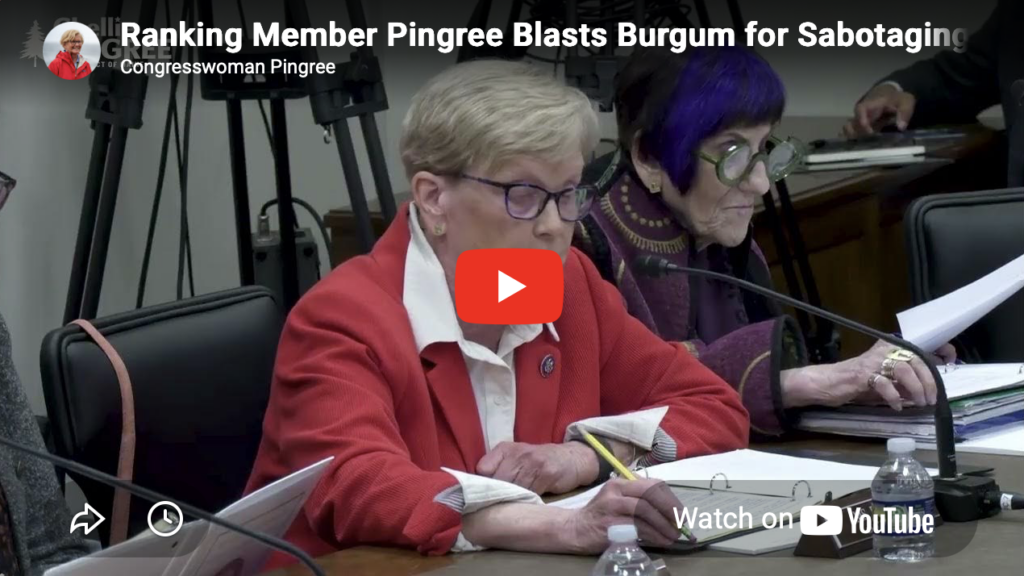
The House Appropriations Interior and Environment Subcommittee convened a critical hearing on the Fiscal Year 2027 budget with Interior Secretary Doug Burgum. Ranking Member Chellie Pingree (D-Maine) took the opportunity to voice her disapproval of the Trump Administration’s handling of energy policies amid rising gas prices. She criticized the administration’s focus on supporting Big Oil while undermining renewable energy initiatives.
Watch Pingree’s full opening remarks here and follow the hearing live here.
“All of these dirty deals are to benefit industry. And it’s at the expense of the American people. Americans are now paying an average of $4.04 for a gallon of gas. According to Stanford Institute for Economic Policy Research, gas prices could peak at $4.36 a gallon, costing the average household $740 more for gas this year,” Pingree said. “So it makes no sense to me why this administration would be actively sabotaging renewable energy, which we know is the cheaper and more affordable energy option for families. Honestly, it just makes me very angry. This administration’s policies are causing an affordability crisis and there seems to be a lack of focus on what the Department’s mission actually is.”
Budget Cuts and Their Implications
The proposed budget for 2027 requests $15 billion for the Department of the Interior, with significant reductions in several areas:
- Renewable Energy: $45 million cut from the Bureau of Land Management and Bureau of Ocean Energy Management, eliminating funding for onshore and offshore wind energy.
- Bureau of Land Management: $480 million cut, including a $139 million reduction for Wildlife and Aquatic Habitat Management.
- US Fish and Wildlife (FWS): $526 million cut, resulting in a 20 percent decrease in the National Wildlife Refuge System.
- National Park Service: $1.06 billion cut with significant impacts on various programs.
- U.S. Geological Survey (USGS): $526 million cut, affecting ecosystems and core science funding.
- Bureau of Indian Affairs: $378 million cut, eliminating important programs and reducing tribal operations funding.
- Bureau of Indian Education: $436 million cut, affecting Tribal Colleges and funding for early development programs.
Wildland Fire: All U.S. Forest Service Wildland Fire Management functions transferred to the Department of the Interior.
Concerns Over Policy Directions
During the hearing, Pingree expressed her concerns over the administration’s approach to energy policy, which she sees as skewed toward oil and gas interests. She highlighted a controversial decision in the Gulf of Mexico, where exemptions from the Endangered Species Act were granted to facilitate offshore drilling. Additionally, the administration’s efforts to block renewable energy projects, such as halting offshore wind development, were questioned.
Pingree argued that these moves undermine critical safeguards and could lead to a revival of past oversight failures that endangered both workers and the environment. The budget proposal, she suggested, could exacerbate these issues by dismantling staff and resources at the Department of the Interior, thereby jeopardizing its mission.
Pingree concluded her remarks by urging a reevaluation of the department’s priorities and committing to oppose the proposed budget cuts: “I will do everything in my power to oppose these reckless cuts and fight the administration’s destructive policies.”
Original Story at pingree.house.gov