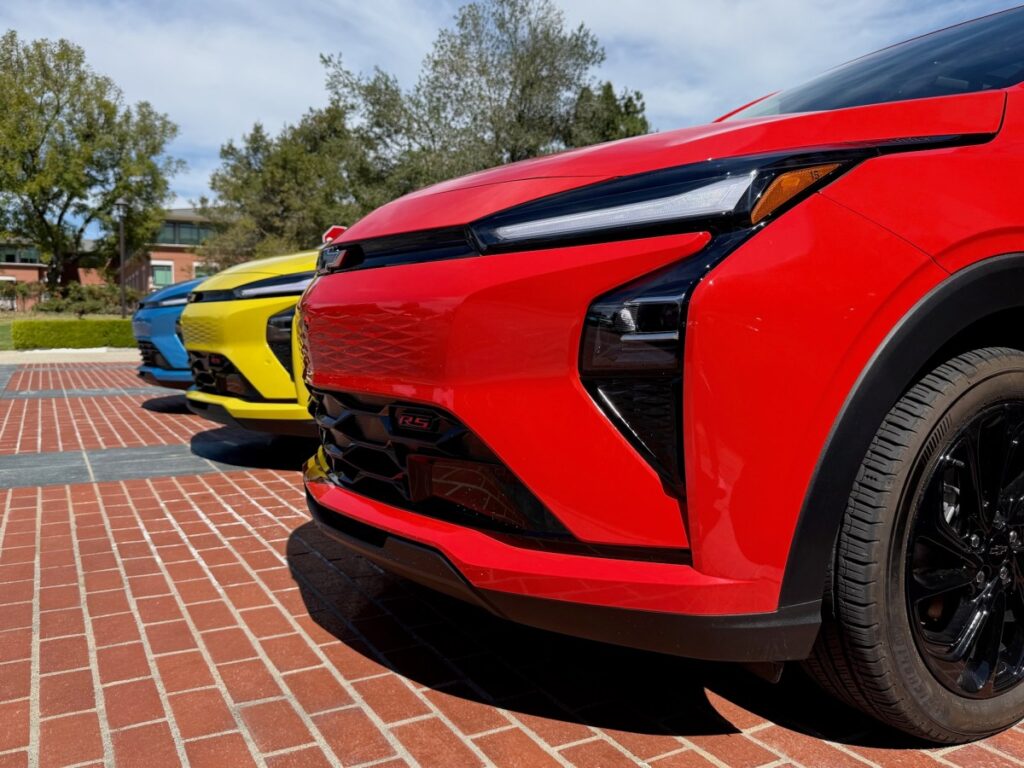
Chevrolet Bolt’s Return: A Strategic Move by General Motors
The announcement of Chevrolet Bolt’s comeback sparked excitement among its enthusiasts, as General Motors (GM) decided to reintroduce the EV subcompact. The credit for this revival largely goes to dedicated Bolt owners and supporters within GM. However, mere enthusiasm isn’t enough to restart a program of this magnitude. The decision was driven by more than just fanfare.
GM’s decision to bring back the Bolt aligns with its factory logistics. The Fairfax Assembly Plant in Kansas, which previously focused on the Chevy Malibu, had the capacity to spare. With Malibu production already ceased two years ago, and no plans to start manufacturing Chevy Equinox SUVs or Buick Envisions until 2027 and 2028 respectively, the Bolt found its opportunity to re-enter production.
Another crucial factor for the Bolt’s return was the accessibility of EV-specific components, which reduced production costs. The new model doesn’t boast a groundbreaking platform but relies on subtle enhancements to improve its overall quality.
TechCrunch had the opportunity to test drive the latest Bolt and noted its potential to boost GM’s EV sales in a challenging U.S. market. It is compelling enough to suggest it will give GM an EV sales bump in an uncertain U.S. market.
The original 2017 Bolt marked GM’s first dedicated electric vehicle in two decades, requiring the company to design a new motor and battery management system, alongside a collaboration with LG Chem (now LG Energy Solution) for the battery pack. This was a costly endeavor, as the chassis was entirely new and not derived from an internal combustion platform.
Today, GM offers around a dozen all-electric models across its Chevrolet, Cadillac, and GMC brands in the U.S. This experience provided a wealth of parts and expertise for the development of the new Bolt.
For consumers, these advancements are apparent the moment they step into the vehicle. The large touchscreen utilizes the Android Automotive operating system, keeping track of the battery’s charge level. This enables the system to suggest charging stations along routes and optimize the battery for faster charging.
In terms of mechanics, the new Bolt shares the front drive motor with the Chevy Equinox. While it maintains the previous generation’s 200 horsepower, the torque is 169 pound-feet. Despite appearing lower, the enhanced motor operates with greater speed and efficiency, enabling the use of a shorter gear in the single-speed transmission. Consequently, the motor’s output remains consistent with its predecessor.
This improved motor, coupled with efficient power electronics, allows the 2027 Bolt to travel approximately 15 miles farther than the prior Bolt EUV model, which the new version is based on.
GM expects the revamped Bolt will be profitable, addressing a challenge that the previous model faced.
Despite some challenges in the EV transition, GM continues its commitment to electric vehicle production, maintaining its goal to phase out fossil fuel vehicles by 2035. The company has acknowledged a $6 billion charge due to slower-than-anticipated EV adoption but remains focused on its EV agenda.
While some might view the new Bolt as a modest update, it exemplifies the benefits of technology sharing and incremental improvements. Although a 15-mile range increase may seem small, consistent progress could significantly impact GM and the EV industry over the coming decade. Not every advancement requires massive investment; sometimes, steady enhancements can drive substantial change.
Original Story at techcrunch.com