Range Rover’s New GT Model: A Departure into Sedan Territory
In a bold move, Range Rover unveils its new ‘GT’ model, offering a striking departure from the brand’s traditional SUV design. This latest model resembles a sedan more closely than any previous Range Rover vehicle.
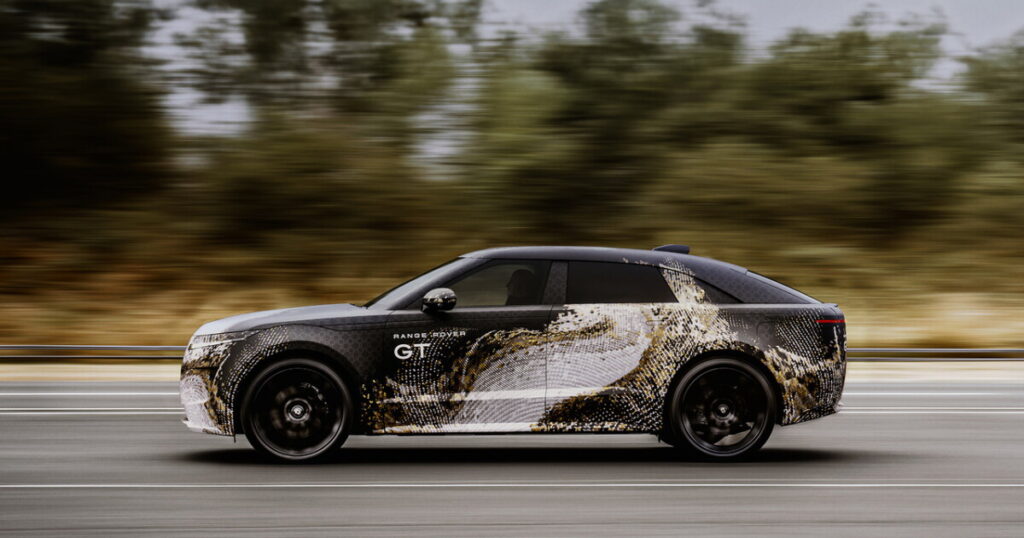
The initial images of the GT, heavily camouflaged during its final testing phase, suggest a shift from the typical boxy off-road Range Rover SUV to a more road-oriented luxury vehicle. Historically, Range Rover has been synonymous with robust four-wheel-drive capabilities, but the GT is set to redefine this legacy with a focus on road performance and luxury travel.
This revelation is particularly noteworthy as it introduces the platform set to support many future Range Rover models.
Land Rover
The choice of the GT badge hinted at a new direction for the company. Traditionally, the Grand Tourer (GT) category is known for mixing high-performance sports cars with plush, comfortable sedans. This category originated from the “Grand Tour” of the 1800s, where affluent Europeans traveled for cultural enrichment. The Italian term Gran Turismo describes vehicles built for high-speed, comfortable long-distance travel, akin to classic models like the Jaguar or Aston Martin.
As consumer preferences evolved, the GT segment expanded to include Super SUVs like the Bentley Bentayga and Porsche Cayenne. The Range Rover GT is poised to join this exclusive group.
While Jaguar Land Rover has yet to disclose extensive technical specifications, the GT is anticipated to be a modern, luxurious crossover, replicating the classic Grand Tourer experience for contemporary audiences.

Land Rover
Range Rover’s GT will be the first all-electric model from the brand, built on the new EMA platform at the Halewood facility in the UK. Initially offered as a battery electric vehicle, a hybrid variant may follow. Martin Limpert, Range Rover’s Managing Director, noted that the GT “is the most car-like” vehicle the company has produced. This marks a significant evolution from the brand’s pioneering luxury SUVs of the 1970s.
The current Range Rover family includes the Range Rover, Range Rover Sport, Range Rover Velar, and Range Rover Evoque. The GT is set to occupy a niche above the aging Velar and Evoque models.
Land Rover has indicated that more details will be forthcoming, with the GT not expected to hit the market until 2027.
Prototypes of the GT have been showcased undergoing testing, including in a soundproof chamber designed to detect any unwanted noises. This suggests a commitment to enhancing the vehicle’s interior tranquility and overall refinement.
The GT features a notably aerodynamic design with a coupe-like silhouette, big wheels, and horizontal light signatures, staying true to Range Rover’s stylistic trademarks.

Land Rover
The interior of the GT showcases a minimalist dashboard featuring a full-width air vent, a smaller steering wheel with integrated drive selector, and a 13-inch touchscreen. Notably absent are traditional buttons, replaced by voice-operated systems that promise to be “much more responsive to natural conversation,” according to Range Rover.
The spacious rear seating area, beneath the largest panoramic roof in Range Rover’s history, offers either a fixed four-seat configuration or a flexible rear bench for five, with all seats capable of folding flat for increased versatility.
Parent company Tata is constructing a £4-billion (US$5.32-billion) battery manufacturing facility in Somerset, UK, to support the new platform. The GT is expected to offer a range exceeding 500 miles (800+ km). Anticipation surrounds the pricing, with estimates suggesting it might start at over US$90,000.
Source: Land Rover
Original Story at newatlas.com