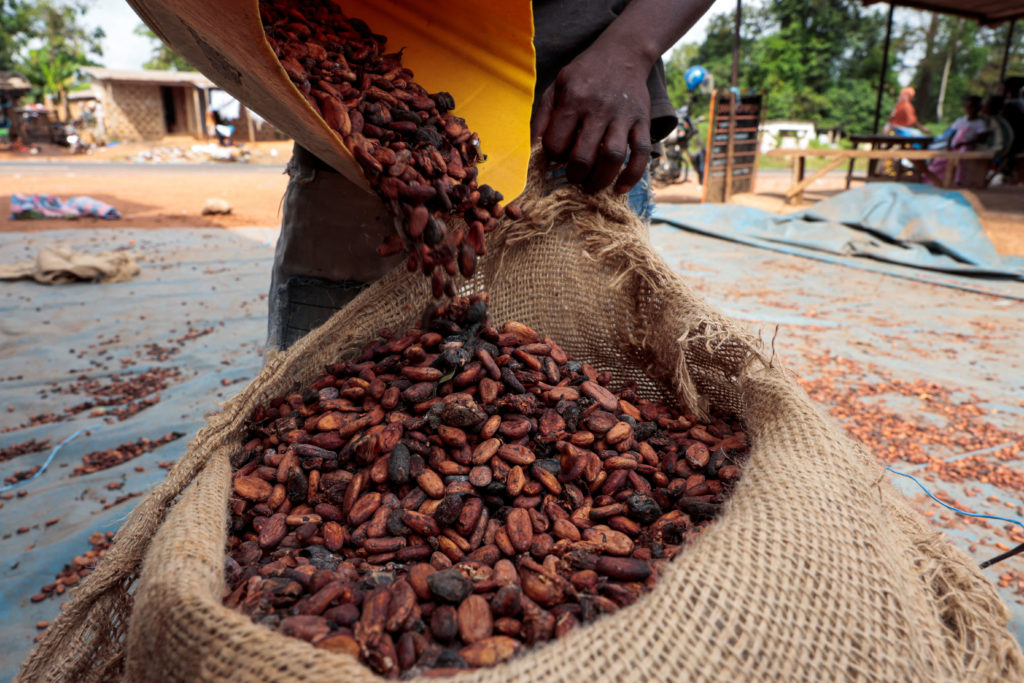
A worker fills a sack with cocoa beans as he prepares to gather unsold stocks of cocoa at the warehouse of Sekou Dagnogo, an independent cocoa buyer, in Fengolo, Ivory Coast, February 11, 2026. File photo by Luc Gnago/Reuters
Cocoa Farmers in West Africa Face Unprecedented Challenges
KONA, Ghana (AP) — The land Manu Yaw Fofie inherited in Ghana, which once promised prosperity, has now become a source of concern. The recent plummet in cocoa prices has led to a surplus of unsold beans in West African warehouses, leaving global chocolate manufacturers in a scramble.
Faced with declining revenue, Fofie has resorted to leasing part of his land to illegal sand miners, driven by the construction boom requiring concrete materials. This activity, however, renders the land barren.
Despite the risks, Fofie felt compelled to act as his cocoa production dwindled from 300 bags in the past to just 50 bags by 2025, partly due to climate change.
WATCH: Hard-hit cocoa harvests in West Africa cause chocolate prices to soar worldwide
Fofie is among numerous cocoa farmers in Ghana and Ivory Coast, the countries accounting for around 70% of the world’s cocoa, forced to diversify land use following the commodity’s market downfall.
Ivory Coast, the world’s top cocoa producer, bought surplus cocoa from farmers in January, and recently reduced cocoa prices by over half for 2026.
Edward Karaweh, former general secretary of the General Agricultural Workers Union, noted that while cocoa markets often experience crises, Ghana was unprepared for the magnitude of this one. “Preparation allows you to mitigate the crisis. It is not that you prevent the crisis altogether,” Karaweh explained.
Cocoa Market Fluctuations
In West Africa, hundreds of thousands of farmers depend on cocoa for their livelihoods. Cocoa exports make up 40% of Ivory Coast’s export revenue and nearly 15% of Ghana’s.
Government-set fixed cocoa prices aim to shield farmers from international market volatility. However, after a spike in cocoa futures to over $12,000 per metric ton in 2024, prices crashed to about $4,000, exceeding supply over demand.
WATCH: The challenging lives of the world’s cocoa growers
Traders faced losses in purchasing cocoa from these regions, leading to warehouses stocked with unsold, deteriorating beans, and delayed payments to farmers.
The price volatility prompted some farmers to rethink their reliance on cocoa.
Climate Impact on Cocoa Production
In Ivory Coast, François N’Gbin highlighted disease and drought affecting his cocoa crops. He, too, has leased land for illegal gold mining, obtaining a permit to avoid legal issues.
The mining, spanning at least 1,000 square meters, presents a more lucrative option, with gold fetching around 1,500 CFA francs ($2.67) per gram. “Today, gold is more profitable than cocoa,” N’Gbin remarked.
Moussa Koné, president of the Ivorian cocoa farmers’ union, acknowledged the trend of farmers seeking alternative land uses, including mining, to support their families.
Efforts to Stabilize the Market
Ghana has moved to relax price control regulations, cutting its cocoa price by 28% to 41,392 cedis ($3,881) per metric ton in January, aiming to boost buyer interest.
This week, Ivory Coast also halved payments to cocoa farmers to 1,200 CFA ($2.13) per kilogram ($0.97 per pound) for 2026. Farmers report slim profit margins when factoring in production costs.
“Accepting the current price means my son will have to drop out of school,” noted Mercy Amponsah, a 50-year-old Ghanaian cocoa farmer who protested the price cuts in Accra.
While South American and Asian cocoa producers have increased supply, West Africa remains the primary cocoa source. Farmers like Fofie are exploring new survival strategies. “If I keep this cocoa farm for the next 10 years, I would die a poor man,” he stated.
Original Story at www.pbs.org