In a strategic shift, the White House has unveiled its fiscal 2027 budget proposal, marking a notable pivot towards bolstering fossil fuels and artificial intelligence, while significantly scaling back on renewable energy initiatives. This proposal hints at a profound transformation in federal spending priorities, reflecting President Donald Trump’s commitment to revamping energy strategies.
The budget outline also introduces a plan to reorganize key energy offices within the Interior Department, namely the Bureau of Ocean Energy Management and the Bureau of Safety and Environmental Enforcement. This restructuring aims to optimize governance and resource management.
President Trump’s fiscal blueprint suggests dismantling numerous Biden-era environmental programs, proposing steep cuts across various sectors, including electric vehicle infrastructure and environmental crime prosecution. The administration’s stance is clear: “President Trump is committed to eliminating funding for the globalist climate agenda while unleashing American energy production,” according to a White House fact sheet titled “Ending the Green New Scam.”
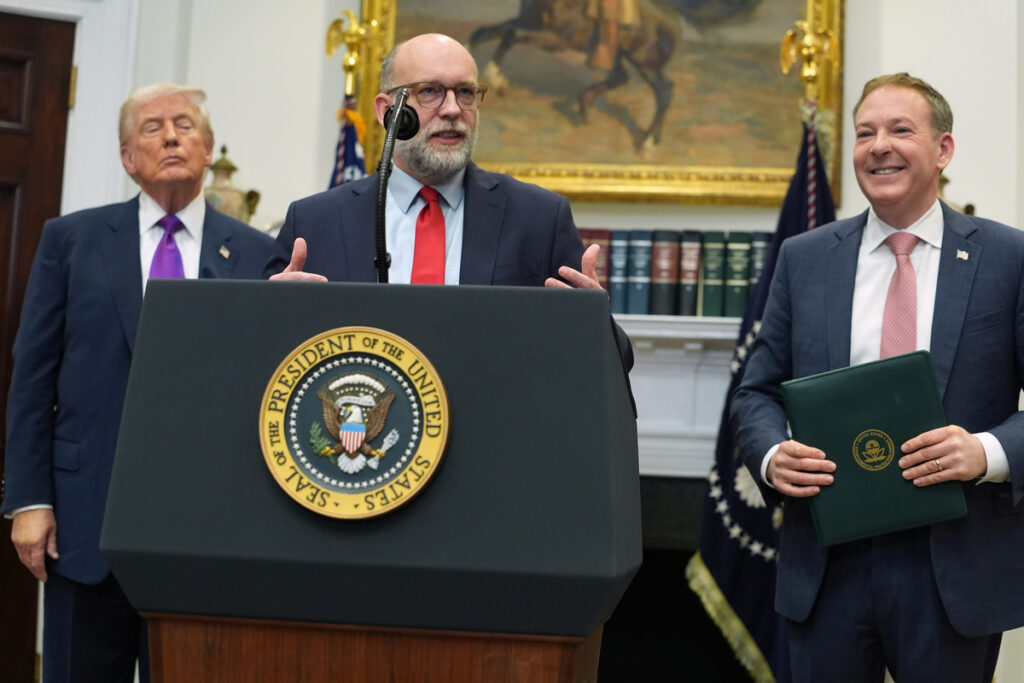
Amid these reductions, there is a concerted push to enhance funding for oil and gas initiatives, mining operations, manufacturing, and AI development, potentially at the expense of alternative energy projects. White House budget director Russ Vought emphasized a “historic paradigm shift” in budgetary approaches, suggesting that “fiscal futility is ending.”
Although this budget proposal is nonbinding, it lays the groundwork for congressional Republicans to draft fiscal 2027 spending legislation. Historically, appropriators have often modified presidential budget requests, as seen last year.
Infrastructure Projects Under Scrutiny
Part of the proposed budget cuts includes retracting $15.2 billion from the 2021 bipartisan infrastructure law, specifically targeting funds allocated for renewable energy and carbon capture projects. The administration plans to redirect $3.5 billion from renewable energy priorities to Department of Energy (DOE) programs aimed at enhancing energy affordability and abundance.
Additionally, $1.2 billion is earmarked for the deployment of AI supercomputers at national laboratories. The budget also seeks to end subsidies for electric vehicle battery manufacturers and cancel $4 billion for electric vehicle charging infrastructure, potentially impacting the National Electric Vehicle Infrastructure (NEVI) program.
Reorganization in the Interior Department
The Trump administration is proposing a $15.9 billion discretionary budget for the Interior Department, reflecting a 12.9 percent cut. The focus is on consolidating offshore energy management to address concerns about coastal impacts and streamline resource governance. This includes merging the Bureau of Ocean Energy Management with the Bureau of Safety and Environmental Enforcement.
Efforts are also underway to establish a unified wildland firefighting agency, despite previous congressional hesitations. The administration continues to advocate for this consolidation.
Environmental and Energy Department Adjustments
The Environmental Protection Agency (EPA) is facing a proposed 52 percent budget cut, down to $4.2 billion. Last year, similar cuts were suggested, but Congress only implemented a 4 percent reduction. The DOE is set to receive $53.9 billion, with a strong emphasis on AI, marking a shift from energy efficiency and renewable priorities. “The era of wasting taxpayer dollars on unreliable, expensive energy that is dependent on foreign supply chains is over,” the budget asserts.
Nondefense DOE spending is proposed to decrease by 11 percent, with a focus on critical minerals and AI-driven energy improvements. The Office of Critical Minerals and Energy Innovation is allocated $1.1 billion.
Allocations for Other Agencies
The Department of Defense is poised for a 42 percent budget increase to $1.5 trillion, with part of the funding contingent upon a forthcoming tax and spending bill. The Army Corps of Engineers faces a 28 percent funding cut, though such proposals are often disregarded by lawmakers.
While FEMA’s structure remains unchanged, some grant programs face reductions. The disaster relief fund is set to increase by $2 billion. Meanwhile, NOAA is targeted for $1.6 billion in program terminations related to climate research, though additional funding is requested for unmanned systems supporting fisheries and ocean exploration.
NASA’s science budget could see a $3.4 billion reduction, affecting international climate partnerships. Additionally, the Global Environment Facility faces a $150 million cut, reflecting Congress’s fiscal 2026 provision.
Original Story at www.eenews.net