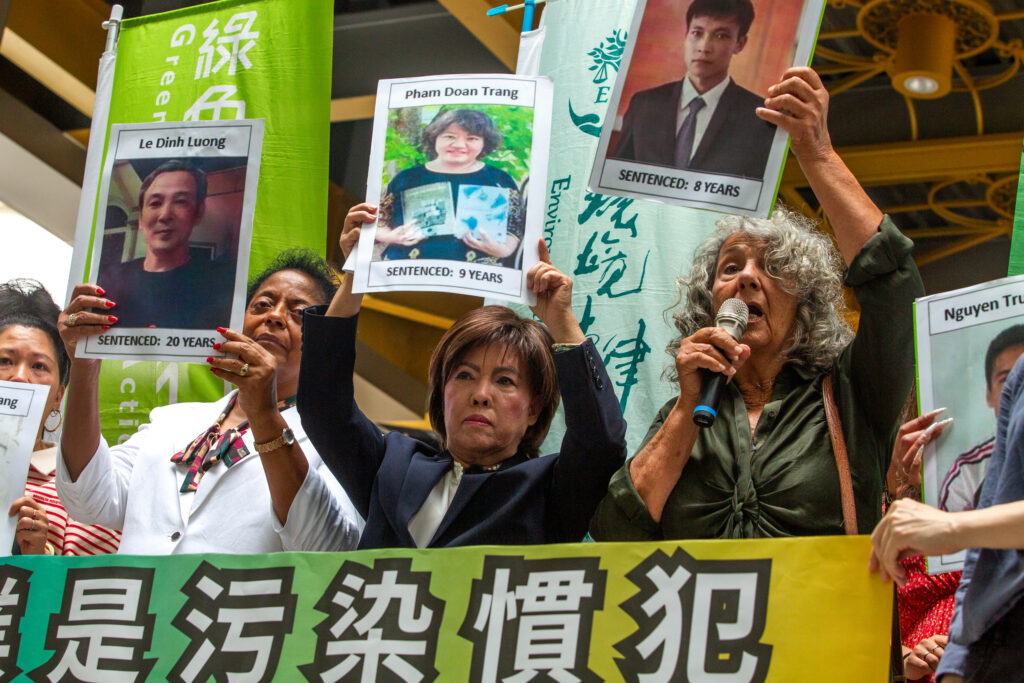
The Resistance, Part 2: Gulf Coast environmentalists confront Formosa Plastics Corp. at its shareholders meeting.
YUNLIN COUNTY, Taiwan—Diane Wilson, approaching 80, often acts on impulse. Despite preferring to stay home, she traveled to Taiwan. Wilson, a retired shrimper, had recently spent March camped outside a chemical plant on a hunger strike in Texas, and now stood on a Taiwanese dock, listening to an oysterman named Lin Chun Lan speak in Mandarin.
Wilson connected with Lin; both shared a love for the ocean and a determination to challenge Formosa Plastics Corp. Their persistence earned them animosity from local powers.
“No one can buy him,” Lin’s translator said, with politicians detesting him. Lin added, through translation, his disdain for them.
Wilson laughed, understanding the sentiment.
Years of activism have labeled Wilson an extremist in a profit-driven political system. Yet, receiving the Goldman Environmental Prize in 2023 for her landmark lawsuit against Formosa Plastics in Texas, she gained many allies.
Wilson traveled 13 time zones to challenge Formosa’s leadership at its shareholder meeting in Taipei. Joining her were Sharon Lavigne, a retired teacher from Louisiana, also a Goldman Prize recipient, and Nancy Bui, a Vietnamese refugee suing Formosa over a 2016 disaster in Vietnam.
Wilson didn’t expect immediate change from Formosa’s board. Her mission was to keep the pressure on them.
The Environmental Rights Foundation invited the activists to Taiwan to influence Formosa shareholders and inspire local leaders against Asia’s largest petrochemical company.
A Shrimper and an Oysterman
Lin recounted decades of organizing against industrial giants like Formosa. He described how they planned to replace his oyster farm with a steel mill, how civic leaders rarely supported him, and how intimidation tactics were common.
“He was threatened with guns,” Lin’s translator said. Lin defied threats, but industrial expansion eventually damaged the local marine environment.
Wilson related to Lin’s story. Her fishing village in Texas saw a similar decline as petrochemical industries took over.
Lin and Wilson reminisced about past methods of harvesting wild oysters, acknowledging how industrialization changed their traditional practices.
Four Trips to Taiwan
Wilson’s first trip to Taiwan was in 1992, invited by local environmental groups. There, she learned from Taiwanese activists and attended a clandestine rally. These experiences inspired her future protests in Texas.
In 2010, despite legal risks, Wilson disrupted Formosa’s shareholder meeting in Taipei, protesting their pollution. She returned twice more, in 2018 and recently, as part of ongoing efforts against the company. The Environmental Rights Foundation organized these trips.
Solidarity Between Villages Around the World
The activists traveled over 400 miles, sharing stories of pollution and health issues. Wilson, nearly 80, remained resolute despite the heat.
“There is a solidarity, not just within this village but in many villages all around the world.”
— Annie Huang, Environmental Rights Foundation
Huang explained the importance of global solidarity in these struggles, highlighting the respect Taiwanese people have for international support.
Wilson shared her experiences with pollution in Texas, noting the lack of local protest due to intimidation and Formosa’s power.
A Meeting at the Presidential Office
On a record-hot May day in Taipei, the activists met behind closed doors with Taiwanese officials, discussing Formosa’s environmental impact.
Wilson carried documents about her successful lawsuit against Formosa in Texas, which resulted in a landmark settlement and a commitment to zero plastic discharge, though violations continued.
Texas regulators recently proposed removing the zero-discharge requirement from Formosa’s permits, a decision Wilson’s group is challenging.
Sharon Lavigne
Lavigne, from Louisiana’s Cancer Alley, began her activism after Formosa proposed a massive petrochemical complex near her home. Realizing the environmental racism at play, she led local resistance, eventually winning a court victory against Formosa. Although the ruling was overturned, her efforts earned the Goldman Prize in 2021.
Nancy Bui
Bui, a Vietnamese refugee, founded Justice for Formosa Victims following a 2016 environmental disaster in Vietnam caused by Formosa. The incident devastated local fisheries and led to widespread suffering. Bui’s organization is pursuing legal action in Taiwan to seek justice for affected communities.
The Shareholder Meeting
At Formosa’s shareholder meeting in Taipei, the activists highlighted the company’s environmental offenses. Lavigne addressed community health impacts in Louisiana, while Bui discussed ongoing issues in Vietnam. Wilson emphasized Formosa’s failure to meet zero-discharge commitments in Texas.
Formosa’s chairman acknowledged the financial challenges but offered no substantial commitments. The activists left without a tangible victory but remained undeterred.
Taking Stock
Reflecting on the week, the activists agreed that persistence is key in their environmental battles. Lavigne emphasized the importance of speaking up against injustice, while Wilson encouraged bold actions and sustained efforts.
“When you start doing this work, you can’t turn around.”
— Sharon Lavigne
Bui highlighted the importance of youth involvement, urging young people to act against environmental issues.
Wilson noted the fear that often prevents people from acting. She advised aspiring activists to be bold and unafraid of mistakes.
Postscript
Upon returning home, Wilson faced ongoing challenges, including efforts to prevent further industrial pollution in her region. Despite exhaustion, she remains committed to her environmental advocacy.
Original Story at insideclimatenews.org