Understanding the Role of ‘Ghost Forests’ in Coastal Climate Resilience
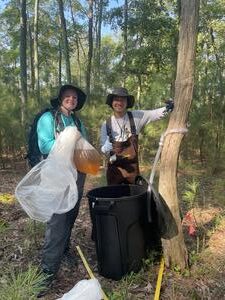
image: Robyn O’Halloran (left) and Ryan Kim (right) collect the rainwater that travels down branches and the trunk of a sweetgum tree to study the rapid changes to coastal forests caused by rising sea levels.
Credit: Samantha Chittakone
As sea levels rise along the eastern United States, the encroaching saltwater has led to the creation of “ghost forests”—areas of dead and dying trees that serve as stark reminders of climate change’s impact. Researchers are now exploring these eerie landscapes to understand how coastal ecosystems might respond to such environmental changes.
At the American Chemical Society (ACS) Spring 2026 meeting, Samantha Chittakone, an environmental engineering student at the University of Delaware, shared findings about these ghost forests. The conference, held from March 22-26, featured nearly 11,000 scientific presentations.
These ghost forests not only reveal the visible effects of climate change but also hint at underground shifts in tree carbon and nutrient processing. Chittakone and her research team, including supervisors Robyn O’Halloran, Delphis Levia, and Yu-Ping Chin, focused on the stemflow of sweetgum trees—a process where rainwater moves down tree trunks and branches, influencing nutrient distribution around the roots.
“Walking through these coastal forests, surrounded by nature, is beautiful,” remarks Chittakone. “However, it is disheartening to see the healthy trees becoming less prevalent as you approach the shoreline and the effects of rising sea levels become apparent.”
By collecting stemflow samples from healthy, stressed, and dead sweetgum trees, the team aimed to understand the cascading impacts on forest ecosystems. They discovered that dead trees absorbed stemflow like sponges, reducing the water and nutrient flow to the forest floor, which could significantly affect soil and other organisms.
“Stemflow is basically injecting nutrients and really important chemicals into the forest ecosystem so the microbiome there can thrive,” explains Chin. The color and composition of stemflow can vary, influenced by factors like bark texture and nutrient concentration.
Levia added, “Our results signify that the transition from healthy trees to ghost forests changes the magnitude and chemistry of stemflow, leading to pronounced differences in dissolved carbon inputs.” These insights could help predict which forest areas are most vulnerable to rising seas.
This research forms part of a broader initiative to study stemflow’s role, including its effects after wildfires. “People are beginning to understand the role that stemflow plays in forest floor carbon cycling,” notes Chin. “We’re kind of preaching the gospel, not just to the general community, but our own scientific community.”
Chittakone emphasizes, “Stemflow is a significant transporter of nutrients and other important chemicals in these coastal forests. It’s something that we should study more and not overlook whenever it comes to carbon cycling, especially in these vulnerable ecosystems.”
The research received funding from the U.S. National Science Foundation.
Visit the ACS Spring 2026 program to learn more about this presentation, “Linking stemflow to groundwater in ghost forests: Accessing tracers and impacts of tree health on dissolved organic carbon composition,” and other science presentations.
###
The American Chemical Society (ACS) is a nonprofit organization founded in 1876 and chartered by the U.S. Congress. ACS is committed to improving all lives through the transforming power of chemistry. Its mission is to advance scientific knowledge, empower a global community and champion scientific integrity, and its vision is a world built on science. The Society is a global leader in promoting excellence in science education and providing access to chemistry-related information and research through its multiple research solutions, peer-reviewed journals, scientific conferences, e-books and weekly news periodical Chemical & Engineering News. ACS journals are among the most cited, most trusted and most read within the scientific literature; however, ACS itself does not conduct chemical research. As a leader in scientific information solutions, its CAS Division partners with global innovators to accelerate breakthroughs by curating, connecting and analyzing the world’s scientific knowledge. ACS’ main offices are in Washington, D.C., and Columbus, Ohio.
To automatically receive press releases from the American Chemical Society, contact newsroom@acs.org.
Note to journalists: Please report that this research was presented at a meeting of the American Chemical Society. ACS does not conduct research, but publishes and publicizes peer-reviewed scientific studies.
Follow us: Facebook | LinkedIn | Instagram
Title
Linking stemflow to groundwater in ghost forests: Accessing tracers and impacts of tree health on dissolved organic carbon composition
Abstract
Coastal margins along the Atlantic seaboard are undergoing profound transformations due to rising air temperatures, sea level rise, and saltwater intrusion. A visible consequence is the emergence of “ghost forests”, characterized by moribund and dead trees that potentially disrupt biogeochemical cycling. Such disruptions would include altering stemflow (the intercepted precipitation that is funneled over tree stems), which serves a critical yet understudied role in carbon cycling. In coastal forests, where the groundwater table is at or near the surface, stemflow may interact with groundwater more directly, possibly introducing previously unaccounted-for organic matter. This study explores the interactions between stemflow and groundwater from moribund and healthy sweetgum trees (Liquidambar styraciflua L.) within a coastal forest experiencing the effects of sea level rise. Groundwater wells were placed near tree trunks and measured water levels for trees with stemflow collection systems, where groundwater is unaffected by stemflow, and trees without collection systems, where stemflow can enter the ground and affect groundwater. Following each rain event, the water table near moribund and healthy tree trunks was consistently higher, suggesting contributions from stemflow. Dissolved organic matter (DOM) fluorescence indices (FI) for stemflow impacted groundwater (median value of 1.46) revealed the presence of allochthonous precursors, while less stemflow influenced groundwater (median of 1.90) revealed DOM that has been microbially processed. Dissolved lignin was also directly measured in these samples for use as a tracer of tree-derived organic matter. The median concentration of total dissolved lignin products in stemflow-influenced groundwater near healthy trees (0.88 µM) was greater than that of unimpacted groundwater (0.54 µM), corroborating results from the FI analysis. By defining the relationship between stemflow and groundwater, the quality and quantity of carbon entering these vulnerable ecosystems can be determined, providing insight into the effects of tree health on carbon cycling.
Original Story at www.eurekalert.org