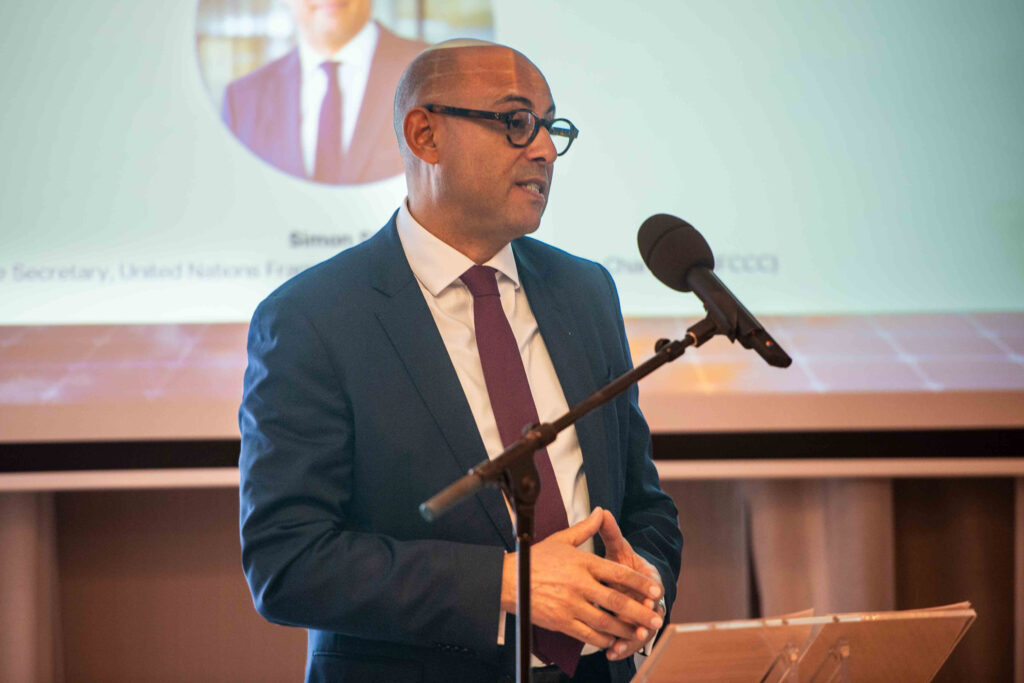
The Iran conflict has disrupted the global energy market, highlighting the risks for nations dependent on fossil fuels, United Nations climate chief Simon Stiell stated at a conference on Monday.
Speaking at the Green Growth Summit in Brussels, Stiell, executive secretary of the U.N. Framework Convention on Climate Change, cautioned against fossil fuel reliance. He called for accelerated adoption of renewable energy to enhance security and spur economic growth.
“Climate cooperation is a remedy for current chaos,” Stiell said, as detailed in a transcript of his speech.
The U.S.-Israel conflict with Iran has curtailed 20% of the world’s oil supply, triggering shortages and price hikes. Labeling recent events as a stark lesson, Stiell criticized increased fossil fuel reliance.
“This approach is misguided,” he warned. “Fossil fuel crises are recurrent.”
Stiell urged European policymakers to adopt renewable energy strategies for economic and health benefits and protection from global upheaval. He aligned with experts who argue the war underscores the need for renewable energy, as seen in a report supporting this view.
He highlighted financial impacts from climate change, citing research showing €43 billion in short-term losses in Europe due to extreme weather, while fossil fuel companies benefit from subsidies.
Stiell emphasized that dependency on fossil fuel imports keeps Europe vulnerable to crises, impacting both homes and industries.
Kate Logan, director at the Asia Society Policy Institute, noted Stiell’s speech reflected an urgent tone unusual for the UNFCCC, indicating the severity of the situation.
Logan remarked on the broader implications of the speech, emphasizing the undeniable necessity of transitioning away from fossil fuels.
The U.S.-Israel conflict in Iran, initiated without Congress or U.N. Security Council approval, has resulted in over 1,440 deaths in Iran, according to Iran’s health ministry, and displaced 800,000 in Lebanon due to a chain of counterattacks.
Attacks on Iran’s desalination plants threaten regional water access and breach international law, underscoring fossil-fuel dependence risks. Experts highlight this dependency, with the plants reliant on oil and gas.
Stiell’s speech addressed Europe’s energy challenges, but the global impact is evident, particularly in countries heavily reliant on imported oil and gas.
Pakistan announced a two-week school closure and reduced government services to conserve fuel. India faces a cooking gas shortage, prompting protests.
Bangladesh and Myanmar have implemented fuel rations, while the Philippines announced a four-day workweek to reduce energy demand.
The Strait of Hormuz is vital for fertilizer shipments, and African governments are preparing for agricultural economic impacts.
Stiell argued that renewable energy ensures energy security and stability amid conflict. “Sunlight and wind don’t depend on vulnerable routes,” he noted.
Kate Guy, from Columbia University, indicated the Iran conflict illustrates how energy resources, particularly fossil fuels, can be weaponized. She highlighted that clean energy systems, while not immune, have fewer vulnerabilities than traditional fossil fuel markets.
Stiell urged leaders to focus on the societal and economic advantages of emission reduction. He referenced the U.S. withdrawal from the Paris climate agreement under President Trump as a shift in international environmental diplomacy.
Original Story at insideclimatenews.org