UK Government to Reassess Electric Car Sales Quotas Amid Industry Concerns
The UK government is revisiting its electric vehicle policies, sparking speculation of a potential shift in its ambitious green agenda. This comes as ministers initiate a review of the zero-emission vehicle (ZEV) mandate, which has been a cornerstone of the country’s environmental strategy.
Officials are actively exploring new strategies that may lead to modifications in the existing ZEV mandate. High-level discussions are reportedly taking place between industry leaders and government officials.
Automakers have been requested to provide detailed production plans for battery electric vehicles (BEVs) and plug-in hybrid electric vehicles (PHEVs) expected to roll out by 2035. Industry insiders express optimism as they see the government beginning to respond to their concerns.
A government spokesperson stated, “We recognise manufacturers are facing challenges, but we’ve shown we are adaptable before, and are beginning conversations to inform the planned review of the ZEV mandate, to be published by early 2027.”
Despite these discussions, the spokesperson added, “It has never been easier or cheaper to own an EV, especially against the backdrop of high and fluctuating prices at the pumps.”
The ZEV mandate, effective since 2024, initially required 22% of new cars to be zero-emission. This target has since risen to 33% this year and is set to escalate to 80% by 2030, with the sale of new petrol and diesel cars banned from that point. Hybrid vehicles have a reprieve until 2035.
This policy has been linked to a significant drop in UK vehicle manufacturing, with production plummeting to its lowest since 1952. Proponents of electric vehicles are urging the government to maintain its course despite these challenges.
Whitehall sources highlighted the government’s flexibility last year when they adjusted the ZEV mandate in response to US tariffs.
Non-compliance with the mandate could result in a hefty £12,000 penalty per vehicle for manufacturers, who have instead opted to offer substantial discounts. These price cuts have reportedly cost the industry £10 billion within the first two years, according to the Society of Motor Manufacturers and Traders (SMMT).
In contrast, the European Union delayed its own 2035 deadline for phasing out petrol and diesel cars. With 80% of UK-produced cars destined for export, and 54% heading to the EU, this decision holds significant implications for the UK industry.
Government departments are working against the clock to finalize the review, aiming for publication in early 2024. However, industry leaders hope to see the results sooner, potentially this year, to avoid the imposition of a 38% sales quota by 2027.
Major automakers, including BMW and Stellantis, have voiced criticism of the ZEV mandate. Jaguar Land Rover (JLR), in particular, has expressed concerns about the rapid pace of quota increases as it prepares to launch a new line of electric models.
The business department is eager to attract international car manufacturers to the UK to spur economic growth, yet these companies demand a revised ZEV mandate framework before committing to investments.
The extensive review will not commence until after the May elections in Scotland and Wales due to the statutory nature of the ZEV mandate and its implementation by devolved administrations.
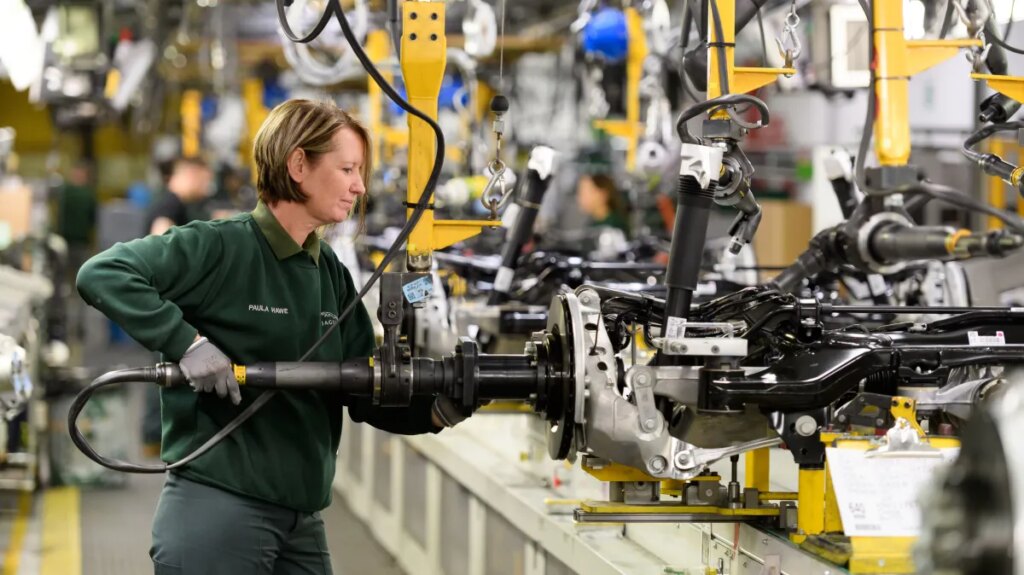
Concurrently, Jaguar Land Rover is striving to circumvent another crisis as suppliers anticipate potential disruptions in the West Midlands. The company recently confirmed a temporary halt in production of its Range Rover models at Solihull, extending its Easter shutdown.
Large JLR suppliers have advised their staff to expect the shutdown to last until at least April 13, raising concerns of a repeat disruption similar to last year’s cyberattack-induced halt.
The latest issue arises from a fire at Raufoss Technology, a key supplier of lightweight aluminium chassis components. As Raufoss is the sole supplier of these parts to JLR, the fire is expected to impact production for several weeks. Fortunately, no injuries were reported among Raufoss’s 180 employees.
A JLR representative stated, “Due to a parts supply challenge … we are temporarily pausing production on certain vehicle lines at our Solihull manufacturing facility. We are working closely with that supplier to resolve the issue as quickly as possible and minimise any impact on our clients or our operations.”
Raufoss has declined to provide further comments on the situation.
Original Story at www.thetimes.com