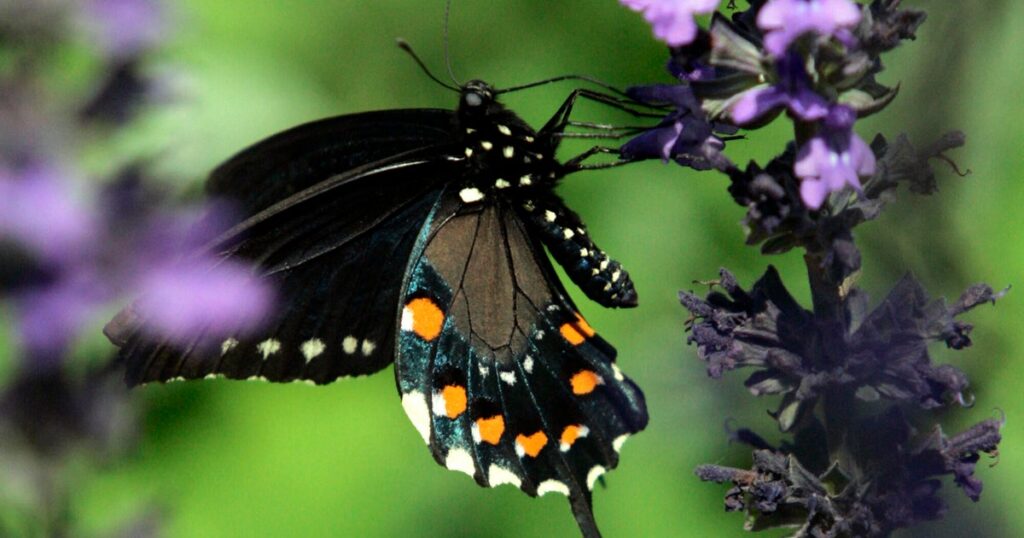
Amidst the vibrant surroundings of the University of California, Berkeley, a unique ecosystem quietly thrives near the iconic Campanile and Strawberry Creek. This sanctuary is home to the California pipevine swallowtail, a native butterfly that finds refuge and sustenance here.
“It’s so beautiful to have around. And all the butterflies you see on campus, the blue and black pipevine swallowtails, they’re all born on this site,” remarked Rosetta Wang, the founder of the Wild Harvest and Restoration Fund, dedicated to the revival of native flora and fauna.
Berkeley elementary school teacher, Jacob Pavlosky, describes the butterfly habitat as enchanting. “It’s almost like a fairy tale. You know, there are not a lot of places where you can be close to butterflies, caterpillars, walk around and have them flying around you,” he said. His students have contributed colorful artworks depicting the butterflies and their habitat, adorning the area.
The survival of these butterflies hinges on the California pipevine, the sole plant on which female butterflies lay their eggs and caterpillars feed. Unfortunately, this delicate balance faces disruption due to a new clean energy project underway at UC Berkeley.
Irfan Khan/Los Angeles Times via Getty Images
Wang, who has been actively removing invasive plants to support the pipevine, is concerned about the potential impact of the construction. The project aims to replace the outdated natural gas-burning cogeneration plant near Edwards Stadium with a modern, renewable system. “We regret that this project is going to disturb the area a little bit. We want to disturb it as little as possible,” stated UC Berkeley spokesperson Kyle Gibson.
The construction requires access to existing utility lines beneath the butterfly habitat, necessitating excavation and potential disruption of the pipevine plants. Gibson noted that neither the plants nor the butterflies are legally protected but emphasized the university’s commitment to minimizing impacts. “We want to maintain our campus biodiversity to the extent that we can, and we do want to minimize the impact of this project as much as possible,” he said.
Mia Monroe, a former national park ranger and butterfly expert now volunteering with the Xerces Society, questioned the compatibility of sustainability goals with preserving biodiversity. “How can we have green, clean energy among a bright blue butterfly? How can we do both?” she asked. The butterfly, once vanished from many East Bay urban areas, has seen a resurgence thanks to local conservation efforts led by groups like the Pollinator Posse.
Local advocates, including Monroe, Wang, and concerned citizens, have urged the university to reconsider the project’s impact on the habitat. In response, UC Berkeley devised a four-part plan to protect and replant the pipevines, involving limited excavation, relocation of plants to alternative sites along Strawberry Creek, and long-term restoration and expansion of the habitat.
However, Wang expressed skepticism about the plan’s feasibility, particularly regarding the transplantation of mature vines. She highlighted the challenges of moving these plants, which require careful handling of their extensive root systems and precise timing during dormancy. Wang has called for additional surveys before any construction begins.
“I would really like to see that it ultimately is not destroyed,” Wang expressed, underscoring the community’s desire to preserve this unique ecological niche.
Original Story at www.cbsnews.com