In a significant policy shift, President Trump, on his first day in office on January 20, 2025, took decisive steps to roll back electric vehicle (EV) initiatives. His executive order, titled “Unleashing American Energy,” targeted the removal of the “electric vehicle (EV) mandate” and aimed to eliminate what he described as “unfair subsidies” that favored EVs over other technologies.
Following the executive order, the General Services Administration (GSA) issued a directive to reshape the federal fleet, which in 2023 comprised 8,622 EVs, excluding postal vehicles. The directive stipulated that only “mission-critical” EVs and charging stations would remain operational, with others being decommissioned or sold.
Progress on these initiatives over the subsequent months remains somewhat ambiguous. When Autoweek inquired about the status of military base chargers and the “mission-critical” order, the GSA responded with a statement from Marianne Copenhaver, GSA Associate Administrator of Strategic Communication. She highlighted the issuance of GSA Directive 5605.1B, which halted new charging station installations unless a mission-critical need was documented.
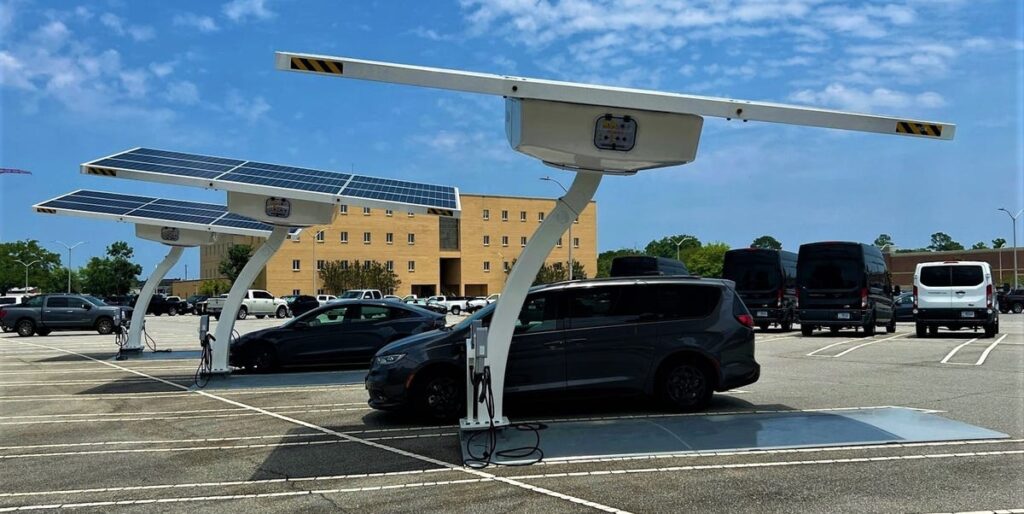
Military bases continue to host EV charging stations, with installations like Fort Buchanan in Puerto Rico and Fort McCoy in Wisconsin maintaining operational chargers. However, the exact impact of the administration’s order on these facilities is still under review, as noted by an Army spokeswoman.
Despite the changes, the federal Alternative Fuel Data Center’s EV station finder does not list some military chargers, possibly due to their restricted access. For instance, Fort Knox’s 16 chargers, introduced in 2023, remain operational, as confirmed by R.J. Dyrdek, energy division manager at Fort Knox Directorate of Public Works.
The Trump administration’s strategy includes shutting down EV chargers at urban federal buildings by canceling maintenance contracts and switching off power breakers. Analyst Lauren Fix observed that this “clawing back” has led to the disconnection of EV chargers across federal buildings.
Oshkosh Defense, contracted for Next Generation Delivery Vehicles, has delivered only 612 vehicles out of an initial order of 50,000, reflecting challenges in meeting federal electrification targets.
The administration also paused $5 billion in EV infrastructure funding from the National Electric Vehicle Infrastructure (NEVI) Formula Program, though a federal judge later overturned this decision. Trump subsequently redirected NEVI funding towards existing gas stations and truck stops.
Efforts to electrify the Postal Service fleet faced hurdles, with only a portion of the initial vehicle order being electric. Senator Joni Ernst’s “Return to Sender Act,” aimed at halting Postal Service electrification, failed to pass, but ongoing debates suggest continued scrutiny over EV investments.
Original Story at www.autoweek.com