Trump Administration Set to Announce New Fuel Economy Standards
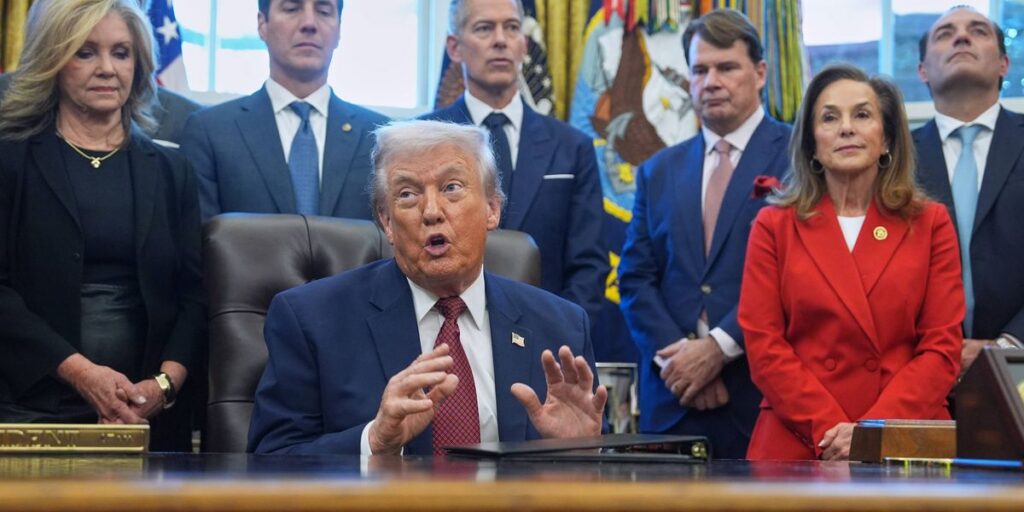
The Trump administration is gearing up to unveil a new set of fuel economy standards aimed at easing the regulatory burden on automakers. These changes are intended to reduce pollution controls on gasoline-powered vehicles, a move that President Donald Trump claims will cut costs for consumers and boost U.S. auto production.
On his Truth Social media platform, President Trump stated that the revised standards will “take the waste out of building cars in America” and provide significant savings for families on new vehicles while enhancing domestic auto manufacturing.
Last December, the National Highway Traffic Safety Administration (NHTSA) predicted that the new standards would reduce the industry fleetwide average for light-duty vehicles to approximately 34.5 miles per gallon by the 2031 model year. This is a significant decrease from the projected 50.4 miles per gallon under the previous rules established by the Biden administration. The revised standards reflect Trump’s ongoing efforts to roll back policies that favor electric vehicle production.
Since assuming office, Trump has adjusted various regulations, including easing auto tailpipe emissions rules, repealing fines for automakers that fail to meet federal mileage standards, and ending consumer credits of up to $7,500 for electric vehicle (EV) purchases.
Secretary of Transportation Sean Duffy, via his social media account on X, indicated that the changes would be formally announced on Monday. As of now, the White House, Department of Transportation, and NHTSA have not provided additional details on the new standards.
Major automakers such as General Motors, Stellantis, and Ford Motor, the producer of the best-selling F-150 pickup truck, have also not commented on the impending announcement. The administration and automakers have previously stated that the new rules will broaden access to a diverse range of gasoline vehicles that meet consumer needs and budget constraints.
Recent data from Kelley Blue Book highlights that the average price of a new car in the U.S. reached $50,089 in August, marking a return above the $50,000 threshold since last December. Concurrently, fuel costs are rising as geopolitical tensions, including Washington’s conflict with Iran, disrupt global fuel supplies. As reported by AAA, the national average gas price was $4.47 per gallon on Sunday, up from $4.09 a month earlier.
Despite Trump’s assertions, no federal mandate requires auto companies to sell electric vehicles, although President Biden has set a goal for half of all new vehicle sales to be electric by 2030. According to Edmunds, EVs represented 6.5% of new vehicle sales in February, down from 7.4% in 2025.
The proposed changes have sparked criticism from environmental groups. Dan Becker, director of the Center for Biological Diversity’s Safe Climate Transport Campaign, criticized the move, stating that it disregards the potential of clean technology and the prevalence of fuel-efficient vehicles currently available.
“Trump is tanking sensible mile per gallon standards at the worst possible time for consumers, who are getting hit with sky-high prices at the pump,” Becker commented, emphasizing that consumers will ultimately bear the costs of these rollbacks while benefiting the oil and auto industries.
Katherine García, director of the Sierra Club’s Clean Transportation for All campaign, also pledged to challenge the rule, warning that looser fuel standards would increase driving costs.
“Less fuel-efficient cars mean more gas burned, spending more at the pump, and dirtier air in our communities,” García stated.
When the 2024 standards were introduced, NHTSA estimated they would prevent the burning of 14 billion gallons of gasoline by 2050. The agency also noted that while fuel-efficient vehicles typically have higher upfront costs, the savings on gasoline over the vehicle’s lifetime would outweigh these initial expenses.
Without these standards, by 2035, cars could emit an additional 22,111 tons of carbon dioxide annually compared to the Biden-era rules. This also implies an increase of 90 tons of harmful soot particles and 4,870 tons of smog-causing pollutants like nitrogen oxides and volatile organic compounds each year.
First implemented during the 1970s energy crisis, corporate average fuel economy (CAFE) standards have historically driven automakers to enhance their vehicles’ fuel efficiency over time.
Original Story at www.audacy.com