In the fast-evolving world of electric vehicles, the debate over the best battery technology is heating up. While Tesla and BYD both aggressively advance their battery technologies, they each follow distinctly different paths. This divergence has sparked interest and curiosity about which direction holds the future of sustainable mobility.
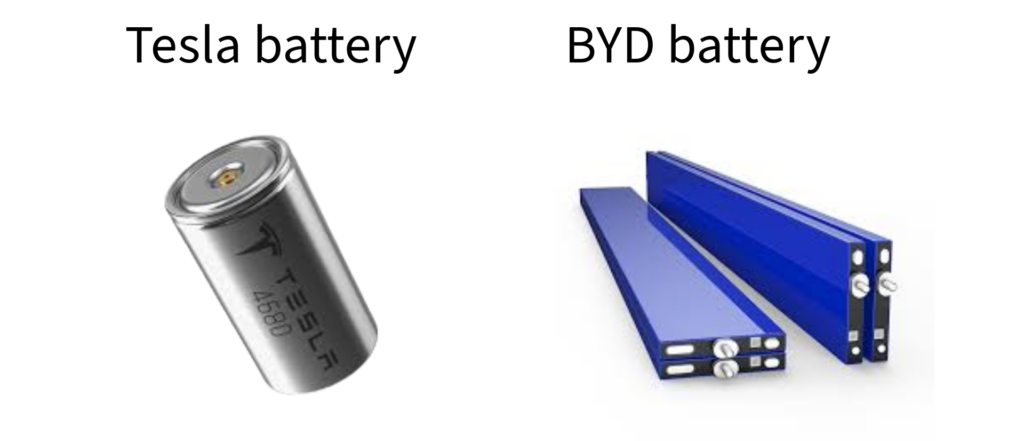
At the forefront of Tesla’s vision is their 4680 cylindrical cell, which promises high energy and extended range. BYD counters with its Blade battery, a prismatic LFP cell, highlighting safety and cost-effectiveness. Understanding the nuances between these technologies requires peeling back their layers, which researchers have done by meticulously analyzing the batteries’ structures and functionalities.
The “Coca Cola” Formula
The clandestine nature of battery technology makes it a challenging field to study, often compared to a secret recipe like Coca Cola’s. Researchers, led by Jonas Gorsch from RWTH Aachen University, aimed to unveil the intricacies of these batteries through a detailed teardown.
“There is very limited in-depth data and analysis available on state-of-the-art batteries for automotive applications,” stated Gorsch. Using advanced tools like scanning electron microscopy and thermogravimetric analysis, the team evaluated various parameters such as energy density and thermal efficiency.

Tesla’s battery, with its cylindrical format, measures 46 mm in diameter and 80 mm in length. BYD’s Blade battery presents a stark contrast with its elongated prismatic shape, measuring 90 mm in height, 965 mm in length, and 14 mm in thickness. These structural choices reflect the unique priorities of each manufacturer.
In terms of energy density, Tesla’s 4680 cell achieves 241 Wh/kg and 643 Wh/l, surpassing BYD’s Blade at 160 Wh/kg and 355 Wh/l. Despite its advantage in power, Tesla’s reliance on nickel-rich materials drives up costs compared to the more stable LFP components used by BYD.
Expectations and Surprises

The Tesla 4680 employs a “jelly roll” configuration, winding electrodes within its cylindrical casing. Conversely, BYD’s Blade uses a Z-folded electrode stack, enhancing mechanical stability. Manufacturing methods also vary, with Tesla opting for laser welding, while BYD combines ultrasonic and laser techniques.
Surprisingly, neither battery incorporates silicon in their anodes, despite its potential for boosting energy density. Gorsch noted, “We were surprised to find no silicon content in the anodes of either cell, especially in Tesla’s cell.” This choice underscores the gap between academic research and the practical demands of mass production.
Two Different Visions

Cost considerations remain a significant barrier for EV adoption. Tesla’s high-nickel cathode results in about a $10/kWh cost disadvantage compared to BYD’s LFP-based Blade. This is compounded by differences in thermal management; Tesla’s higher internal resistance can lead to more heat, whereas BYD’s design inherently mitigates thermal risks.
The choice between these batteries depends on the vehicle’s purpose. While Tesla’s 4680 might suit luxury and performance models, BYD’s Blade could excel in commercial and budget-friendly vehicles.
Updates, a Year Later
The landscape is evolving. BYD has introduced a second-generation Blade battery capable of rapid charging and increased energy density, challenging the notion that LFP batteries are inherently slower. Tesla, meanwhile, is diversifying into LFP production while advancing its 4680 technology.
The battery industry extends beyond Tesla and BYD, with CATL leading global production. Despite differing strategies, both companies demonstrate that there is room for various technologies to complement the diverse needs of electric vehicles.
The study appears in Cell Reports Physical Science.
This article was initially published in March 2025 and updated with recent developments.
Original Story at www.zmescience.com