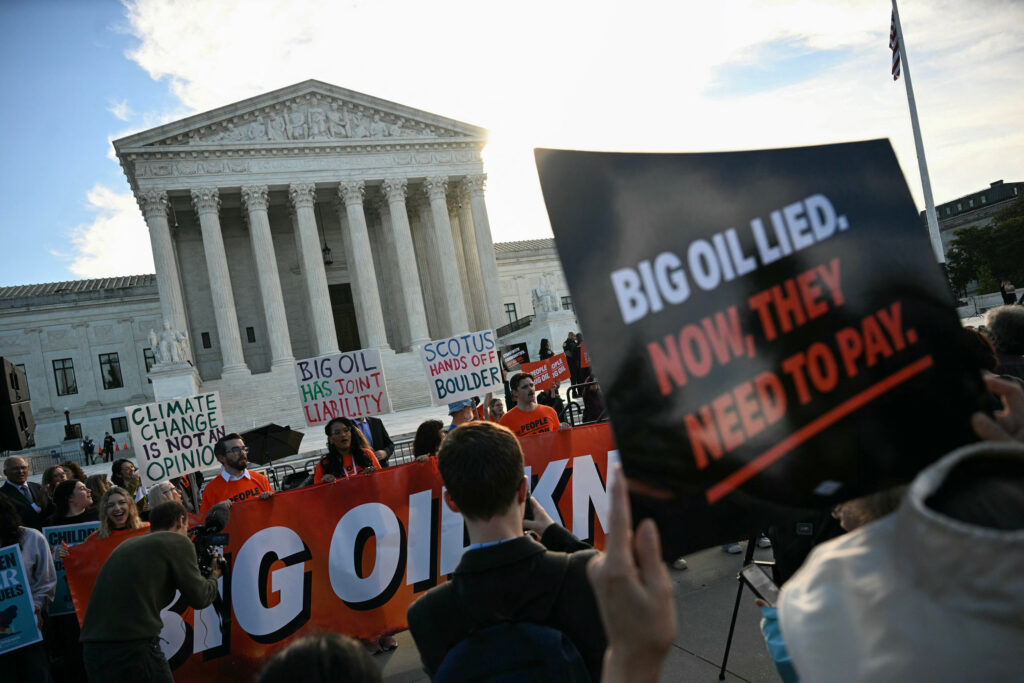
The U.S. Supreme Court recently heard arguments from oil companies, which could determine the outcome of over two dozen lawsuits accusing the industry of misinforming the public about climate change. These lawsuits aim to secure billions in damages to cover costs from climate-related extreme weather events.
The court’s focus was on technical legal issues regarding whether these lawsuits should proceed, rather than the validity of the claims themselves.
The case, filed in 2018 by Boulder against ExxonMobil and Suncor Energy in Colorado, is one of many that have withstood various appeals. The oil companies are urging the Supreme Court to rule that federal law supersedes state and local governments from filing such claims.
Kannon Shanmugam, representing Exxon and Suncor, argued that Boulder is trying to use state law to globally regulate oil companies. He warned that if Boulder’s claims proceed, it could lead to numerous municipalities influencing energy policy by imposing damages on fossil fuel producers.
Boulder and other plaintiffs counter that their lawsuits are not about regulating emissions but seeking damages for deception.
Oil companies and conservative groups have intensified efforts to block these lawsuits, with some states passing laws to prevent them, and Republicans proposing federal legislation to shield oil companies from climate liability claims. The Trump administration has also intervened in some cases, including Boulder’s, to halt their progress. According to Politico, scientists cited in these cases have faced numerous public records requests from conservative groups.
Justice Clarence Thomas raised the question of whether the Supreme Court has jurisdiction to hear this case, as no ruling has been issued yet. Some justices suggested it might be premature to decide.
Michael Gerrard from Columbia University’s Sabin Center for Climate Change Law noted Boulder’s strongest argument is the jurisdictional question, indicating it might be too early for the court to intervene.
Justices also explored whether federal law, via the Clean Air Act or the Constitution, preempts state claims related to climate change.
Several conservative justices appeared inclined to agree that federal law preempts some of Boulder’s claims, according to Gerrard.
The oil companies argue that the Clean Air Act preempts any claims against them related to climate pollution, asserting that the federal government has exclusive control over interstate pollution.
Russell argued that Boulder’s claim seeks damages, not emission limits, and nothing in the Clean Air Act or the Constitution prevents states from actions that indirectly reduce pollution.
Justice Samuel Alito recused himself from the hearing, leaving the possibility of a tie vote, which would allow the case to proceed. Alito’s absence follows pressure due to his ownership of stocks in oil companies involved in related lawsuits. Read more here.
Supporters rallied outside the court, urging justices to let the case move forward. Boulder City Manager Nuria Rivera-Vandermyde highlighted the daily challenges Boulder faces from climate change and questioned whether taxpayers alone should bear the costs or if defendants should share responsibility.
Conservative groups and politicians have backed the oil companies, with the Trump administration presenting arguments. Boulder received support from climate advocacy groups, Democrats, academics, and former EPA officials, including Republicans.
The Supreme Court’s decision, expected by June, will impact numerous paused cases and could either halt these claims or initiate trials.
Original Story at insideclimatenews.org