Examining Yellowstone National Park’s past may offer critical insights into its future. Researchers have delved into 15,000 years of ecological history preserved beneath the park’s lakes to gauge future changes in its unique landscape.
A recent study titled “Postglacial ecosystem development of a hydrothermal landscape in Yellowstone National Park” utilized lake sediment analysis to track historical changes in the park over millennia. The findings reveal that while Yellowstone’s geothermal features and forests exhibit certain vulnerabilities, they also demonstrate significant resilience.
Lead author Cathy Whitlock, regents professor emerita at Montana State University, explained, “We’re trying to understand the sensitivity of the Greater Yellowstone Ecosystem to past climate change, so that we can better understand what’s going to happen in the future.” She added, “It’s a puzzle that can take us into the future.”
Muddying Through Time
The team, comprising scientists from various Western U.S. universities, collected data from small lakes in the Lower Geyser Basin and on the Yellowstone Plateau. These lakes, which formed as glaciers retreated 14,000 to 15,000 years ago, serve as environmental archives. “Lakes are great collectors of environmental information,” Whitlock noted. “Anything that lands on the surface of the lake can get buried in the mud.”
In the sediment cores, researchers uncovered pollen grains, charcoal fragments, and diatoms, all of which help reconstruct historical environmental changes. Radiocarbon dating of sediment layers from sites including Yellowstone Lake, Goose Lake, and Blacktail Pond provided a timeline for these changes.
Water, Earth, and Fire
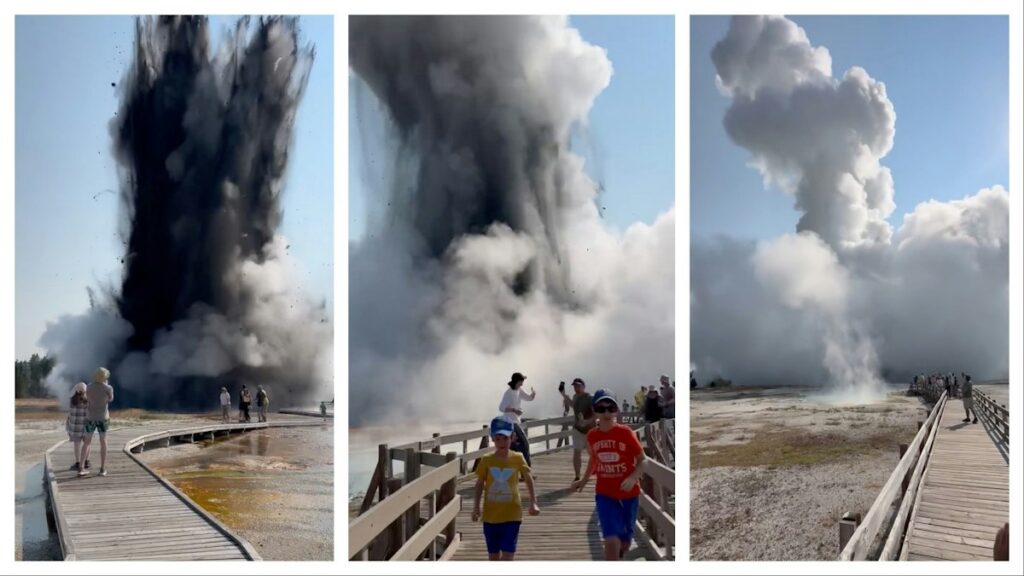
The study indicates that Yellowstone’s geothermal phenomena are closely linked to water availability. “We found that the origin of the lakes is related to hydrothermal activity,” Whitlock stated. The presence of abundant water can lead to hydrothermal explosions, such as the July 2024 event at Black Diamond Pool.
Whitlock’s research also highlights that during warmer periods with reduced snowpack, hydrothermal systems receive less water, affecting geyser activity. This aligns with past findings of prolonged dormancy at geysers like Old Faithful during droughts.
“Our geysers, hot springs, and hydrothermal explosions are strongly dependent on the input of water, which is dependent on snowpack,” Whitlock explained. Shaul Hurwitz, a U.S. Geological Survey hydrologist, found that Old Faithful didn’t erupt for over a century during a severe drought from 1233 to 1362 CE.
A Geo-Ecosystem
Despite climatic shifts, Yellowstone’s vegetation has remained stable. Lodgepole pine forests have dominated the landscape for about 11,000 years, thriving in the volcanic rhyolitic soils that are prevalent in the park.
Whitlock describes Yellowstone as a “geo-ecosystem,” noting, “The geology of Yellowstone has a big control on the vegetation in creating the ecosystem, and it has for a long time.”
Looking Ahead
By correlating past trends with possible future scenarios, Whitlock anticipates reduced geyser activity as temperatures rise and snowpack diminishes. While lodgepole pines have historically weathered climatic changes, the current rate of climate change poses unprecedented challenges.
“Climate change is happening so fast that it’s putting the whole ecosystem into a massive reorganization,” Whitlock remarked. As the park adapts, the findings from these sediment cores offer a blueprint for understanding the potential impacts of future climate shifts.
Original Story at cowboystatedaily.com