The Future of Forests: A Glimpse into the Past
Recent research has revealed that excessive carbon dioxide emissions, rather than fostering growth, could lead to the demise of Earth’s forests. This study challenges claims that fossil fuel pollution benefits the environment by promoting plant life.
The study, which analyzed fossilized leaf cells from the Paleocene-Eocene Thermal Maximum (PETM) about 56 million years ago, reconstructs how global forests responded to a rapid increase in planet-warming gases. This prehistoric episode, characterized by a significant carbon release over 130,000 years and a global temperature rise of 8°C (14°F), offers the closest historical parallel to today’s climate conditions.
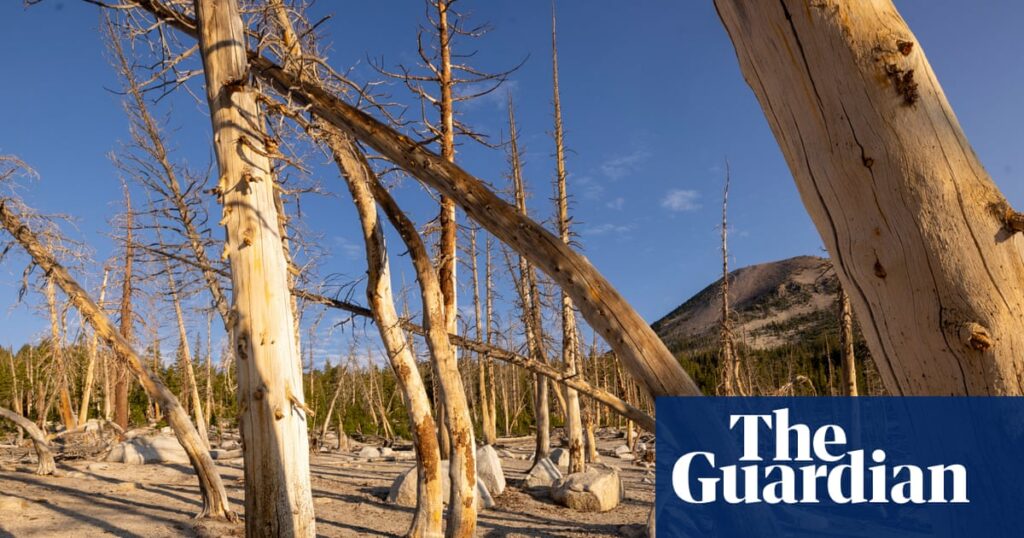
Researchers discovered that this ancient shift resulted in a significant decline in forest areas, with forests retreating and dying off, a finding with “chilling implications” for the current climate scenario.
“What we see is that as the carbon dioxide ramped up, the forests became very dense but then subsequently collapsed, opening up dramatically,” stated Regan Dunn, a lead researcher of the study based in Los Angeles.
The pace of current carbon emissions from fossil fuels surpasses any previous records, including the PETM. Dunn highlighted that around 60% of the biomass of standing vegetation vanished during this prehistoric event, emphasizing that never before has the rate of carbon release been higher than today.
The industrial revolution marked a significant increase in carbon dioxide emissions, with atmospheric levels rising by over 50% within a century. Initially, this increase seemed to benefit plant life, a notion used by some to dismiss climate science. Key figures in Donald Trump’s administration argued that fossil fuel use is beneficial for the environment, with statements such as Doug Burgum’s assertion: “CO2 was never a pollutant.”
However, experts have refuted these claims, noting that trees require more than just CO2 to thrive. Excessive carbon dioxide leads to increased heat, causing trees to suffer from extreme temperatures, nutrient deficiencies, and increased vulnerability to pests and fires.
The study indicates that the transition from greening to browning forests began around 2000 due to drought and heat stress surpassing the benefits of additional CO2. Evidence shows rising global tree mortality, with tropical trees suffering from dehydration.
“Once the climate becomes too warm, plants aren’t able to handle it,” said Dunn. “It affects their physiology and their relationship with water.” The current situation, Dunn warns, necessitates urgent carbon emission reductions to prevent repeating the PETM’s trajectory.
By examining fossilized leaf cuticle fragments, Dunn and her team estimated the extent of ancient forests, revealing that forests covered much more of the Earth in the past, with no polar ice and higher sea levels. While PETM changes occurred over thousands of years due to natural volcanic activity, today’s rapid climate change is driven by human actions.
Trevor Keenan from the University of California, Berkeley, described the paper as a “genuine advance,” providing a long-term perspective on the impacts of thinning forests. “The headline is that warming won,” Keenan noted, emphasizing that the benefits of increased CO2 were insufficient to prevent forest decline.
Today’s situation, Keenan added, is even more concerning. “The ancient carbon release happened over thousands of years; ours is happening over decades,” he explained. “Faster forcing gives ecosystems less room to adjust.” Additionally, modern forests face additional challenges such as fragmentation, logging, and changing fire patterns.
Original Story at www.theguardian.com