
Imagine Earth’s climate as a swing, gently swaying in the backyard for millennia. Now picture human-induced global warming as a forceful push, disrupting its rhythm and straining the chains. This analogy is at the heart of a new study by international scientists, published in One Earth, warning of a potential self-sustaining hothouse trajectory if greenhouse gas emissions persist.
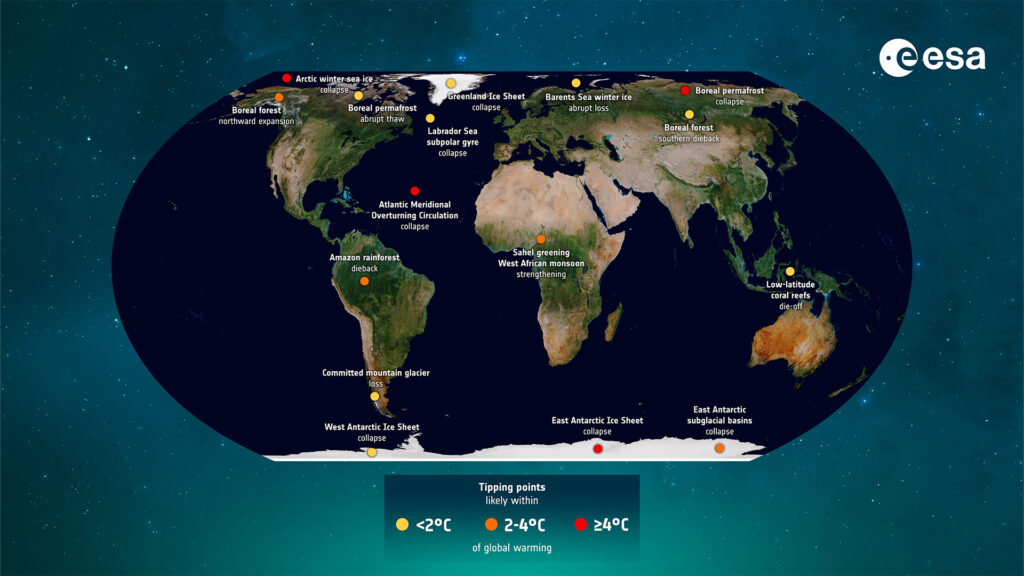
The research examines 16 crucial Earth systems, such as oceans, ice sheets, and forests, which risk destabilization with continued warming. A significant die-off of the Amazon rainforest or coral reefs would mean reduced carbon dioxide absorption, setting off a warming domino effect.
Lead author William Ripple, an ecology professor at Oregon State University, describes the potential scenario as a “global tipping point.” He explains that the climate could sustain its warming even if emissions decrease, likening it to a swing pushed so hard it hesitates at the top, indicating a loss of control.
Ripple notes, “What typically took thousands of years is now happening in decades.” Human activity is shifting Earth’s climate away from 11,000 years of stability, marked by favorable conditions for agriculture and societal growth.
Recent climate models might underestimate the Earth’s sensitivity to warming, Ripple suggests. He emphasizes the urgency for policymakers and the public to acknowledge these developments.
Earlier this year, climate experts called for stricter climate targets, urging a 1-degree Celsius limit on human-induced warming. This is more ambitious than the 1.5 to 2 degrees Celsius target from the Paris Agreement. Scientists have also reported diminishing Earth’s reflectivity and changing ocean currents that destabilize global climate systems.
Reinhard Steurer, a climate policy professor, highlights the challenge of conveying these scientific warnings in a “post-truth era.” He stresses the importance of continued scientific discourse, despite political and social hurdles.
The study clarifies that a self-sustaining hothouse trajectory doesn’t equate to a Hothouse Earth state, which would involve a hotter global climate equilibrium.
No Good Analog Climates
Instead of a single prediction, the paper compiles decades of research showing how interconnected climate components can amplify each other’s stress, potentially locking Earth into a warming loop.
Historically, Earth experienced hothouse climates, but co-author Johan Rockström suggests the current situation is unique due to the starting point being already warm. This could result in a global temperature rise of 4 to 6 degrees Celsius over pre-industrial levels, far exceeding current projections.
Rockström points out that human-caused warming is occurring much faster than past climate changes and is primarily driven by greenhouse gas emissions. The Earth is losing natural buffers that previously mitigated climate fluctuations, and recent extremes suggest the climate might react more intensely than before.
Climate scientist James Hansen also noted the quickening pace of warming, predicting potential new temperature records in upcoming years due to current oceanic shifts.
Hansen advises against pessimism, urging for a “realistic understanding of the climate situation” as a crucial step for effective climate action.
Rockström concludes that climate stability is no longer assured, and decisions made now will impact future generations.
Original Story at insideclimatenews.org