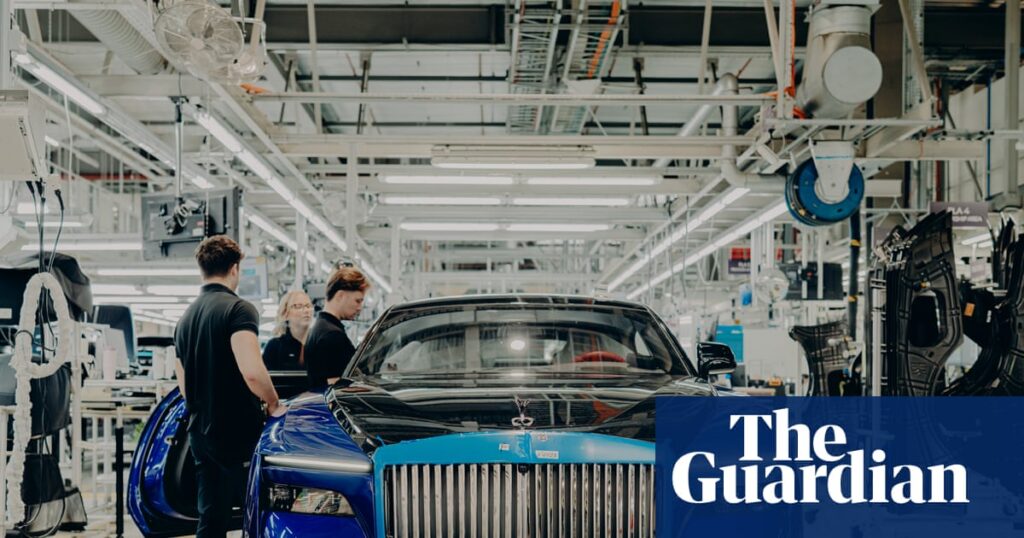
Rolls-Royce, a name synonymous with luxury and prestige, continues to captivate the world’s elite, from royalty to Hollywood stars. Renowned for its bespoke creations, the carmaker’s Goodwood factory in West Sussex is a hub of innovation where customer requests become increasingly extravagant, such as interiors adorned with thousands of feathers or personalized homages to pets.
Despite the growing demand, Rolls-Royce’s workforce is feeling the strain, prompting a significant expansion of its Goodwood facility. This endeavor is part of a £300 million investment by its owner, BMW, aimed at securing the company’s future in the UK. With a younger clientele, many of whom have amassed fortunes in technology, the average age of a Rolls-Royce buyer has decreased to 43 from 56 in 2010. “Never has there been so much wealth created so quickly at such a young age,” states Julian Jenkins, Rolls-Royce’s director of sales and brand.
The push for customisation reflects a broader trend in UK manufacturing, which remains a vital part of the economy. This sector recently contributed to a surprise 0.8% growth in the UK GDP for August, defying expectations. Rolls-Royce’s ability to meet unique customer demands, such as a car featuring a bitcoin symbol or another celebrating a beloved Labrador, underscores the company’s adaptability to evolving tastes.
With four models in its lineup, including the Phantom, Cullinan, Spectre, and Ghost, the average price for a Rolls-Royce has surged to about £500,000, driven by custom demands that can elevate prices by 25% or more. “The limits are set by the client,” Jenkins explains, noting that some complex commissions can take years to complete, adding significant value in the process.
Rolls-Royce’s history of excellence dates back to 1904, and by 1907, the company was already hailed for its reliability. Today, it stands as a benchmark of quality, with its Phantom model celebrating a century of production. The brand’s journey has seen it survive financial difficulties and changes in ownership, including its acquisition by BMW in 1998. The Goodwood factory, opened in 2003, now produces thousands of vehicles annually, fulfilling the vision of its founders.
While Rolls-Royce remains a British icon, it benefits from the technological synergies with BMW, particularly in areas such as battery research. However, the brand faces challenges, including competition from Chinese manufacturers and economic pressures. The company has also had to adjust its plans for electrification, having scrapped its 2030 target for an all-electric lineup.
The Goodwood factory’s latest upgrade focuses on meeting the intricate demands of its clients rather than boosting production volume. Each vehicle is crafted to order, involving the skills of 2,500 workers over a meticulous assembly process. The art of customisation is taken to new heights with features like starlit ceilings and handcrafted designs, overseen by artisans like Andrew Hopkins, who embraces the varied tastes of clients without judgment.
Rolls-Royce’s allure continues to attract high-profile figures, from sports stars to celebrities like Kylie Jenner. Despite economic slowdowns, particularly in China, the brand still draws young, affluent buyers. Jenkins notes the rapid wealth accumulation among these individuals, emphasizing its impact on the company’s prosperity. “It’s a fact, isn’t it?” Jenkins remarks, acknowledging the implications of concentrated wealth on society and the luxury market.
Original Story at www.theguardian.com