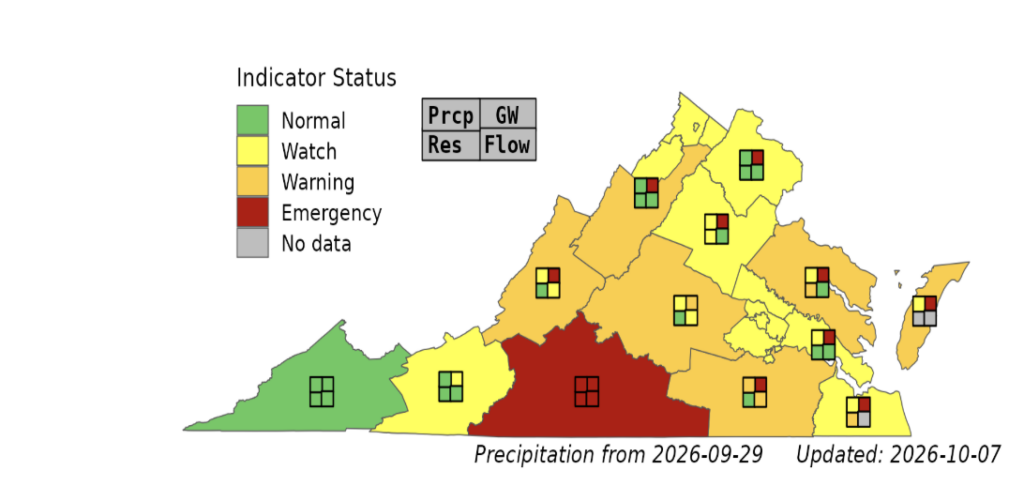
For many Virginians, recent rainfall may have felt like a sign that the state’s long drought was finally easing — but for residents of the Roanoke region, that relief has not arrived. As of early October 2026, the Roanoke area remains under emergency drought conditions, even as other parts of the commonwealth have seen meaningful precipitation.
Emergency drought designation is the most severe classification issued by the state, signaling that water supplies are under serious stress and that immediate conservation measures are in effect. The persistence of this status in the Roanoke region highlights how unevenly drought conditions can be distributed across a state — a pattern that has defined Virginia’s water crisis throughout 2026.
A Drought That Has Lasted Months
Virginia’s drought troubles did not begin recently. By May 2026, Virginia Mercury reporting confirmed that over 80% of the state was experiencing severe drought conditions, a widespread crisis that prompted concern from water managers, farmers, and local officials alike. Some relief emerged in the following weeks — May rains helped ease conditions in parts of the state — but dry conditions continued to persist well into the summer and fall months.
For the Roanoke region specifically, that easing never fully materialized. While rainfall redistributed some pressure in other Virginia localities, Roanoke’s water situation remained critical enough to sustain an emergency-level designation through October 8, 2026, the date of the latest reporting by Shannon Heckt, an environment and energy reporter whose coverage has tracked Virginia’s drought from its early stages.
Statewide Drought Has Touched Every Sector
The breadth of Virginia’s drought crisis has drawn scrutiny across multiple areas of public life. In June 2026, reporting revealed that data centers — a booming industry in Virginia — were subject to the same water use restrictions as all other customers during the drought, underscoring just how seriously authorities were treating conservation requirements. No sector was exempt from the pressure to reduce water consumption as reservoirs and groundwater supplies remained strained.
This statewide context makes the Roanoke region’s continued emergency status all the more significant. Even as conditions improved elsewhere and some drought classifications were downgraded in other parts of Virginia, Roanoke’s situation has remained in the most severe category, placing ongoing demands on local water systems and the communities that depend on them.
Virginia Mercury, which is part of States Newsroom — the nation’s largest state-focused nonprofit news organization — has provided continuous coverage of the drought’s progression across the state throughout 2026. That reporting has documented both the scale of the crisis and the ways in which its impact has varied significantly by region, with some communities finding temporary relief while others, like Roanoke, have remained under the most serious emergency designations.
Residents in drought-affected areas are encouraged to follow local water authority guidance on conservation measures, which remain in effect as long as emergency conditions persist.