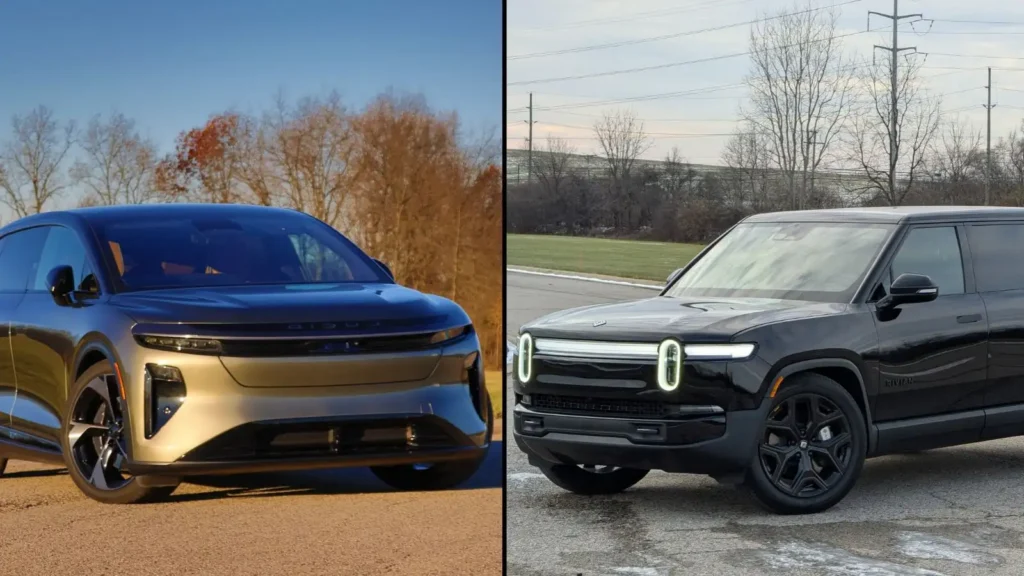
Comparing the Rivian R1S and Lucid Gravity: Which Three-Row EV Suits You?
In the evolving landscape of electric vehicles, the Rivian R1S and Lucid Gravity stand out with their unique offerings. While both are three-row SUVs designed for families, they cater to diverse preferences in performance, design, and technology. Here’s a detailed look at how these two models stack up against each other.
Performance and Range
Horsepower: The Lucid Gravity takes the lead with a maximum of 1,070 horsepower in its GT-S configuration, slightly edging out the Rivian R1S, which offers up to 1,025 horsepower in its Quad setup.
Acceleration: Despite its lower horsepower, the R1S accelerates faster, reaching 60 mph in just 2.6 seconds compared to the Gravity’s 3.1 seconds.
Range: The Gravity also offers a longer range, with a maximum of 450 miles on a single charge, surpassing the R1S’s 410 miles.
Design and Dimensions
The Rivian R1S is the larger of the two, measuring 2.6 inches longer and offering a wheelbase that’s 1.6 inches longer than the Gravity. It also boasts a significant ground clearance of up to 14.9 inches, compared to Gravity’s 9.3 inches.
The R1S presents a traditional SUV look with its distinctive oval headlights and upright body, akin to its sibling, the R1T pickup. In contrast, the Gravity features a more aerodynamic design, resembling a minivan with its cab-forward layout but still offering ample space for a large family.
Interior Space and Technology
Inside, the Gravity provides more legroom and headroom in the second row, while the R1S offers more shoulder room across all rows. Cargo capacity is greater in the Gravity, but the R1S comes standard with three rows compared to the Gravity’s optional third row.
Both vehicles feature advanced tech, such as heated front seats, built-in navigation, and wireless charging. The R1S sports a 12.3-inch digital gauge cluster with a 15.6-inch infotainment screen, while the Gravity hosts a 34-inch display combining multiple functionalities.
Infotainment and Control Systems
Both SUVs use custom interfaces built on Google’s Android Automotive OS but without Google Automotive Services. Lucid includes Apple CarPlay and Android Auto, unlike Rivian. Control interfaces also differ, with Rivian favoring touchscreen controls for most functions, whereas Lucid incorporates physical controls for essentials.
Safety Features and Driving Experience
Both models include standard adaptive cruise control and automatic emergency braking, with variations in additional safety features. The R1S is equipped with a surround-view camera and lane-keeping assist, while the Gravity offers speed limit assist and traffic-sign recognition, among others.
Driving experiences differ, with the R1S designed for adventurous off-road trips and the Gravity favoring urban and highway driving with its compliant ride.
Pricing and Options
Starting at $79,900, the Lucid Gravity is priced lower than the Rivian R1S, which starts at $85,885. However, the Gravity GT-S tops the range at $125,900, slightly more than the R1S Quad at $123,885. Both vehicles offer various luxury options, enhancing their appeal but also increasing their price.
For further details on the Rivian R1S and Lucid Gravity, explore their respective model hubs.
Original Story at www.greencars.com