Coastal Cities in Africa Face Growing Flood Risks by Mid-Century
New research warns that over seven million residents in Africa’s coastal megacities might confront significant flooding risks by 2050, a consequence of both rising sea levels and sinking land.
The study, available in Science Advances, evaluates flooding threats in 20 of Africa’s largest coastal cities by integrating satellite data with sea level rise predictions.
Under a moderate climate warming scenario, the study anticipates an “extreme sea level event” could jeopardize one million buildings and $180 billion in assets. This risk is particularly high in Lagos, Nigeria, and Alexandria, Egypt.
Lagos and Alexandria alone might see five million people and $150 billion in assets at risk by mid-century.
Human-induced activities, such as groundwater extraction and fossil fuel drilling, contribute to land subsidence. This phenomenon, along with natural seismic or volcanic activities, can alter land elevation, intensifying the impact of rising sea levels.
The researchers utilized over 4,000 satellite images to measure the rate of land elevation changes along Africa’s coastlines.
The study identifies Lagos and Alexandria as significant “subsidence hotspots,” with sinking rates of 5.2mm and 6.3mm per year, respectively. These rates are akin to those observed in Southeast Asian cities such as Jakarta and Manila.
To assess regional sea level changes, the research combined these subsidence rates with sea level rise forecasts from the Intergovernmental Panel on Climate Change’s sixth assessment report, across various emissions scenarios.
Using 2020 data on population, building footprints, and GDP per capita, the study estimates the extent of each city’s exposure to future flooding events, assuming no changes to the cities themselves.
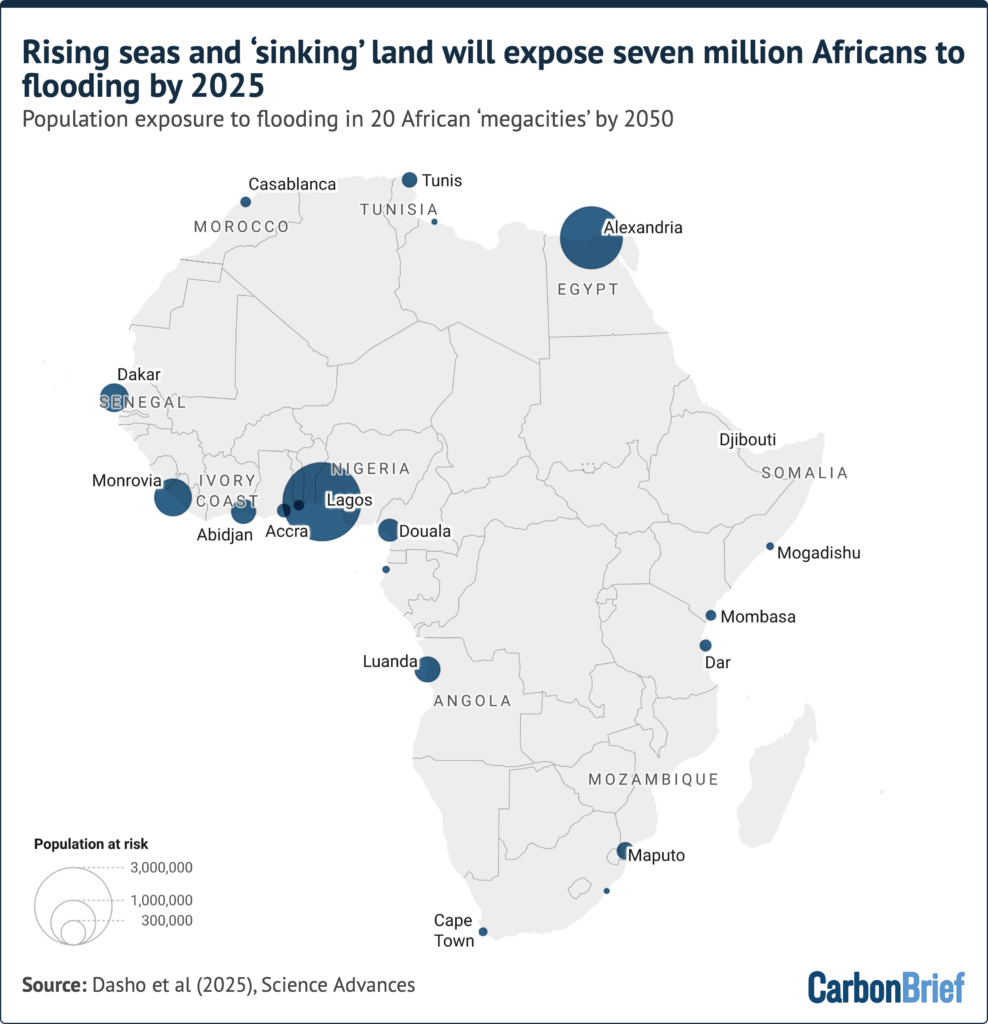
Although Lagos and Alexandria are most at risk, cities like Djibouti City, Mogadishu, and Tripoli face lower economic exposure due to smaller populations and infrastructure.
Lead researcher Oluwaseyi Dasho, a PhD candidate at Virginia Tech, explains that the study holds 2020 population and city data constant to isolate the effects of sea level rise and land movement on flood exposure.
Dasho notes that migration from threatened areas or continued urban growth could alter these estimates. Africa’s urban population is projected to double by 2050, growing at an average annual rate of 3.5%.
The flood model does not factor in potential coastal defenses, presenting a worst-case scenario of physical impact.
The study highlights the scarcity of consistent subsidence monitoring in African coastal cities due to limited local data. The authors suggest their satellite-based method could be applied to other data-scarce coastal regions worldwide.
Original Story at www.carbonbrief.org