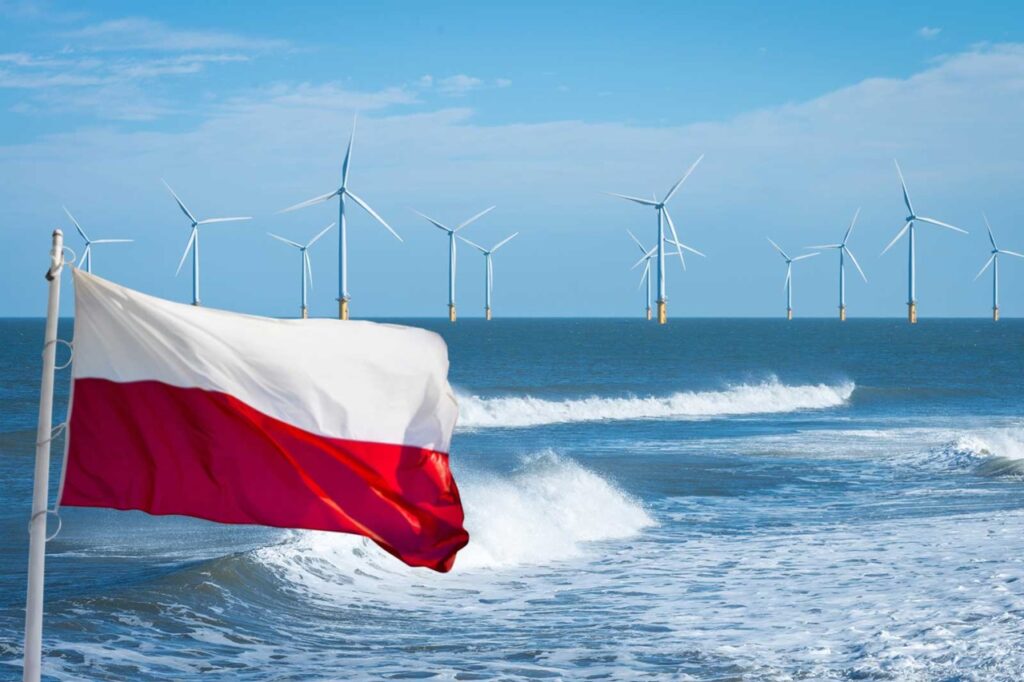
The Polish government has launched a new “local content” framework to boost the share of domestically generated value in large-scale investments, including energy projects, by changing procurement practices and evaluation criteria.
Prime Minister Donald Tusk announced on April 10 that the government aims to prioritize Polish companies in procurement processes involving public institutions and state-owned enterprises.
Minister of State Assets Wojciech Balczun detailed the initiative, defining local content as the value of goods or services produced by a domestic entity.
The Ministry established criteria for a company to qualify as a domestic entity: over 50% of annual turnover in Poland; Polish-based owner; principal business location in Poland; tax residency in Poland; more than 50% of employees paying taxes and social security in Poland; a registered office in Poland, and at least three years of continuous operation.
“These criteria will have specific weights, and we will assess the domestic content’s degree in the overall composition. This should be reflected in the tender specifications prepared by contracting authorities – both state-owned companies and local governments,” said Wojciech Balczun, Poland’s Minister of State Assets.
The framework aims to comply with EU rules while maximizing the domestic component of investments, Balczun explained.
The Minister noted a shift from prioritizing price in procurement decisions to considering local employment, supply chains, carbon footprint, and economic impact.
The government will introduce a Local Content Code of Good Practice, offering recommendations for state-owned companies on integrating these criteria. Guidelines and performance indicators for management boards will accompany the code.
The Ministry plans to develop a monitoring system in collaboration with Poland’s Central Statistical Office to measure local content in projects. A pilot phase will track progress over time.
The announcement follows a review of major investment programs, including offshore wind, where the Ministry found foreign contractors have dominated project value, leaving limited participation for Polish companies.
“We lacked competencies in [offshore wind], but analyses showed the public sector was the contracting authority, with foreign firms becoming primary beneficiaries. Risks and costs were borne by Poland, with minimal participation in projects,” said the Minister of State Assets.
The Polish Offshore Wind Industry Chamber (PIMEW) welcomed the local content plan and noted it had advocated for this change for years.
Poland is set to launch its first offshore wind farm this year with the 1.2 GW Baltic Power project by Polish company Orlen and Canadian Northland Power, scheduled to be operational in the latter half of 2026.
Development has accelerated on the 1.5 GW Baltica 2 project by PGE and Ørsted, set for completion in 2027, and Ocean Winds’ 390 MW BC-Wind project, planned for 2028.
Offshore construction began on 1.4 GW Bałtyk 2 and Bałtyk 3 projects by Equinor and Polenergia early this year.
In December 2025, the Polish government awarded Contracts for Difference (CfDs) to three projects: Baltica 9 (by PGE), Baltic East (by Orlen Group), and Bałtyk 1 (a joint venture between Equinor and Polenergia).
The first power from these new offshore wind farms is expected by December 2032.
Following the CfD award, PGE acquired a 350 MW project site from RWE, adjacent to its Baltica 9 site.
Original Story at www.offshorewind.biz