Innovative Organ-on-a-Chip Platform Paves Way for Chemical Toxicity Testing
In a significant advancement in environmental chemical assessment, scientists have unveiled a novel organ-on-a-chip (OOC) system designed to replace traditional animal testing. This new platform is set to revolutionize how toxicity is evaluated for the numerous chemicals encountered in daily life.
SEOUL, South Korea, Nov. 20, 2026 /PRNewswire/ — Current methods of assessing chemical toxicity heavily rely on animal testing, which is not only expensive and time-consuming but also limited due to species-specific differences. A breakthrough by researchers at Seoul National University of Science and Technology (SeoulTech) addresses these challenges with their modular liver-on-a-chip (LOC) platform.
Organ-on-a-chip systems utilize microfluidics technology to replicate human tissue environments closely, offering a more applicable alternative for toxicity assessments. However, their complexity, particularly in flow control and biological replication, has hampered widespread adoption.
Professor Ki-Tae Kim and PhD candidate Jiyun Kang spearheaded the development of the LOC system at SeoulTech. Prof. Kim notes, “The use of organ-on-a-chip platforms for environmental chemical assessment has advanced slowly since testing many chemicals at multiple concentrations puts different demands on the system.” Their findings, published in Environmental Science & Technology, offer solutions to these challenges.
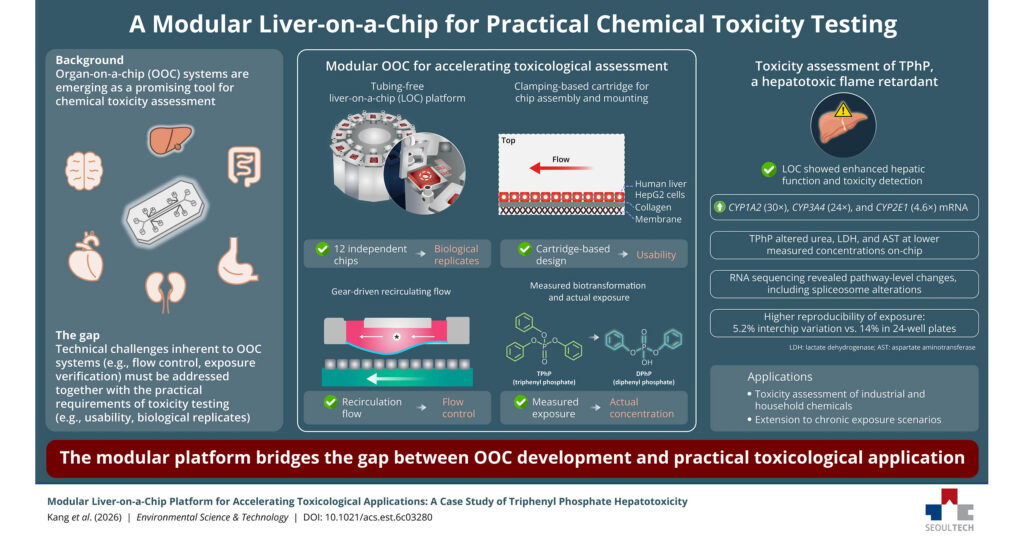
This novel LOC platform accommodates 12 cartridge-based chips, eliminating the need for complex tubing. Each chip features a unique clamping-based mechanism and supports independent unidirectional recirculating flow. This setup facilitates continuous and consistent exposure to chemicals, mimicking more accurately the dynamic biological conditions.
When compared with traditional methods, the LOC platform showed enhanced hepatic functionality, with increased expression of key liver enzyme mRNA. The platform was tested with triphenyl phosphate (TPhP), a flame retardant known to affect liver function. The results demonstrated significant changes in hepatic markers at lower concentrations than those observed in static plate cultures.
RNA sequencing further revealed significant alterations in biological pathways linked to TPhP-induced liver toxicity, underscoring the platform’s sensitivity and accuracy. Prof. Kim highlights, “Our platform can support human toxicity assessment based on real cell exposure, enabling next generation risk assessment.“
The LOC platform represents a promising tool for advancing toxicity testing, potentially reducing reliance on animal models and providing insights into chronic and long-term toxicological effects.
Reference
Title of original paper: Modular Liver-on-a-Chip Platform for Accelerating Toxicological Applications: A Case Study of Triphenyl Phosphate Hepatotoxicity
Journal: Environmental Science & Technology
DOI: https://doi.org/10.1021/acs.est.6c03280
About the institute Seoul National University of Science and Technology (SEOULTECH)
Website: https://en.seoultech.ac.kr/
Media Contact:
Seo-Hee Yoon
82-2 – 970 – 9166
[email protected]
SOURCE Seoul National University of Science and Technology
Original Story at www.prnewswire.com