The rapid advancement of artificial intelligence in the United States is facing a critical challenge that its Chinese counterparts do not. This issue, as highlighted by Elon Musk, revolves around a fundamental resource constraint.
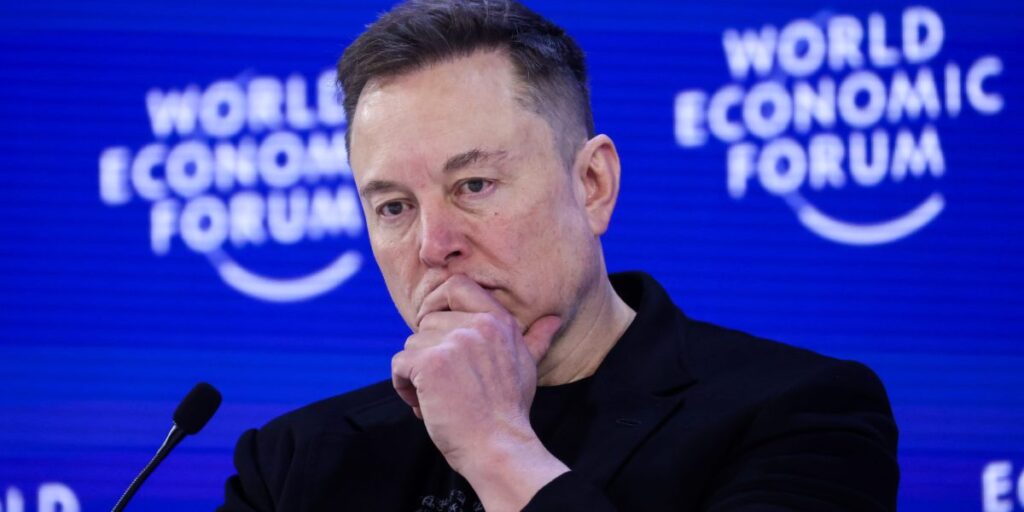
During a discussion in Davos, Switzerland, with BlackRock CEO Larry Fink, Musk pointed out that while AI chip production is growing rapidly, the U.S. lacks enough electrical power to support AI data centers effectively. This shortage in power supply is a significant bottleneck in the training and deployment of AI models.
Musk emphasized, “I think the limiting factor for AI deployment is fundamentally electrical power.” He predicted that the U.S. might soon produce more chips than it can power, potentially as soon as later this year.
The American electrical grid, characterized by its outdated and underfunded infrastructure, struggles to meet the increasing power demands of tech companies. This situation has led to concerns about an AI bubble and a belief that the U.S. is losing ground to China in the tech race, as reported by investors.
For instance, two major data centers in Santa Clara, California, where Nvidia is headquartered, might remain unused for years due to power supply issues. The resulting demand surge, paired with the need for infrastructure upgrades, has also led to higher electricity costs for the average American.
In response to these challenges, the Trump administration, along with 13 bipartisan governors, has urged PJM Interconnection, the operator of the country’s largest grid, to enhance power supply. They also proposed an auction for tech firms to secure 15-year contracts for power plant construction, shifting electricity costs from consumers to data center operators.
Interior Secretary Doug Burgum remarked, “We know that with the demands of AI…it’s going to transform every job and every company and every industry.” However, he stressed the need for adequate power to compete with China.
President Donald Trump, speaking in Davos, encouraged tech companies to build nuclear plants to support the AI boom, promising swift approvals, despite the usual lengthy process.
Why is the U.S. losing the production capacity battle with China?
As many fear, China’s AI sector is not constrained by the same power limitations. The country relies heavily on solar energy, which is cheaper and quicker to deploy than nuclear power, with fewer safety concerns.
Musk noted, “China’s growth in electricity is tremendous.”
In pursuit of expanding the U.S. solar capacity by 100 gigawatts, Musk has engaged with China to procure solar panels for Tesla. CNBC and Reuters reported Tesla’s discussions with Chinese suppliers like Suzhou Maxwell Technologies for $2.9 billion worth of solar equipment.
Data from the Global Energy Monitor’s Global Solar Power Tracker indicates China has nearly four times more solar power capacity than the U.S., with a projected output of 1,118,442 MWac compared to the U.S.’s 237,947 MWac.
Musk stated, “Solar is by far the biggest source of energy.”
According to Musk, a 100-mile-by-100-mile solar field could power the entire U.S. However, U.S. policies have hindered solar energy adoption. The Trump administration has ended subsidies for renewable energy sources, claiming they compromise grid reliability, and imposed hefty tariffs on Asian solar equipment.
A study from the National Bureau of Economic Research indicated these tariffs increased energy costs and hindered solar adoption in the U.S.
Musk commented, “Unfortunately, in the U.S., the tariff barriers for solar are extremely high.”
Original Story at fortune.com