Exploring Sodium-Metal Batteries as a Viable Alternative to Lithium-Ion
As the demand for renewable energy and high-power digital technologies escalates, the need for efficient and cost-effective energy storage systems has become crucial. Current reliance on lithium-ion batteries, which contain critical minerals such as lithium, cobalt, nickel, and graphite, poses challenges due to potential supply chain disruptions. In response, researchers at MIT, led by Professor Ju Li, are investigating sodium-metal batteries as a promising alternative.
Sodium, being roughly 1,000 times more abundant than lithium and significantly cheaper, presents an attractive option. However, sodium metal’s high reactivity has made achieving long-term stability and fast cycling difficult. A study published in Joule by the MIT team addresses these challenges by focusing on the role of electrolytes in sodium-metal batteries.
Understanding Electrolyte Challenges
Electrolytes in batteries function as the medium allowing ions to move between the anode and cathode. Ju Li explains, “The electrolyte is supposed to just transmit those ions. It’s supposed to be an ion conductor.” Unfortunately, common electrolytes often partake in unwanted chemical reactions with the electrodes, compromising battery stability. These reactions can lead to the formation of insoluble compounds, blocking ion transport and causing eventual battery failure, as noted by Weiyin Chen, a postdoc and lead author of the study.
An initial breakthrough came in 2021 when the MIT team discovered a “sulfonamide” molecule, DMTMSA, that remained stable in lithium batteries. Building on this discovery, the team explored whether similar molecules could enhance sodium batteries, aiming for stability alongside fast charging and discharging capabilities.
Solvent Size Matters
The research team sought to identify smaller solvent molecules that could facilitate faster ion movement without compromising stability. Chen illustrates this with an analogy: ions can move more swiftly when surrounded by smaller solvents, akin to navigating a crowd with a compact backpack rather than a bulky suitcase. This design approach aims to optimize ion transport for rapid charging and discharging.
Despite a trade-off between ion transport speed and electrolyte stability, Li notes that reducing solvent size offers a new solution to this challenge. The team searched for molecules similar to DMTMSA, aiming to find smaller candidates retaining the desired stability.
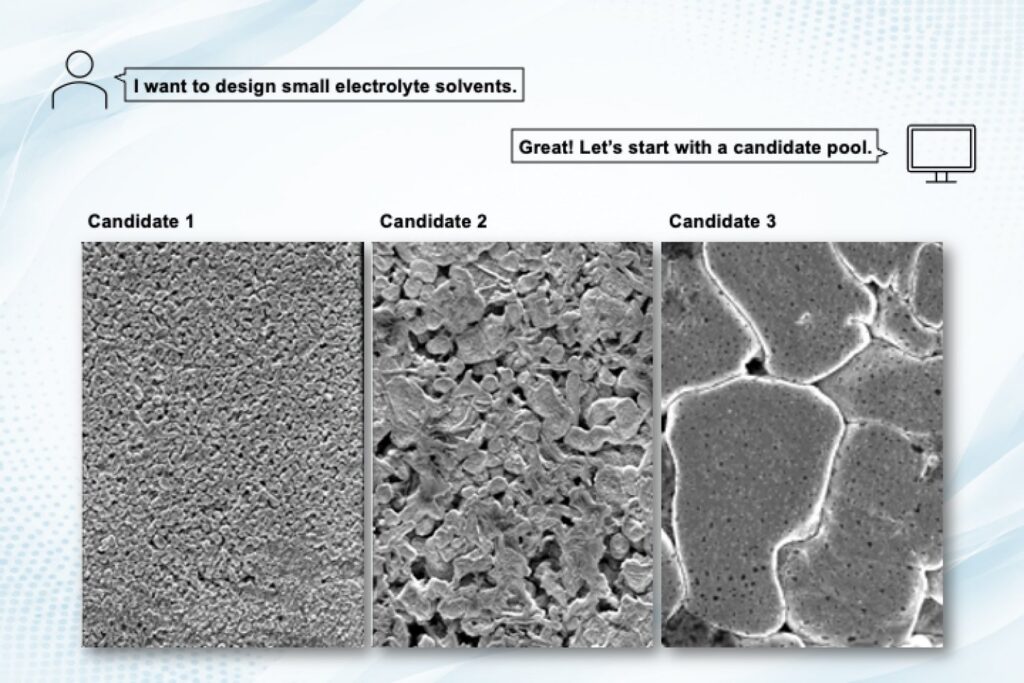
Utilizing an AI-guided algorithm, PhD student Chia-Wei Hsu generated 100,000 molecular candidates, narrowing them to 200 based on technical criteria. Following experimental tests, DMFSA emerged as the most promising solvent, being both the smallest and most effective.
Future Implications and Broader Applications
Jinhyuk Lee from McGill University, not involved in the study, highlights the significance of the research, stating it “addresses one of the most persistent challenges in battery research: improving battery performance at high charging and discharging rates without sacrificing long-term stability.”
MIT researchers are now seeking even better solvents, using DMFSA as a starting reference. Their overarching goal is to pioneer a new approach to electrolyte design, emphasizing solvent size and molecular similarity. This methodology, while demonstrated with sodium-metal batteries, could influence future energy storage technologies more broadly.
The research received support from the National Research Foundation of Korea and a U.S. National Science Foundation fellowship, with resources from the MIT.nano Characterization Facilities.
Original Story at news.mit.edu