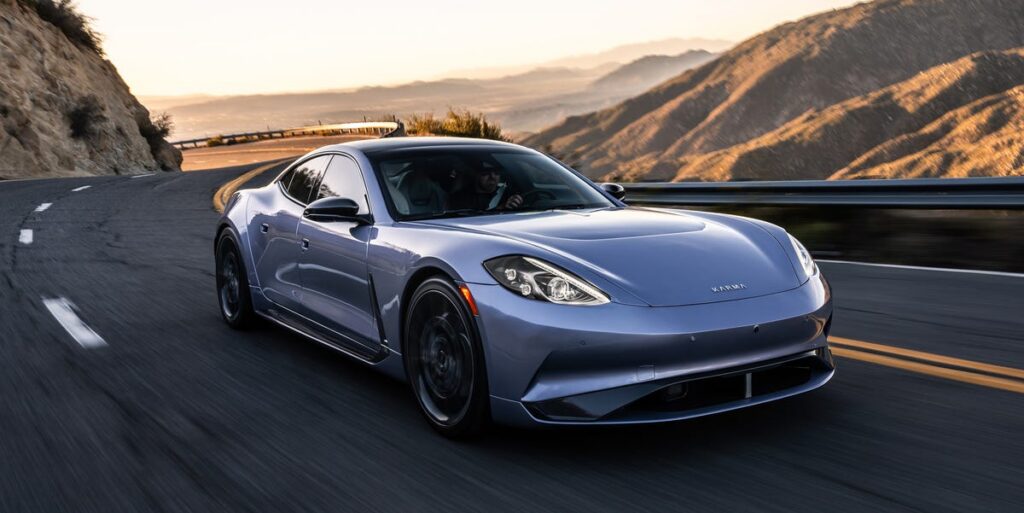
When Henrik Fisker introduced the Karma plug-in hybrid sedan in 2011, he likely did not anticipate how aptly the vehicle’s name would reflect its journey. Like the concept of karma in Hinduism, the car has experienced a form of reincarnation. Although Fisker’s original venture concluded in 2014, the Karma brand found new life under Wanxiang Group, a Chinese automotive parts giant. The Karma Revero, launched in 2016, marked this revival. Despite ongoing updates, the car struggled to gain traction in the competitive market.
Fast forward to the present, and Karma Automotive is again attempting a comeback with the introduction of the 2027 Gyesera. Under the leadership of Marques McCammon, who joined as president in 2023, the Gyesera represents a new chapter for the company. While the vehicle shares some features with its predecessors, it boasts improvements such as an updated powertrain and revamped design that aim to rejuvenate the brand’s prospects. During a test drive in Las Vegas, the Gyesera impressed with its unique appeal and versatile powertrain, although it still grapples with some persistent issues.
The Gyesera was initially revealed as a fully electric vehicle in 2024, but Karma Automotive shifted its focus after observing slower-than-expected adoption of electric vehicles in the luxury segment. The Gyesera now features the fifth generation of Karma’s plug-in hybrid technology. It is powered by a turbocharged 1.5-liter three-cylinder engine, sourced from the BMW i8, which serves as a generator for a 28-kWh battery. This battery supplies energy to two motors on the rear axle.
Generating 566 horsepower, the Gyesera surpasses the Revero’s 536 hp and produces 594 pound-feet of torque, an increase of 44. It accelerates from zero to 60 mph in 3.7 seconds, faster than the Revero’s 4.5 seconds, and reaches a top speed of 150 mph. The vehicle is capable of 80 miles of electric-only driving, with a total range of 360 miles on gasoline. The battery supports DC fast-charging up to 50 kilowatts and AC charging at 6.6 kilowatts.
On approach, the Gyesera’s design makes an immediate impact. Echoing the original Fisker Karma, it features an evolved aluminum spaceframe chassis. The car’s design is striking, with an elongated hood and a roofline tapering over robust rear haunches. The body combines aluminum and carbon fiber, the latter used for the hood, rear decklid, and other key components.
The Gyesera’s design includes fresh elements. A defined line beneath the headlights and carbon-fiber trim enhance the front, while a “Comet Line” across the hood adds a dynamic element and serves as an engine bay vent. Unpainted carbon fiber accents further emphasize its premium construction.
Wheel options include 21-inch forged aluminum wheels from HRE and a 22-inch variant. At the rear, the vehicle features slim taillights and a discreet diffuser, adding to its visual allure. The Gyesera’s presence in Las Vegas was particularly noticeable, attracting attention even among other luxury vehicles.
Inside, Karma has redesigned the dashboard, opting for rectangular vents over the Revero’s circular ones. The 10.1-inch touchscreen, paired with a 12.3-inch digital gauge cluster, is repositioned for improved usability. Despite some familiar elements, like the gear selector and steering wheel, the interior showcases high-quality materials. Bridge of Weir leather and Alcantara microsuede enhance the cabin’s luxury feel, though glossy black plastic detracts slightly from the overall quality.
While most functions are digitally controlled, the interface is user-friendly, with the screen easily accessible to the driver. Although physical buttons would add a touch of sophistication, the system, supporting wireless phone mirroring, performs well. Additional features include a wireless charger and USB-C ports.
The battery resides in the space traditionally occupied by a transmission tunnel, enabling a low seating position. However, the seats are narrow, and the non-adjustable headrest sits low, which may not suit all users. Despite the ample bolstering, a more spacious seat design would better suit a grand tourer.
The center console extends to the rear, housing two additional bucket seats. Although Karma claims improved legroom, the back seats remain cramped for adults. The trunk space is similarly restricted, with a high floor and narrow opening.
Driving the Gyesera is largely satisfying, with responsive controls and natural steering feedback. The accelerator provides a smooth power increase, and despite its weight and size, the car handles corners with agility.
While not matching the power of some high-end electric vehicles, the Gyesera offers a spirited drive. The rear tires occasionally lose grip, adding a playful edge to its performance. Its Brembo brakes provide strong stopping power, though feedback could be improved. Regenerative braking levels are adjustable, with the strongest setting nearing one-pedal driving.
The Gyesera offers three driving modes: Stealth, Sustain, and Sport. Stealth mode uses electric power only, while Sustain activates the engine for efficient battery maintenance. However, the engine can become loud. Sport mode maximizes battery charging and opens the exhaust, but the engine’s sound is less refined, lacking the appeal expected of a luxury vehicle. The Karma Eximius 1, with a V-8 engine, might offer a more fitting auditory experience.
Despite lacking adaptive dampers, the Gyesera’s Öhlins coil-over suspension delivers a smooth ride, maintaining comfort and control. This balance is ideal for a grand tourer, offering confidence in handling without sacrificing ride quality.
Karma Automotive’s Gyesera is a niche offering, intended as such. With 50 units expected to hit dealerships by year-end, it remains a low-volume, handcrafted model. Priced from $139,995, the test model reached $158,995 with options. Although its powertrain may not rival high-performance sedans from brands like Mercedes-AMG and Porsche, the Gyesera compensates with its eye-catching design, premium materials, and engaging drive experience, alongside the benefits of electric torque and an 80-mile electric range. This iteration marks significant progress for Karma Automotive’s evolving journey.
Original Story at www.caranddriver.com