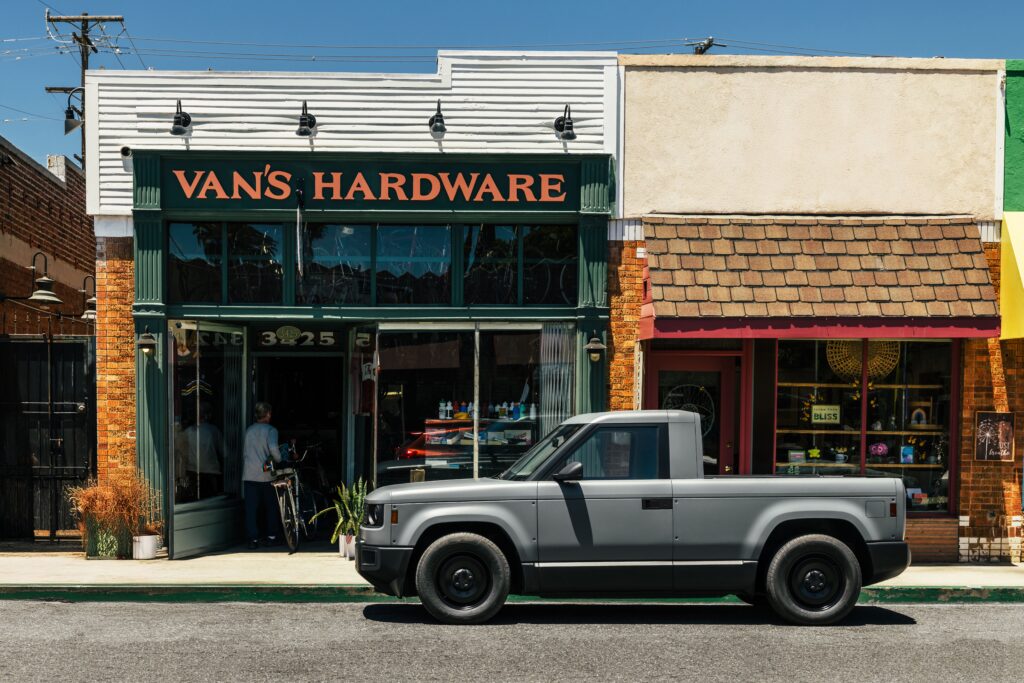
In a bold move to redefine affordability in the electric vehicle market, Slate Auto is making waves with its minimalist EV truck priced at $24,950. Spearheaded by a team of former Amazon executives and backed by Jeff Bezos, the startup has already garnered 180,000 reservations since its April 2025 debut, and 10,000 pre-orders following the price announcement last week.
The Blank Slate pickup is stripped down to essentials with no stereo or infotainment system, adaptive cruise control, or even paint. Instead, owners can purchase wraps for a fee. Additional features such as door armrests and center consoles are optional, with DIY installation guides provided by Slate or the option to have them installed at a RepairPal-certified shop for a cost. The truck offers a 205-mile range on a single charge and is compatible with the Tesla Supercharger network. Notably, the $25K price point is unprecedented, as even Tesla has yet to produce a vehicle this affordable.
Despite questions regarding the demand for low-cost EVs amid economic pressures, Slate Auto is banking on its experienced leadership and innovative “manufacturing-constrained design” strategy to succeed. This approach, driven by ex-Amazon leaders, focuses on designing vehicles with manufacturing efficiencies that reduce costs and increase appeal among consumers.
Slate Auto originates from Re:Build Manufacturing, a venture initiated in 2020 by former Amazon executive Jeff Wilke and investor Miles Arnone, aiming to revitalize domestic production at scale. Initially focused on aerospace and defense projects, Re:Build’s automotive foray aligns with reshoring manufacturing to enhance national security.
Jeff Wilke, who retired from Amazon in 2021, emphasizes the need to counter the industry’s trend of producing increasingly expensive vehicles, which he believes neglects the average American consumer. Slate Auto CEO Peter Faricy, also an Amazon alumnus, underscores the company’s commitment to frugality, highlighting cost-saving measures like eliminating paint shops and stamping plants.
More than just another EV company
Re:Build’s unexpected entry into the automotive sector is driven by a mission to reclaim U.S. industrial capabilities outsourced over decades. Wilke states, “If we don’t do it, nobody’s going to do it, and then we might as well just hand the keys to China.” This philosophy underpins Slate’s approach to affordable vehicle design, reversing traditional production sequences to prioritize factory input alongside consumer needs.
Arnone elaborates on their method: “We call it manufacturing controlled design, as opposed to design for manufacturing.” Such an approach allows Slate to operate with a leaner, more efficient structure, reducing overhead by minimizing the need for extensive engineering and administrative resources.
Jeff Bezos’ manufacturing bet
Backing Slate is Bezos Expeditions, Jeff Bezos’ family office, reflecting his broader interest in scalable manufacturing innovations. His investment in Prometheus, an AI startup developing an “artificial general engineer,” aims to expedite the design-to-production process across industries, echoing Slate’s cost-focused, efficiency-driven ethos.
However, Slate’s novel process remains untested in mass production. Reservations do not equate to sales, and with the Warsaw, Indiana plant still under construction, the viability of Slate’s model hinges on its ability to deliver consumer-ready trucks by late 2026. The plant’s break-even target of 80,000 vehicles annually poses a significant challenge for the nascent company.
Wilke and Arnone view Slate as a strategic endeavor to prevent foreign domination of the affordable car market, though such competition remains a future concern. The immediate challenge lies in generating sufficient demand to disrupt the industry, a question only time will answer.
Original Story at observer.com