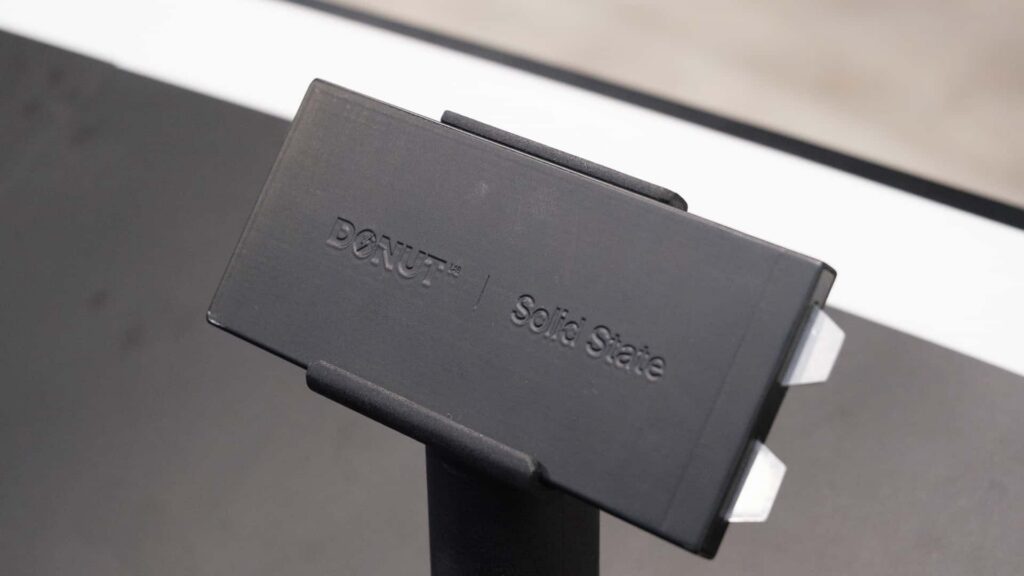
Finnish Startup’s Solid-State Battery Claims Under Scrutiny
In a recent twist within the battery technology sector, Donut Lab, a Finnish startup, is under investigation for its bold claims regarding the creation of the world’s first production-ready all-solid-state battery. The investigation, carried out by Ryan Hughes of the Ziroth YouTube channel, casts doubt on the authenticity of these claims and suggests possible misleading involvement by another company, CT Coatings.
Donut Lab had previously announced that its breakthrough solid-state battery could revolutionize electric Verge Motorcycles with unprecedented capabilities, including a five-minute charge time, a lifespan of 100,000 cycles, an energy density of 400 watt-hours per kilogram, and immunity to thermal runaway. These specifications are significantly beyond what current lithium-ion batteries can achieve, which made the startup’s assertions particularly bold.
However, the reality of mass-producing all-solid-state batteries remains distant, with major players in the industry not expecting a breakthrough until the decade’s end. This context makes Donut Lab’s claims especially surprising and, as Hughes’ investigation suggests, possibly too good to be true.
The investigation revealed that Donut Lab’s batteries might actually be high-end lithium-ion cells misrepresented as solid-state. This conclusion was reached after reviewing leaked emails, consulting with battery experts, and speaking with Lauri Peltola, a former chief commercial officer at Nordic Nano, an affiliate of Donut Lab. Peltola admitted, “Neither of the companies had, when I was still working at Nordic Nano, a deep understanding on battery chemistry and manufacturing.” He further stated that they relied heavily on information provided by Donut Lab.
Key evidence, such as the battery’s expansion curve tested at Finland’s VTT Research Institute, indicates that the batteries behave more like advanced lithium-ion cells than the claimed solid-state type. The energy density calculations also fell short of Donut Lab’s claims, aligning more closely with those of CT Coatings’ lithium-ion cells.
Battery scientists interviewed by InsideEVs after Donut Lab’s initial announcement have consistently urged caution and called for more data. The performance figures touted by Donut Lab, such as rapid charging and high-temperature tolerance, are within the capabilities of current lithium-ion technology, as demonstrated by products like the new Mercedes-AMG GT and BYD’s Blade batteries.
While major corporations like Toyota and CATL continue to invest heavily in developing genuine solid-state batteries, the prospect of a small, inexperienced startup achieving such a breakthrough remains highly unlikely.
Have a tip? Contact the author: suvrat.kothari@insideevs.com
Original Story at insideevs.com