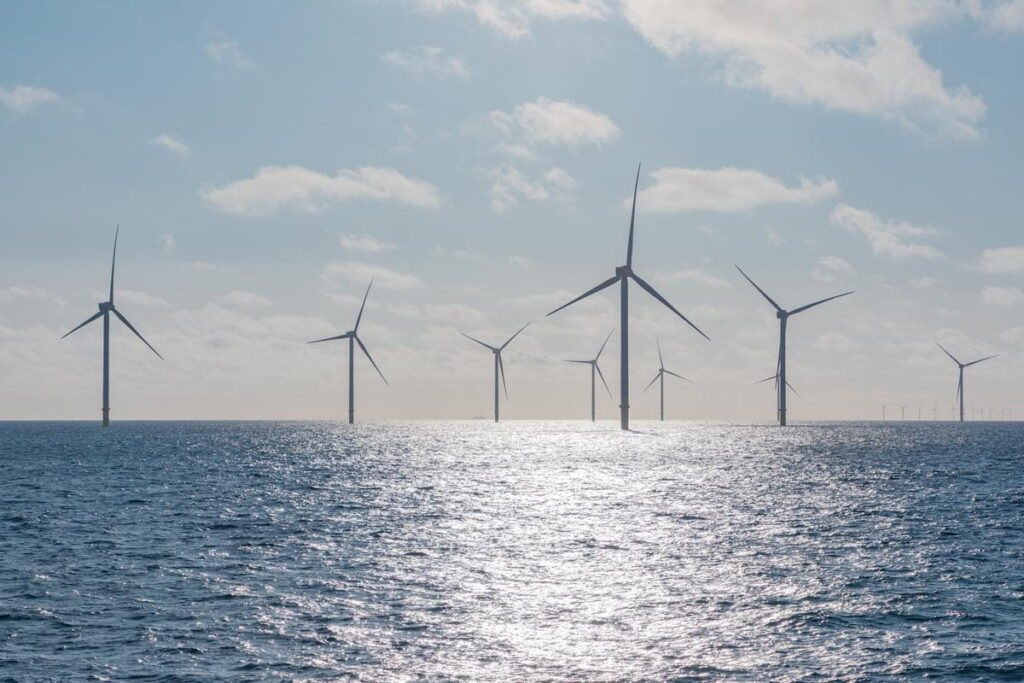
A study by the Fraunhofer Institute for Wind Energy Systems (Fraunhofer IWES) reveals that less dense offshore wind development in Germany’s Exclusive Economic Zone (EEZ) in the North Sea and relocating capacities to neighboring countries can enhance offshore wind yield and reduce costs.
The study indicates Germany’s 2045 target of 70 gigawatts (GW) will not reach its full potential under current land use plans. Although the North Sea is one of the world’s windiest areas, shading effects significantly reduce potential yields of up to 5,000 full-load hours. Wind farms in close proximity to each other further diminish wind output.
An alternative approach suggested by the German Association of Energy and Water Industries (BDEW) and the German Offshore Wind Energy Association (BWO) involves cross-border expansion and European coordination to mitigate shadowing effects. Their scenarios propose installing up to 20 GW in neighboring countries’ waters, which would supply electricity to the German grid.
Such international cooperation would boost plant capacity utilization and lower the overall construction and operational costs of wind farms. Depending on the scenario, full-load hours and yields could increase by 6 to 13 percent on average, while the cost per megawatt-hour of offshore electricity could decrease by 6 to 11 percent.
Focusing on area yield and cost efficiency could achieve an installed offshore wind capacity of 50-60 GW in the German EEZ by 2045, complemented by up to 20 GW from neighboring countries, making the 70 GW target feasible.
Follow offshoreWIND.biz on:
Original Story at www.offshorewind.biz