Imagine a world where the sun always shines and the wind perpetually blows, providing endless natural energy. However, the reality is that these energy sources are not always consistent. So, how does the energy sector maintain a steady power supply when nature takes a break?
Energy storage plays a vital role in balancing the grid and ensuring that the demand for clean electricity is met consistently. Innovations in energy storage are advancing rapidly, with technologies ranging from battery systems and pumped hydroelectric to mechanical and thermal solutions being explored to expand capacity.
“It helps to tackle the issue of variability of renewable energy generation,” states Yonna Vitanova, a senior policy analyst at RenewableUK. She explains that in situations of high wind, the grid sometimes cannot transport the vast amounts of clean power generated, necessitating solutions beyond grid upgrades to make optimal use of renewable resources in the UK.
Yet, ensuring long-term energy security remains challenging. “Resilience is ultimately the big issue,” says Robert Friel from the Institution of Engineering and Technology’s Sustainability and Net Zero Policy Centre. The challenge lies in building a reserve for rare cold spells, comparable to the storage of gas or fuel, while electrifying everything requires a resilient system.
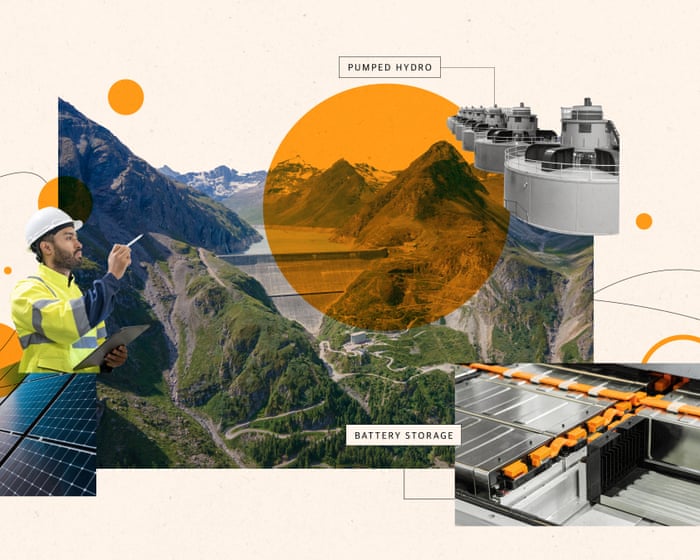
Battery Storage
Batteries are essential for managing short-term supply and demand fluctuations, helping to prevent blackouts. As daily demand rises and falls, both domestic and grid-scale battery systems can alleviate network strain and reduce the risk of overload.
The UK government aims to increase battery storage capacity to up to 27GW by 2030, building on the current 6GW. Large-scale battery plants, like the 50MW West Gourdie plant in Dundee, will be pivotal for steady energy supply.
While lithium-ion batteries are prevalent, new large-scale storage solutions are under development. Sodium-ion batteries, though bulkier and less energy-dense, are cheaper and suitable for grid applications where size and weight are less critical. Additionally, advances in solid state batteries, which are more energy-dense but have a shorter lifespan, are attracting investment and could transform the electric vehicle market. Flow batteries, which store energy in an electrolyte liquid, offer longer-term storage options.
Car batteries present another potential storage solution. Though current EV batteries have an eight-year warranty or 100,000 miles lifespan, they can be repurposed for storing solar energy once retired. Carmakers like Nissan and Toyota are already utilizing spent EV batteries in various applications, such as powering sports arenas and stores.
Pumped Hydro
Batteries alone won’t solve the storage conundrum, and traditional methods like hydropower remain valuable. Pumped hydroelectric storage uses surplus energy to pump water to elevated areas, which can be released later to generate electricity. This method is the most widely used for large-scale energy storage worldwide, with new facilities continuously coming online.
For example, the Tamega hydroelectric complex in Portugal, developed by Iberdrola, is one of Europe’s largest energy storage facilities. It features three dams, three power plants, and two wind farms, generating enough energy for 440,000 homes. Globally, pumped hydro energy accounts for almost 200GW of installed storage capacity.
In contrast, the UK has only 2.8GW of pumped hydro energy storage spread across four schemes in Scotland and Wales, and no new facilities in 40 years. This is far below the 16.6GW of long-duration electricity storage needed by 2050. Building new facilities is costly, and the UK lacks a clear market route.
Other Innovations
Emerging methods for storing and using thermal energy are promising. Heat or cold stored in materials like salts, gravel, oils, and stones can generate electricity or provide heating and cooling. Other innovative techniques involve liquefying air with excess energy, which can be stored in cryogenic tanks and released for energy use. Though in early stages, these technologies hold potential for high efficiency and versatility, offering heating and cooling benefits while helping industries reduce carbon footprints.
As storage options grow, smart systems can optimize their use. Artificial intelligence can analyze weather forecasts, prices, and demand to determine the best times for energy storage or release. “There are a lot of games at play at present about what is the right direction [for energy storage],” says Friel. “What will the mix look like – because it certainly won’t be a single solution. You need a mix of technologies that gives you resilience.”
Original Story at www.theguardian.com