
A glacier in the Alps stands as a silent witness to Earth’s climatic history, holding secrets of past air pollution and environmental changes. As global temperatures rise, researchers are in a race against time to extract and preserve this invaluable climate data before it’s lost forever.
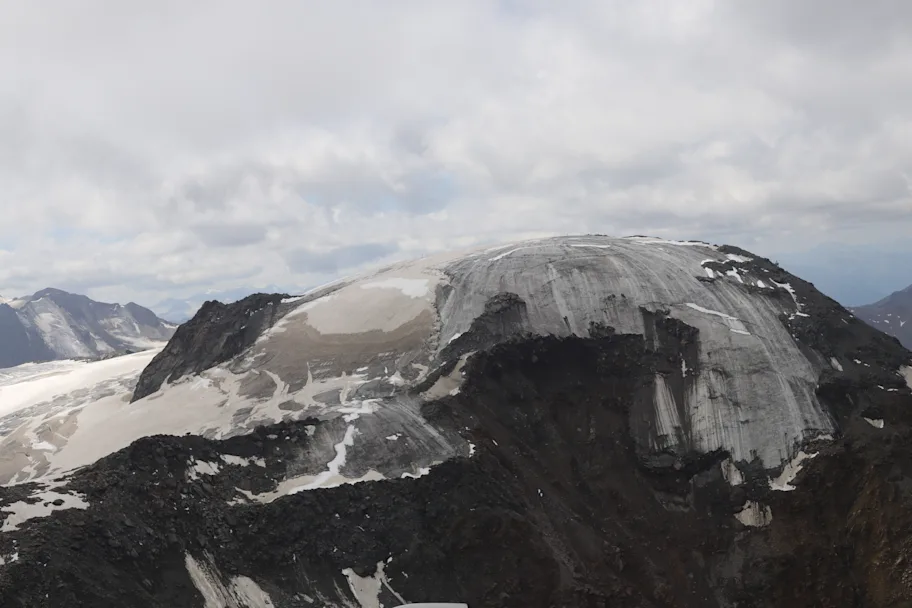
The Weißseespitze glacier, situated near the Austria-Italy border, serves as a crucial archive of climate history. By analyzing ice cores from this glacier, scientists can trace air pollution levels across millennia. However, these glaciers are rapidly melting due to climate change, prompting an urgent call from scientists to capture and preserve climate information locked within these icy layers.
“These remarkable climate archives function much like a history book: past atmospheric conditions and environmental changes are recorded in their layers,” said Dr Azzurra Spagnesi of the University Ca’ Foscari of Venice, lead author of the article in Frontiers in Earth Science. “Alpine glaciers offer a unique opportunity to investigate the critical transition between pre-industrial and industrial times, because of their proximity to human settlements.”
Unveiling the Past
During an expedition in 2019, researchers drilled a nearly 10-meter-long ice core from Weißseespitze. Analyzing argon isotopes, they determined that the ice layers formed between 1552 and 1708 CE at the surface, with the deepest layer dating between 349 BCE and 420 CE. The core was examined for 18 different elements, microcharcoal, levoglucosan, and various acids to uncover historical air pollution levels.
“Between 700 and 1200 CE, lead and other metals showed very low concentrations, reflecting the regional background of a mostly unpolluted pre-industrial environment,” explained Spagnesi. “From roughly 950 CE onward, peaks in arsenic, lead, copper, and silver appear, corresponding to periods of intensified medieval mining and smelting in the Alps and other European regions.”
“Some of the strongest metal peaks also coincide with major volcanic eruptions, as well as periods of dry climate and increased dust transport,” Spagnesi added. “This suggests that both natural events and human activities contributed to the chemical signals preserved in the ice.”
The research highlighted significant chemical pollution between 902 and 1280 CE. This coincided with increased fire activity in the region, as indicated by microcharcoal levels in nearby peat cores. “The elevated fire signal we observe during the roughly century-long drought between about 950 and 1040 CE is likely the result of several interacting factors,” said Spagnesi. These factors included dry conditions promoting vegetation cycles and intensified human activities such as land clearing and agriculture.
Despite advancements in dating techniques, Spagnesi noted, “Although the age–depth scale was substantially improved by adding 39Ar dating to the radiocarbon constraints previously used, the remaining uncertainties are still relatively large.” This complexity makes pinpointing specific events challenging.
Read and download original article
Threatened by Meltdown
While human activities such as mining have historically influenced pollution levels, natural factors like volcanic eruptions also played a role. Surprisingly, human emissions account for just 7% of the recorded pollution in the ice core, contrasting with today’s increased anthropogenic impact.
Scientists revisiting Weißseespitze in 2025 discovered the glacier’s ice was reduced to just 5.5 meters deep. This melting underscores the urgency to sample glaciers before their invaluable climate records vanish.
“Glaciers in the Ötztal Alps are projected to disappear within the coming decades,” said Spagnesi. “If glaciers disappear, the chemical and physical information they contain will be lost forever, leaving gaps in our understanding of past climate variability. In this sense, preserving glaciers is not just about protecting ice. It is about safeguarding the memory of Earth’s climate.”
REPUBLISHING GUIDELINES: Open access and sharing research is part of Frontiers’ mission. Unless otherwise noted, you can republish articles posted in the Frontiers news site — as long as you include a link back to the original research. Selling the articles is not allowed.
Original Story at www.frontiersin.org