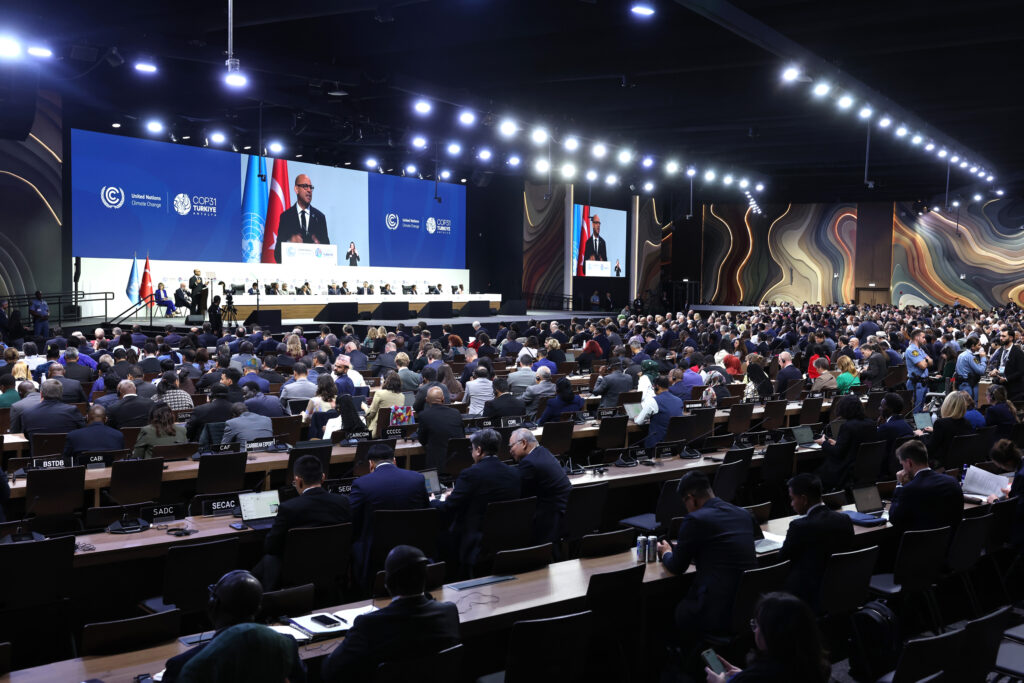
ANTALYA, Turkey—The pervasive presence of fossil fuels is evident at the United Nations’ “Conference of the Parties” climate talks, from the airplanes to the buses transporting delegates.
In Poland, coal remains a dominant energy source, while petrochemical smog has clouded Dubai’s skies during COP28. In Baku, Azerbaijan, refineries cover buildings in gray grime, and last year’s “Nature COP” in Belém, Brazil, saw diesel generators running non-stop to cool the conference halls.
The COP31 negotiations began Monday amid diesel fumes in Antalya’s busy streets, underscoring the global reliance on fossil fuels that drive the climate crisis after decades of climate talks.
This year’s conference occurs against a dire backdrop. Global temperatures have exceeded 3.6°F (2°C) above the preindustrial average. Several glaciers have vanished since last year’s talks, coastal cities face rising seas, and carbon emissions in 2026 are set to hit another peak.
Decades of missed opportunities and political compromises brought the climate crisis to its current state, according to Marc Hudson, a climate researcher in the UK. Revisiting history is crucial to understanding the crisis, he said.
In 1957, global scientists collaborated during the International Geophysical Year, and Charles Keeling developed a CO2 measurement system. A landmark paper questioned the oceans’ ability to absorb CO2 from fossil fuels.
The scientific record shows awareness of the problem nearly 70 years ago, Hudson said.
Climate Politics
The issue gained political attention in 1985 when scientists in Austria warned that rising CO2 levels could cause unprecedented climate warming, affecting agriculture, ecosystems, and people.
Governments were urged to consider policy responses, leading to the formation of the Intergovernmental Panel on Climate Change. In 1990, the panel’s first climate assessment prompted UN action.
Representatives from over 140 countries negotiated the UN Framework Convention on Climate Change. At the time, about 10 industrialized countries were responsible for 80% of historical CO2 emissions, leading to an agreement that these nations should spearhead pollution reduction without hindering poorer countries’ development.
This disagreement is central to climate diplomacy, with the United States playing a key role since the start, Hudson noted. Former President George H.W. Bush, with ties to the fossil fuel industry, was sympathetic to sectors like big auto and big oil.
France and some European countries pushed for a treaty mandating emission cuts for industrialized nations, but the U.S., Saudi Arabia, and Gulf exporters favored a weaker agreement.
In the final treaty negotiations, binding cuts were removed, allowing the U.S. to sign a “toothless” agreement, setting the stage for COP1 in Berlin.
The Kyoto Protocol
The initial climate framework aimed to stabilize emissions at 1990 levels, with hopes of a detailed follow-up agreement. Many involved never expected emissions to still be rising 30 years later, said Joanna Depledge, a University of Cambridge researcher.
U.S. involvement was crucial due to its scientific and political leadership. Despite its tough stance, the U.S. joined the U.N. framework agreement but remained hesitant to assume financial obligations for developing countries, impacting climate talks for decades.
COP1 in Berlin recognized the climate framework’s insufficiency, leading to ongoing meetings to negotiate emission-reduction targets. The Kyoto Protocol, adopted at COP3, included mandatory reductions for industrialized countries. However, the U.S. Senate’s Byrd-Hagel Resolution opposed any agreement without developing countries’ commitments, leading to President Clinton signing but not submitting it to the Senate.
In 2001, President George W. Bush decided the U.S. would not ratify the Kyoto Protocol, hindering global efforts to combat warming.
At COP15 in 2009, developing countries like India and China were close to making emissions pledges, but the pressure to sign a deal perceived as limiting their growth stalled progress.
Subsequent climate talks led to the Paris Agreement at COP21. Under this pact, countries agreed to voluntary emissions cuts and an international reporting scheme, with developed nations taking the lead in emissions reductions and supporting developing countries financially.
Why So Slow?
Since the Paris Agreement in 2015, annual talks have been sluggish, with COP26 in Glasgow marking a significant slowdown.
The slow progress stems from the divide between developed and developing countries. Economic and legal tensions over responsibility and financial obligations have entrenched these divides, hindering progress.
Another factor is the influence of fossil fuel lobbies, which have successfully slowed progress, Depledge noted.
The third hurdle is the consensus-based decision-making at U.N. climate talks, requiring unanimous approval for major decisions. This has prevented stronger decisions, especially concerning underlying science.
Original Story at insideclimatenews.org