
As offshore wind ventures into new territories, jack-up vessels are encountering increasingly challenging environments. Moving beyond the sandy soils of the North Sea, projects are now situated on dense tills, coral limestone, and exposed bedrock. These hard seabeds are pushing the limits of conventional jack-up design and installation, necessitating new engineering, simulation, and digital operations approaches.
Moving Beyond the North Sea
The global expansion of offshore wind is moving into areas with diverse seabed conditions. From the North Atlantic to Asia-Pacific and Australia, new sites offer renewable energy potential, yet present complex conditions beneath the waves.
Hard or uneven seabeds, coupled with greater water depths and long-period swells, pose challenges. Success in these regions requires a deep understanding of how jack-ups interact with the seabed. For companies like GustoMSC, known for jack-up design expertise, this evolution is an opportunity to aid the industry in safely adapting to new geological conditions.
The Hidden Complexity of Hard Seabeds
In soft soil, spudcans — the footings at the base of each jack-up leg — penetrate easily, distributing loads over a broad area. On rock or dense soil, penetration is minimal. When a spudcan contacts a hard surface, it can create peak loads that reverberate through the legs, jacking system, and hull.
These impact loads may lead to overstress or damage if not managed carefully. Uneven seabeds introduce additional risk, as partial contact or eccentric loading can trigger sliding. In areas with long-period swell waves, the risk of resonant motion amplifies impact forces during leg touchdown.
Jack-ups must operate within tighter environmental limits during installation to mitigate these effects. Crews need to assess sea states, jacking speeds, and vessel response — requiring both experience and reliable engineering guidance.
Stability with Minimal Penetration
With minimal penetration, contact pressures concentrate in smaller areas, increasing stress on the structure. Once elevated, jack-ups on hard seabeds must maintain stability without soil embedment.
The seabed’s resistance to tilting is reduced, making the vessel more sensitive to environmental loads. In shallow waters, breaking waves impose strong horizontal forces, increasing the sliding risk on smooth rock with low frictional resistance.
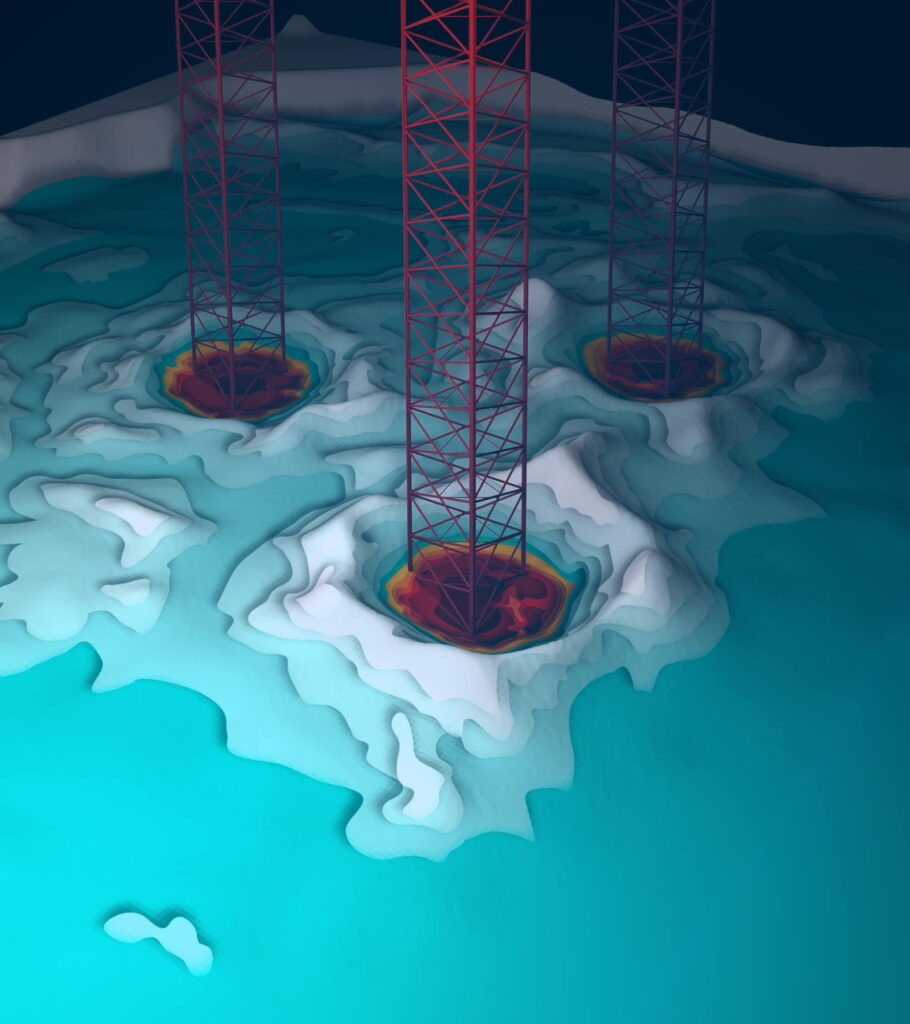
However, hard seabeds also offer advantages: high bearing capacity, eliminating concerns about settlement. In seismic regions, jack-ups on rock foundations perform better under earthquake loading due to lower resonance risk.
Engineering Insight: From Simulation to Field Support
Addressing these challenges starts before a vessel reaches the site. Site-specific soil investigations provide critical data for jack-up operations.
GustoMSC engineers use this data to run advanced time-domain simulations modeling jack-up dynamics, including wave loading and soil response. These analyses define safe operating environments and predict impact loads.
This informs offshore guidance: weather and sea-state limits, safe jacking speeds, and location-specific procedures.
Smarter Operations Through Digitalization
Digitalization now links engineering models with real-world performance. Onboard sensor systems monitor parameters like leg loads and hull motions during installation.
By comparing live data with pre-simulated models, engineers verify performance, identify deviations, and refine future designs. Over time, this feedback loop enhances industry safety and efficiency.
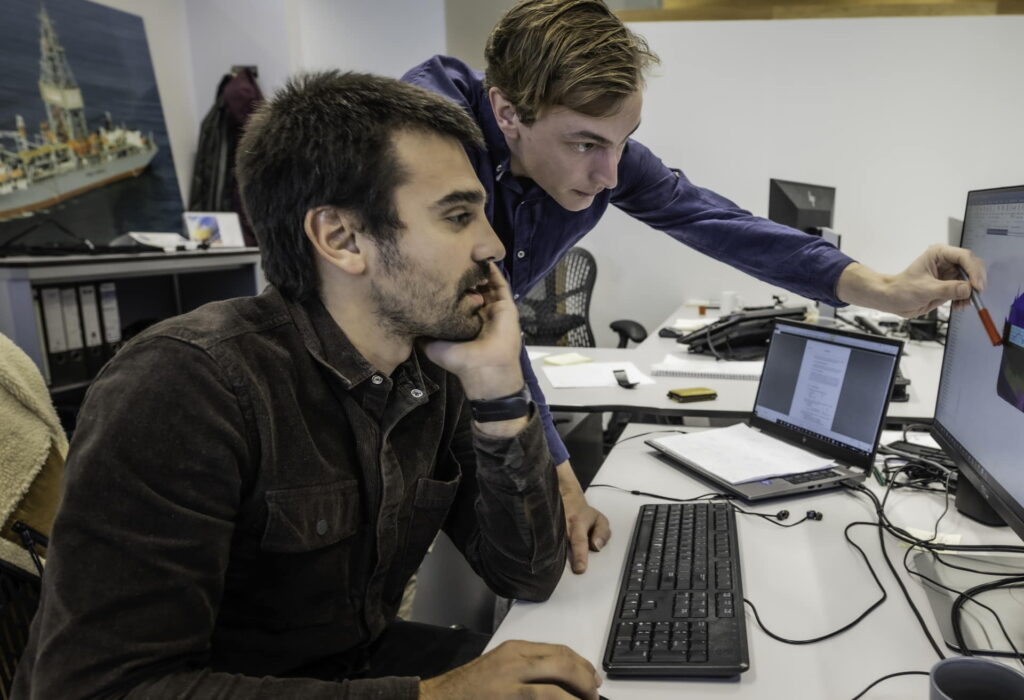
GustoMSC envisions a fully integrated digital environment where simulation, monitoring, and decision support tools work together, enabling data-driven decisions during operations.
Design Evolution: Engineering for Hard Ground
Sometimes, site conditions require hardware adaptation beyond operational control. Measures like seabed preparation and custom spudcan geometries can reduce installation risks.
GustoMSC engineers have developed alternative spudcan designs that distribute loads and absorb impact energy during touchdown. Research has refined models simulating complex leg-soil interactions and jacking responses, improving prediction accuracy.
These advancements allow operators to work safely in previously challenging areas.
Collaboration: Setting the Standard
Progress relies on industry collaboration. GustoMSC collaborates with operators, classification societies, and research institutions to develop best practices and align standards with hard seabeds’ realities.
Looking Ahead: Building for the World’s Seabeds
As offshore wind expands globally, hard soils and rocky seabeds will characterize the next generation of projects. Lessons from Japan, Australia, and the US will shape future standards and influence jack-up design and operation.
This transition signifies a new chapter for offshore engineering, valuing adaptability and experience. With advances in simulation, digital monitoring, and collaborative development, the industry is proving even tough ground can support a sustainable future.
Note: The opinions, beliefs, and viewpoints expressed in this article do not necessarily reflect the opinions of offshoreWIND.biz.
Original Story at www.offshorewind.biz