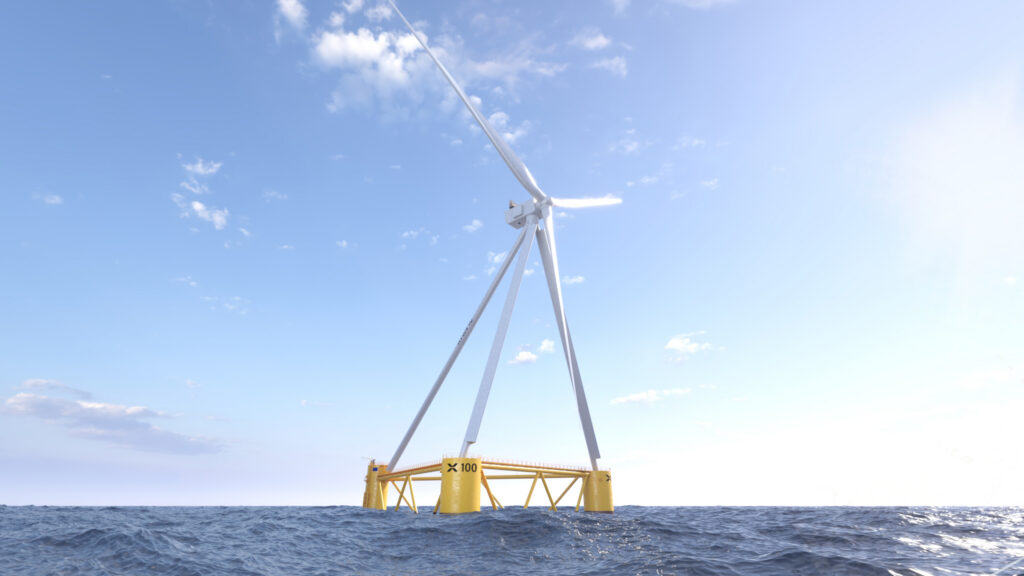
The PlemCat test site, a facility for developing innovative floating offshore wind projects in the LEBA 1 area of the Spanish Mediterranean Sea, has received Environmental Impact Assessment (EIA) approval.
In Spain, acquiring a favorable EIA from the Ministry for the Ecological Transition and the Demographic Challenge (MITECO) represents passing the nation’s toughest environmental review. Published in the Boletín Oficial del Estado (BOE) on July 8, this approval ensures that the PlemCat test site meets environmental, marine, and biodiversity protection standards. The EIA is crucial for any offshore wind installation in Spanish waters and for using the Maritime-Terrestrial Public Domain.
This development advances the NextFloat Project, featuring X1 Wind’s X100 8.5 MW platform. The project, led by Technip Energies and X1 Wind, uses a Tension-Leg Platform (TLP) known for its stability and minimal environmental impact combined with the cost benefits of semi-submersible structures.
The TLP mooring system notably reduces the seabed footprint compared to catenary lines using vertical mooring lines. This design allows the platform to coexist with marine activities like fisheries and research. By avoiding chains and using synthetic mooring lines, the design also minimizes seabed disruption and underwater noise, benefiting marine life.
The X100 platform, with a tripod-shaped design, supports turbines with a 160-meter diameter and achieves a primary steel weight of 1,500 tons, saving 30% to 50% in weight compared to traditional steel floaters in similar European projects.
This platform will have a downwind turbine of 160 meters and 8.5 MW capacity, moving toward the X150 platform, meant for turbines of 20 MW and higher. The pilot will gather data over several years to help with prototype certification and commercial deployment.
The initiative is supported by private capital, EU-funded projects NextFloat and NextFloat+, the PAREF project funded by France 2030, and Spain’s RenMarinas program.
Jacques Vendé, Project Manager at Technip Energies, commented: “Securing this environmental approval underscores our partners’ collaborative efforts and the platform’s minimal environmental impact. We are ready to proceed to the pilot deployment in the Mediterranean Sea, aiming for low-cost floating offshore wind.”
The EIA approval complements recent technical validation of the NextFloat Project. The X100 platform received a Statement of Compliance (SoC) for Basic Design from DNV, confirming the design meets international standards. Together, the DNV certification and EIA provide the required “green lights” for offshore deployment.
Alex Raventós, CEO & Co-founder of X1 Wind, stated: “The EIA for the PlemCat site is a significant step for the NextFloat project. Combined with DNV’s Basic Design Certification, it shows our technology is ready for deployment, moving us closer to making floating offshore wind globally competitive.”
Original Story at www.offshorewind.biz