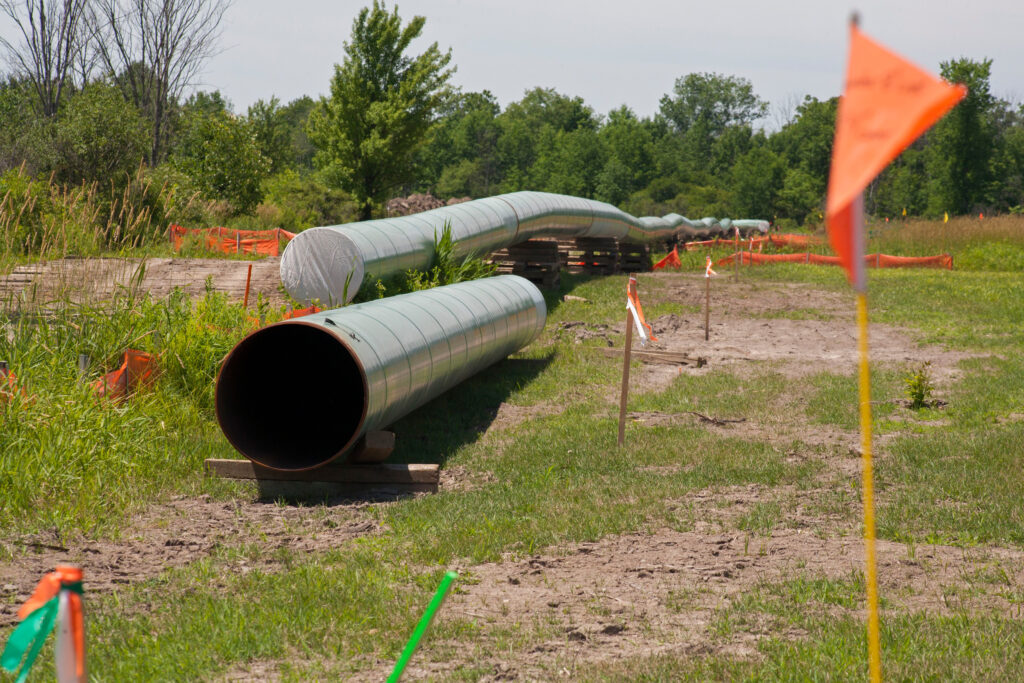
A crude oil pipeline spill in Detroit suburbs last month has led federal authorities to investigate the safety of all 20,000 miles of hazardous liquids pipelines managed by Energy Transfer.
The 600-gallon spill at a commercial intersection in Sterling Heights, Michigan, received minimal media attention. Initial local reports based on a city statement described a smaller spill, emphasizing no danger to residents. The reports did not name Energy Transfer, one of the largest oil and gas companies in the U.S.
In a corrective-action order dated Sept. 21, the Pipeline and Hazardous Materials Safety Administration (PHMSA) disclosed the incident on Energy Transfer’s 59-year-old, 130-mile crude oil pipeline from Marysville, Michigan, to Toledo, Ohio. Initially, PHMSA directed a 16-mile segment shutdown at the spill site. A spokesperson confirmed the pipeline restarted the following day at reduced pressure.
PHMSA, citing “system-wide risk,” demanded Energy Transfer submit a past repairs inventory and a plan to address vulnerabilities within 90 days. This order, the only company-wide safety measure among 23 corrective-action orders this year, affects approximately 20,000 miles of Energy Transfer’s pipelines.
Energy Transfer’s initial investigation confirmed the spill occurred at a past repair site—a steel encasement sleeve installed in 2010. Such sleeve failures have previously caused issues, including a jet fuel leak in Pennsylvania, affecting drinking water sources (see related report).
PHMSA officials noted similar repair failures suggest future risks, ordering Energy Transfer to create a remedial action plan across its hazardous liquids pipelines, including the Twin Oaks and Marysville-to-Toledo lines. Energy Transfer has requested a hearing regarding the order, yet unscheduled, a PHMSA spokesperson stated.
Energy Transfer declined to comment, directing inquiries to PHMSA documents. PHMSA highlighted the company’s inability to produce original records for multiple repair sleeves, an issue affecting both Michigan and Pennsylvania pipelines.
Energy Transfer acquired these pipelines in 2012 after a $5.3 billion purchase of Sunoco, expanding its network into a diversified oil and gas giant. These pipelines are in PHMSA-designated “high consequence areas” where ruptures could significantly impact health, safety, and the environment.
Pipeline Politics
Energy Transfer has a notable political presence, largely due to founder Kelcy Warren’s support for President Donald Trump. Following a proposed safety order, Warren and Energy Transfer donated $25 million to MAGA Inc., a political action committee supporting Trump. This marked Warren’s largest political donation, making Energy Transfer a major industry donor in the 2026 election cycle (source: documentation).
Despite Energy Transfer’s political ties, Michigan’s ongoing environmental challenges, including Trump administration rollbacks, could affect its influence. Michigan’s tightly contested races for governor and congressional seats may further spotlight these environmental issues.
PHMSA’s action against Energy Transfer highlights broader concerns about pipeline repair practices, particularly steel encirclement sleeves. Such repairs can interfere with leak detection systems and smart pig inspections, raising questions about their safety.
Energy Transfer must provide a detailed inventory of all repair sleeves and a plan to assess and address any vulnerabilities within six months. This order covers all hazardous liquid pipelines operated by the company.
Original Story at insideclimatenews.org