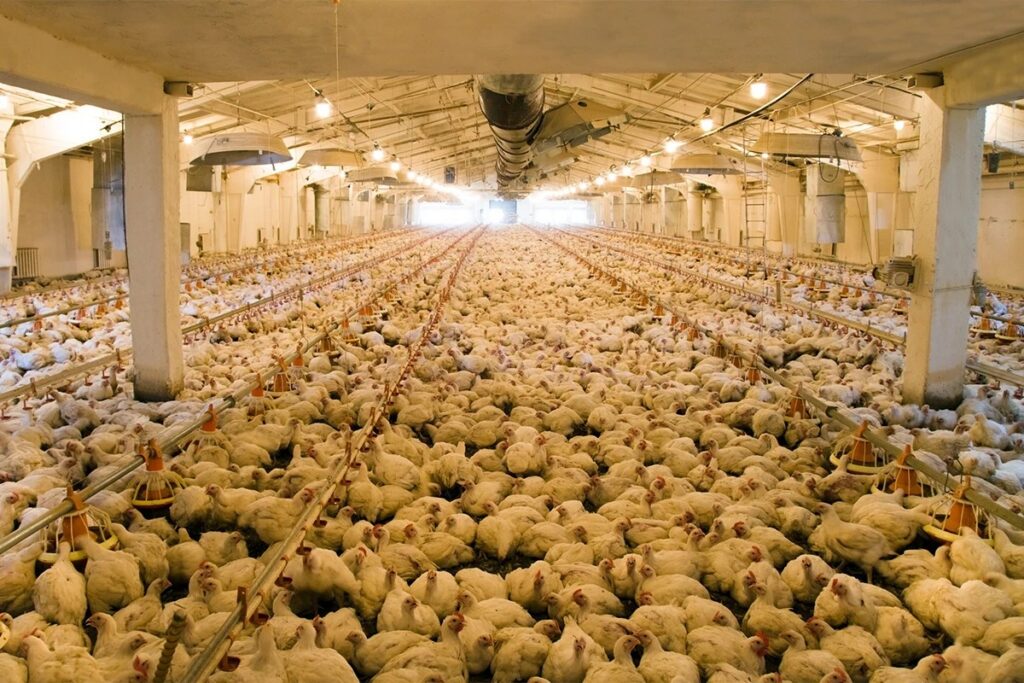
The recent heatwave that swept through France in late June resulted in the tragic loss of approximately 2.5 million to 3 million broiler chickens, as reported by Le Monde. Brittany emerged as one of the hardest-hit regions, with the scale of the losses overwhelming local rendering services and prompting authorities to permit emergency on-farm burials in certain cases. This situation has escalated into a significant animal welfare crisis, posing logistical challenges for farmers.
The repercussions of this heatwave were not confined to France alone. In Belgium, farmers reported that the extreme heat was causing heat stress in cows and pigs, leading to decreased feed intake, reduced milk yields, and slower growth rates. These factors are anticipated to result in financial losses for the dairy and meat industries.
Animal rights organizations have also voiced concerns over the risks associated with transporting livestock during such heatwaves, advocating for stricter regulations to safeguard animal welfare across Europe. The mass deaths have sparked a broader discussion on how European livestock farming can protect both animals and farmers from climate extremes while working to reduce emissions that contribute to these conditions.
Climate Change and Heatwaves
World Weather Attribution, a global scientific initiative, has stated that such a heatwave would have been “virtually impossible” 50 years ago without the impact of human-induced climate change. The organization attributes the severity of the heatwave to climate change, highlighting that a similar event in 1976 would have been approximately 3.5°C cooler. The likelihood of experiencing such high overnight temperatures in Western Europe today is about 100 times greater than during the 2003 European heatwave.
According to World Weather Attribution, much of Europe’s infrastructure, including farms and animal housing, was designed for historically cooler climates. As heatwaves become more frequent, they pose increasing threats to animal welfare and the viability of livestock farming.
Challenges for Farmed Animals
Compassion in World Farming released a report last year detailing the impact of climate-induced extreme weather on farmed animals. The report highlights that heat stress can severely affect livestock, leading to issues such as respiratory and cardiac problems, dehydration, weakened immunity, reduced fertility, lower milk production, and even death in extreme cases.
The organization noted that “factory farming contributes significantly to climate change, and, as temperatures rise, animals trapped in factory farms suffer even more.” It added that millions of animals are confined in overcrowded conditions, lacking sufficient water, and transported in vehicles where temperatures can become dangerously high.
The agricultural authority in Brittany reported significant poultry deaths due to the June heatwave. To manage the crisis, it expedited burial exemptions for farms experiencing mass poultry or pig mortalities, with an expectation of returning to “normal collection and processing capacities” by early July.
Response from European Livestock Voice
Anton van den Brink, chair of the Brussels-based European Livestock Voice coalition, acknowledged that the livestock sector is both susceptible to climate-driven heatwaves and a contributor to emissions that exacerbate these events. “But the discussion needs to be fair and practical,” he stated, referring to a leaked draft of the EU Livestock Strategy. This draft suggests that EU livestock accounts for 8% of total emissions in the EU (66% of agricultural emissions), around 4% of global agriculture emissions, and less than 1% of global total emissions.
Van den Brink emphasized that livestock farmers are on the frontlines of climate change, with heatwaves directly impacting animal welfare, productivity, farm workers, feed availability, and farm economics. He advocates for a transition to more sustainable livestock farming through innovation, efficiency, and investment rather than shifting production outside Europe, which could lead to increased imports from regions with lower standards.
Adapting to Future Heatwaves
Compassion in World Farming has called for emergency protections ahead of future heatwaves, which include reliable water access, lower stocking densities, proper ventilation, and restrictions on animal transport during extreme heat. The organization also suggests a shift towards slower-growing breeds more resilient to higher temperatures.
European Livestock Voice stresses the need for farms to incorporate adaptation as part of their everyday management. Measures include improved ventilation and cooling systems, shade, water access, adjusted feeding strategies, heat-resilient housing design, early-warning systems, contingency planning, and investment in animal health and welfare monitoring.
Financial Implications for Farmers
Van den Brink cautions that transitioning to climate-resilient farming is costly. “Farmers cannot be expected to carry the full burden alone, especially when many are already under severe economic pressure.” He calls for public policy to support climate-resilient farm investments through targeted funding, expedited permits, practical guidance, and research tailored to real farm conditions.
A sensible approach, he suggests, involves improving feed efficiency, animal health, breeding, manure management, renewable energy use, precision farming, and circular resource use. The recent deaths in France underscore the limits of Europe’s livestock systems in coping with extreme heat, raising questions about how quickly farms can adapt to protect both animals and farmers while reducing their contribution to climate change.
Original Story at www.foodingredientsfirst.com