Exploring Measure 20-388: A Fee on Large Retailers for Clean Energy in Eugene
As Eugene prepares for a vote on Measure 20-388, residents are faced with a decision that could influence both the local economy and the city’s environmental efforts. The proposed ordinance aims to levy a 2% fee on large retailers to support clean energy initiatives. Here’s a breakdown of the measure and the campaigns for and against it.
Understanding Measure 20-388
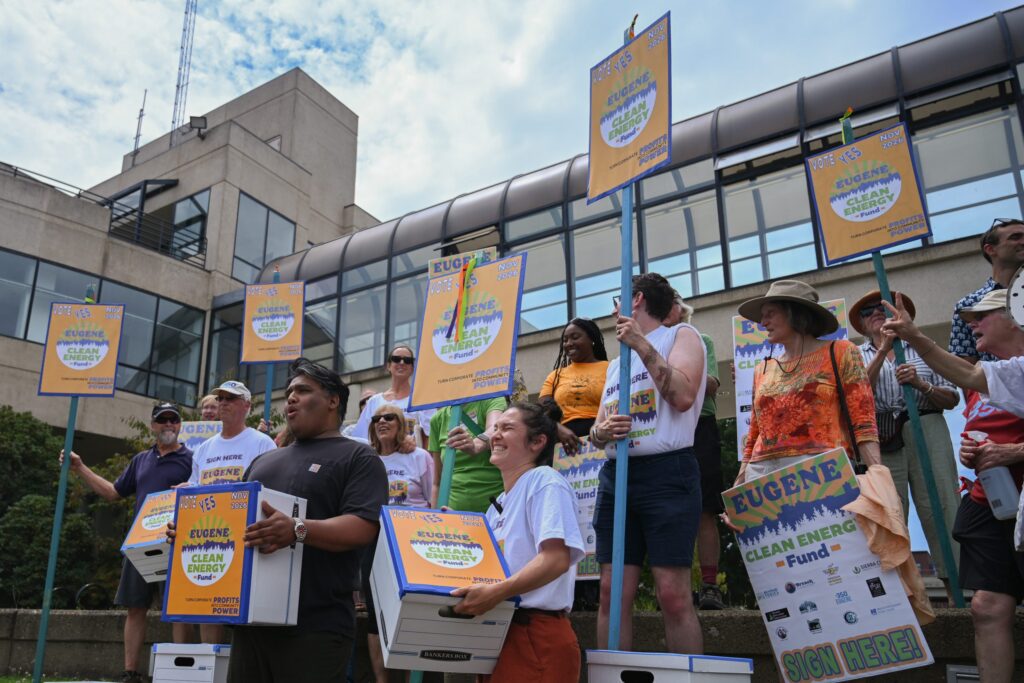
Measure 20-388 proposes a 2% fee on large retailers, defining them as corporations earning over $1 billion in gross profits annually in the U.S. and over $500,000 in Eugene. The measure exempts basic groceries, medicine, and waste services from this fee.
The funds collected would be directed towards energy efficiency projects and jobs in Eugene’s communities that are most vulnerable to climate change impacts. A nine-member committee, comprising appointees from the City Council and local commissions, alongside public members experienced in renewable energy and workforce development, would manage the fund allocation.
Large retailers would require a city license to operate from January 1, 2029, if the measure passes. Administrative costs are limited to 10% of the fund starting in 2030. For more details, read the full measure here.
The Campaigns: Supporters and Opponents
Supporters
The proponents of Measure 20-388 include a coalition of environmental organizations such as Beyond Toxics and the Sierra Club of Oregon. This group, known as “Yes for Clean Energy Fund Eugene,” advocates for the ordinance to follow the success of the Portland Clean Energy Fund. Their campaign has gathered endorsements from notable figures, including U.S. Sen. Jeff Merkley, and raised $292,695 by mid-October.
Opponents
The opposition, dubbed “Stop the Hidden Tax on Eugene,” represents business groups like the Eugene Chamber of Commerce and the Oregon Bankers Association. Concerns include potential price increases for consumers. The campaign has raised $38,360 to date and has public support from several local business leaders and former political figures.
Investigating the Claims
Both campaigns have made several claims regarding the measure’s impact on greenhouse gas emissions, job creation, and consumer costs.
Claim: “Large retailers are a significant contributor to greenhouse gas emissions.”
The city’s 2021 greenhouse gas inventory supports this claim by highlighting that imported goods are a major emission source. These consumption-based emissions, although complex to measure, constitute a significant portion of Eugene’s environmental footprint.
Claim: “It will create good-paying jobs.”
According to the measure, 25% to 30% of the fund is allocated for training and apprenticeships in clean energy sectors. Contractors are required to meet specific wage and benefit criteria, supported by endorsements from Oregon’s largest labor union, SEIU 503.
Claim: “We will see increased costs.”
Opposition spokesperson Laura Sedwick claims that the 2% fee could lead to higher consumer prices. However, this assertion lacks empirical backing, as it draws from estimates rather than documented price changes. The measure itself describes the fee as a “license fee,” not a tax.
Claim: “There is no evidence to show this would be passed onto customers.”
Supporters cite the Portland Clean Energy Fund as evidence that such fees do not inevitably translate to consumer price hikes. Portland businesses faced legal action for attempting to pass on similar fees to customers, highlighting complexities in fee implementation.
Eugene’s Climate Goals: An Overview
Under its Climate Recovery Ordinance, Eugene aims to halve fossil fuel use by 2030, compared to 2010 levels. Despite completing two-thirds of its Climate Action Plan, the city acknowledges challenges in meeting these targets due to funding constraints and evolving federal and state policies.
City spokesperson Marion Suitor noted the budgetary pressures and the reliance on external partners to fulfill the city’s climate commitments.
Original Story at lookouteugene-springfield.com