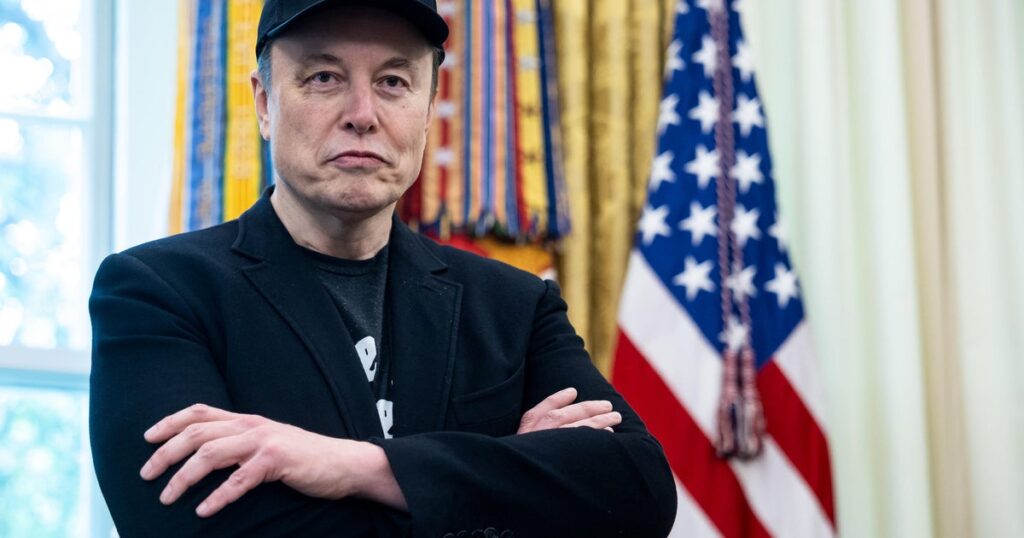
Elon Musk, renowned for his groundbreaking work in the electric vehicle industry, is now facing criticism for potentially hindering Tesla’s growth. According to a recent study by Yale University researchers, Musk’s controversial actions have led to a significant decline in Tesla’s sales.
The study, published by the National Bureau of Economic Research, suggests that Musk’s involvement with the White House’s Department of Government Efficiency (DOGE) and his acquisition of Twitter, now rebranded as X, in 2022, might have cost Tesla up to 1.2 million vehicle sales over three years. The researchers aimed to understand how Musk’s political engagements have affected Tesla’s business operations.
“This study highlights just how impactful a CEO’s partisan actions can be,” the researchers noted. “We show that Elon Musk, the world’s wealthiest person and CEO of the most valuable automaker by market capitalization, had a dramatic effect on Tesla sales due to his politically partisan activities unrelated to Tesla’s core business.”
The decline in Tesla’s sales became evident around mid-2022, with the most noticeable drops occurring in Democrat-majority areas. “Musk’s actions antagonized his most loyal customer base, for, as we show, Democrats are far more likely than Republicans to purchase a Tesla,” the researchers explained.
The lead author of the study, Kenneth Gillingham, is a prominent energy and environmental economist with a focus on consumer behavior and policy in the transportation and energy sectors. Musk announced his intention to step back from DOGE in May, a department established under the Trump administration to streamline government operations and reduce spending.
Tesla has yet to comment on the study’s findings. Mike O’Rourke, a chief market strategist at Jonestrading, previously indicated to CBS News that Musk’s political involvement and advisory role to President Trump during his second term might have alienated some potential Tesla customers.
Recently, Tesla reported a 37% drop in third-quarter earnings, citing increased costs and tariff challenges. Despite a 7% rise in EV sales across the industry, Tesla’s vehicle sales fell by 1% in 2024.
Interestingly, Tesla’s stock experienced a 27% decline in February, coinciding with the first full month of Trump’s presidency. However, the shares have since rebounded, showing a 14% increase this year. Investors are optimistic about Tesla’s potential growth in autonomous driving technology, the robotaxi business, and AI-powered humanoid robots.
Wedbush Securities technology analyst Dan Ives commented, “We estimate the AI and autonomous opportunity is worth at least $1 trillion alone for Tesla,” and expects the Trump administration to expedite these initiatives.
Another point of interest is the substantial compensation package Tesla shareholders are considering for Musk, potentially amounting to $1 trillion over a decade. This would be one of the most lucrative pay packages in corporate history. Achieving this would require Tesla to meet certain profitability and production targets and reach a market cap of $8.5 trillion within 10 years.
Robyn Denholm, chairman of Tesla’s board, is advocating for shareholders to approve Musk’s compensation plan, stating in a letter that without Musk, Tesla might lose significant value and fail to become “a transformative force reimagining the fundamental building blocks of mobility, energy and labor.”
Original Story at www.cbsnews.com