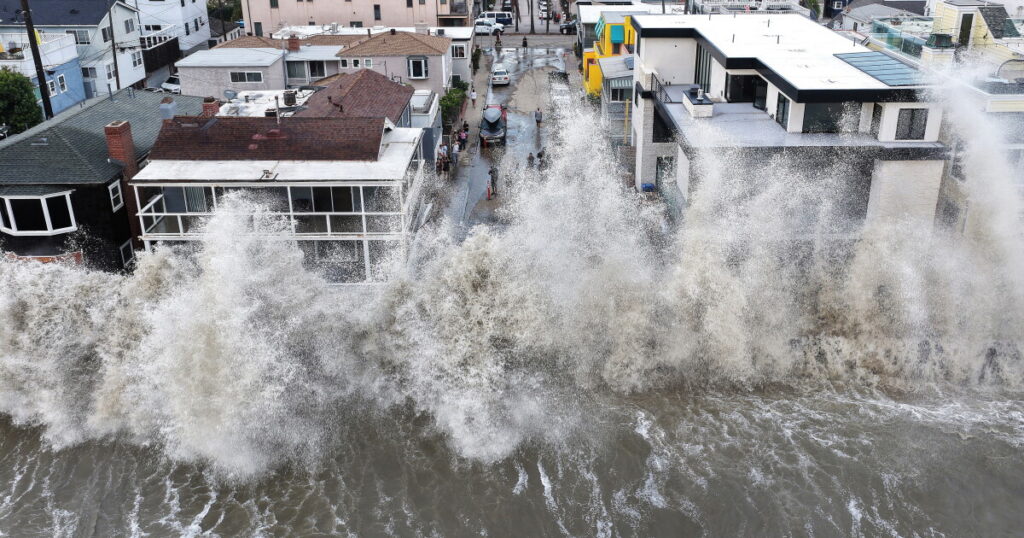
The recent powerful surf in Southern California, spurred by Hurricane Marie, may serve as a precursor to the extensive coastal threats posed by El Niño in the upcoming months, experts suggest.
Over the Labor Day weekend, waves reached heights of 12 feet, causing significant damage along the coast from Malibu to Orange County. Beachfront homes were battered, evacuation orders were issued for several areas, and key transit routes, including the Pacific Surfliner railway between San Clemente and Oceanside, faced temporary disruptions. Coastal emergencies are still active in areas like Laguna Beach and Dana Point.
Experts caution that these events might merely be the onset of a more severe pattern.
The National Weather Service has indicated that there is an over 90% probability of a very strong El Niño this year. Scientists warn of the convergence of several climatic forces that could elevate sea levels and surf conditions to unprecedented heights this winter.
The impact of these atmospheric conditions could be imminent, with El Niño-related sea level rises potentially affecting Southern California as early as October 1.
Understanding Kelvin Waves
Kelvin waves are significant factors in this scenario. These are vast volumes of warm water that traverse the ocean due to elevated temperatures near the equator, integral to the El Niño phenomenon.
Initially moving east along the equator, this Kelvin wave encountered Central and South America, redirecting northward towards Southern California.
Kelvin waves can elevate sea levels by 6 to 18 inches across broad areas. While not easily visible in open waters, their impact is more profound when they reach coastlines, potentially affecting Southern California by early next month.
This graphic shows the sea surface heights over 45 days between August and September as the Kelvin wave hit South America, then began its journey north along the coast of Central America. These number are compared to the 1993-2025 baseline sea levels over 45 days between August and September.
Increased sea levels allow waves to travel further inland, exacerbating coastal erosion.
“ Boy, if you have enough water level to support those waves so they dump right on your coast, they’re right there,” remarked Timu Gallien, a UCLA environmental engineering professor focused on coastal erosion. “Now they’re coming through your window, now they’re on your front porch, quite literally, for the beachfront homes.”
Scientists anticipate a series of Kelvin waves, which may become trapped along the coast, further raising sea levels.
Impact of King Tides
El Niño’s warm ocean conditions naturally elevate sea levels because warm water expands more than cold water. When combined with naturally occurring high tides, these conditions can intensify into destructive king tides.
By late fall and winter, tides are expected to reach their highest levels in 18 years due to lunar and planetary cycles.
The surge in sea levels from these tides could compound with El Niño-related increases.
“That rides on top of the tide,” Gallien explained. “ You’ve got the tides that are going up and down, then you’ve got this El Niño signal that goes up and down on top of that tide.”
Storm Activity
El Niño-induced warm waters are also a catalyst for storm activity, with scientists forecasting some of the highest ocean temperatures ever recorded.
“We’re going to be experiencing record-breaking water temperatures for many, many months on end on the top of what is already a record-breaking marine heat wave,” said Daniel Swain, a UC climate scientist, during a webinar discussing El Niño predictions last week.
Warmer seawater increases evaporation rates, contributing more moisture to the atmosphere, which can turn into rain. El Niño also influences the jet stream to direct more moisture towards Southern California, rather than the Pacific Northwest.
The warmer waters additionally foster more tropical storms in the eastern Pacific, enhancing their intensity and duration.
These storm surges, similar to those from Hurricane Marie, can travel vast distances, ultimately impacting the California coastline.
Original Story at laist.com