
Damen Shipyards Group, a prominent Dutch shipbuilder, has been commissioned to create a new multi-purpose accommodation support vessel (MP-ASV) for Windcat, part of CMB.TECH. The company is a major player in the maritime industry, with around 250 vessels. Damen has an option to construct five more ships of this type.
During the Offshore Energy Exhibition and Conference (OEEC) in Amsterdam, Damen introduced the Innovation Series, a new class of offshore support vessels. The agreement with Windcat involves building a new MP-ASV with an option for five additional vessels. Construction will start in February 2026, with delivery in 2028.
These vessels will be constructed at Ha Long Shipyard in Vietnam. Building on the collaboration during the Elevation Series commissioning services operations vessels (CSOVs), the MP-ASVs represent a new vessel type, enhancing previous designs with increased capabilities and efficiency.
The new series draws on the proven design of CSOVs, sharing some suppliers. The MP-ASVs are larger, measuring 102m x 20m, with a 750 square kilometer deck space, a 150-tonne subsea crane, and the capability to launch and recover remotely operated vehicles (ROVs).
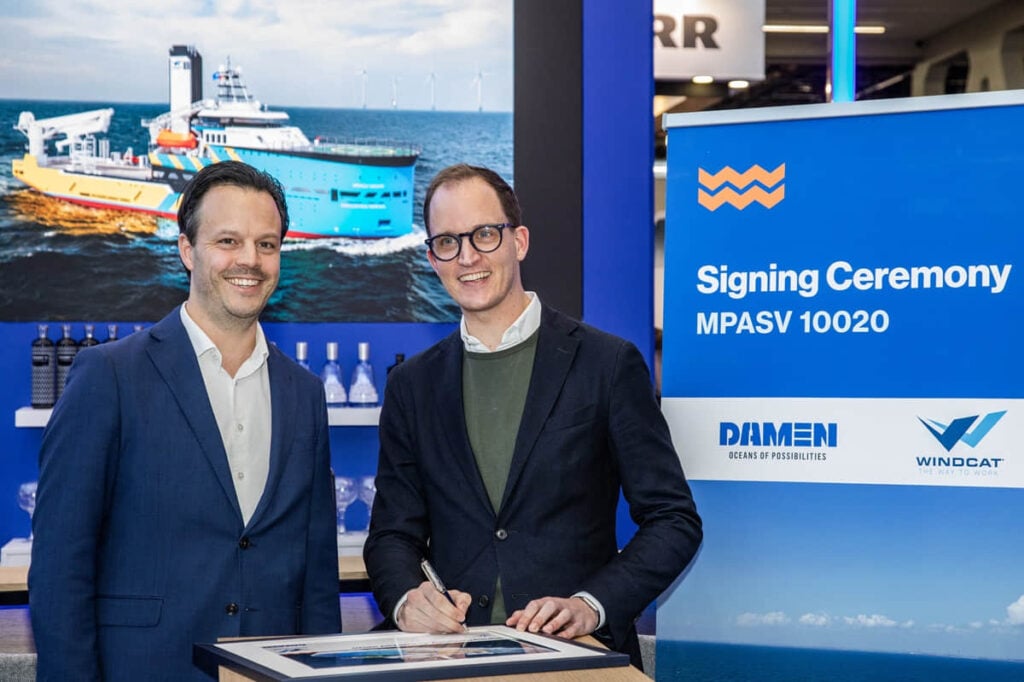
According to Damen, these ships combine a large open deck with a subsea crane, offering fuel-efficient operations and high-quality accommodation for personnel working in the offshore energy sector over extended periods.
Joost van der Weiden, Damen’s Sales Manager, highlighted: “Our partnership with Windcat exemplifies how Damen operates. Collaborating with clients who align with our goals, we aim to innovate next-generation solutions, setting new standards in safety, efficiency, and sustainability.
“This has been successful with the first six vessels of the Elevation Series. We are pleased with this order, marking another advancement. We look forward to our ongoing cooperation with Windcat in developing the Innovation Series.”
Damen Set on Birthing Ships with Decarbonisation Toolkit
The shipbuilder emphasizes the vessels’ incorporation of a 3981kWh battery pack on a DC grid for low-emission performance. This setup allows peak shaving, enabling variable-speed main engines to work efficiently, reducing fuel use.
A notable feature of the Innovation Series is the integration of low-carbon fuels. The dual-fuel hydrogen engine can run the auxiliary genset on hydrogen. The vessels will accommodate up to 190 people for at least 28 days of endurance.
A motion-compensated gangway will enable personnel to access offshore infrastructure safely and comfortably. This tool maintains a fixed connection with other structures.
Willem van der Wel, Managing Director at Windcat, commented: “We are introducing a new vessel type to our fleet and the market, combining the large deck and crane of an MPSV with the comfortable offshore accommodation of an ASV.
“Our collaboration with customers and suppliers and constant innovation keeps us at the forefront of the offshore energy industry, prioritizing our customers’ needs.”
Damen and Windcat emphasize high-standard accommodation to ensure crew and offshore personnel’s well-being, featuring easy navigation, appealing aesthetics, and high-quality materials to minimize seasickness and homesickness.
Equipped with a dynamic positioning system labeled as DP2+, the vessels feature azimuth thrusters and a tunnel thruster fore and aft to maintain operation on DP2 even if a thruster fails, crucial for remote offshore operations.
“By building this new type of vessel, emphasizing comfort, performance, and decarbonisation, we ensure support for tomorrow’s offshore projects globally,” added Windcat’s Managing Director.
Follow offshoreWIND.biz on:
Original Story at www.offshorewind.biz