In the early hours of July 19, as rain drenched the Pir Panjal mountains, Haji Mohammad Latief stepped outside his home in Murrah, a secluded mountain village in Indian-administered Kashmir. His daughter had urged him to relocate the family car to a safer spot as the rain intensified.
Latief recounted, “I had only just parked it. When I turned around, I saw the water coming.” Within moments, a cloudburst unleashed a deluge of mud, boulders, and water down the hillside.
At 48, Latief had invested years into building the home where five generations of his Gujjar family resided. The torrent swallowed the house in minutes, trapping eight family members inside. Latief escaped only because he had stepped out. By daybreak, the home he had painstakingly built was reduced to rubble.
Four days later, when the Guardian arrived in Murrah, the village was cut off from electricity, roads, and mobile networks. Floodwaters had destroyed roads and footbridges, leaving only a 90-minute trek through rain and landslide debris to access the village. Residents carried essentials like flour, cooking gas, and medicines across the fractured crossings.
Situated in the Pir Panjal range above Bafliaz town in the Poonch district, about 125 miles (200km) south-west of Srinagar, Murrah is home to predominantly Gujjars, a major pastoralist community in the Himalayas. Their livelihoods have traditionally depended on livestock, farming, and seasonal migrations.
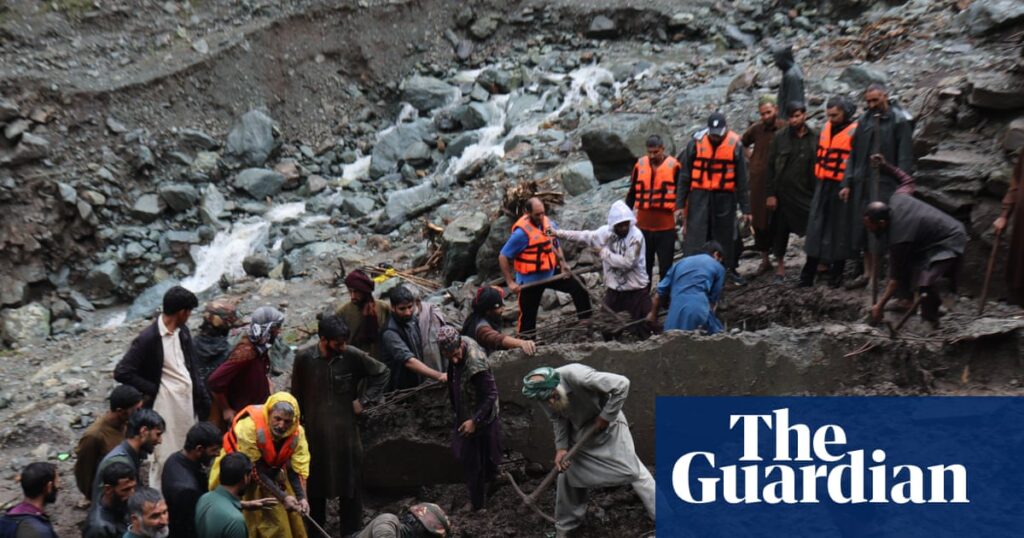
The unstable hillside prevented excavators from reaching the site. Soldiers, disaster response teams, and local volunteers searched the debris manually, while others combed the swollen Suran River for the missing.
Latief now resides with his brother, Mohd Bashir, whose house is positioned just above the landslide. Inside, women gathered to mourn, and men quietly received condolences. Verses from the Qur’an resonated throughout the house.
Latief displayed pictures of his 16-year-old son, Sajjad Ahmed, an aspiring cricketer, whose body remained missing. Just days before the disaster, the family had recorded videos together.
As mourners gathered, news spread of another body found several miles downstream; the room fell silent as a funeral procession passed through the village.
Among those searching was Mohammad Razak, 45, who had spent four days scouring the river with a team of volunteers. “We’ve been searching every bend of the river,” he said. “We’re still hoping we’ll find them.”
Murrah was among the hardest-hit areas following a series of cloudbursts, flash floods, and landslides that swept across Jammu and Kashmir this month, resulting in the deaths of at least 28 people. Scientists attribute the increasing frequency of short, intense rainfall events in the western Himalayas to rising temperatures. In steep mountainous regions, these rains can rapidly trigger floods and landslides, heightening risks for remote communities. For mountain dwellers, the climate crisis is also exacerbating existing geographical and social vulnerabilities.
The devastation extended beyond Murrah. Approximately 30 miles away in Rajouri, the Manawar Tawi River overflowed, sweeping away roads, numerous vehicles, and the town’s main Bela bus station.
Low-lying areas along the riverbank were submerged in mud and debris. Several homes collapsed across the Pir Panjal mountains, livestock were swept away, and hundreds of families were displaced.
Approximately 180 miles north, in the Gurez Valley near the line of control with Pakistan-administered Kashmir, residents observed a similar pattern. A cloudburst in Achoora village on July 20 damaged the crops of 11 families and blocked the valley’s sole road.
Residents reported that increasingly erratic rainfall is disrupting farming and making traditional livelihoods more precarious. These events followed a series of cloudbursts that struck Gurez and neighboring Tulail over the past month, damaging homes, farmland, bridges, and roads.
“People knew when the snow would come and when to plant crops,” noted Aamir Asghar Khan, 26, a resident of Achoora. “Nothing seems predictable anymore. The rain is getting more intense every year, and the frequent cloudbursts are threatening our livelihoods.”
Heavy rainfall also triggered destructive floods and landslides in Ladakh and across the border in Pakistan-administered Gilgit-Baltistan, reinforcing concerns about the impact of increasingly erratic weather on communities throughout the western Himalayas.
The International Centre for Integrated Mountain Development (ICIMOD) highlighted that the western Himalayas are experiencing frequent intense rainfall capable of triggering floods, landslides, and cloudbursts. Accelerating glacier melt is likely to elevate flood risks in the short term before reducing water availability in the coming decades.
“The challenge our mountain communities face is twofold – too much water at times and too little at others,” an expert from ICIMOD explained. “Adaptation requires work on both fronts, managing flood risk and water scarcity together.”
ICIMOD emphasized the importance of expanding community-based early warning systems, installing more weather stations in high-altitude areas, restoring damaged watersheds, and designing infrastructure to withstand future weather conditions rather than relying on historical patterns.
Dr. Suheel Rasool Mir, a sociologist based in Kashmir studying Indigenous communities in Jammu, Kashmir, and Ladakh, noted that pastoral communities are among the first to suffer from erratic weather, as their livelihoods rely directly on forests, rivers, grazing lands, and seasonal migration.
“For Gujjar, Bakarwal, and Dard-Shin communities, these disasters are not simply natural hazards,” he stated. “As climate extremes become more frequent, they lose not only homes and livestock but also the ecological knowledge and ancestral livelihoods that have sustained them for generations.”
For Latief in Murrah, only one hope persists. “I just want to find them,” he expressed. “Then we can bury our family together.”
Original Story at www.theguardian.com