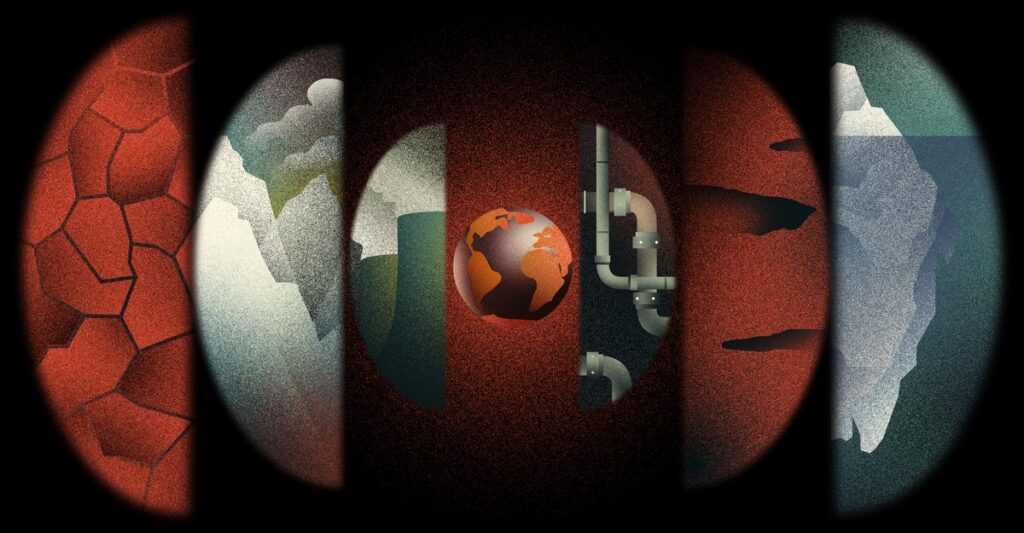
As climate change continues to reshape our world, its effects are becoming increasingly apparent not just in the atmosphere but also on the ground beneath our feet. This transformation is especially evident in regions where glaciers and permafrost have held sway for millennia, causing significant geological shifts.
Historically, tectonic movements have shaped Earth’s landscape over millions of years, yet during the relatively short span of human existence, the planet’s surface has remained quite stable. This era of stability appears to be ending, as climate-driven changes provoke notable geological activity.
Glacial Retreat and Mountain Instability
In numerous mountainous regions like Alaska, Greenland, and the European Alps, rapid glacial retreat is leading to unstable terrains. For example, in 2023, an ice-supported cliff in Greenland collapsed, creating a massive wave detected worldwide. Such events are becoming more frequent, suggesting a pattern linking glacial loss to increased landslide risks. Geologist Kristian Svennevig from the Geological Survey of Denmark and Greenland warns that these occurrences might just be the beginning, with future landslides potentially exceeding known historical magnitudes.
Permafrost Thaw and Its Consequences
Permafrost, another crucial element for mountain stability, is also thawing, particularly in the Arctic. This thaw results in significant land deformation, as seen in Alaska’s Brooks Range, where permafrost loss is destabilizing landscapes. Bretwood Higman, an independent geologist, notes that such changes are driving mountains into a state of imbalance, requiring them to adapt to a warmer climate.
Infrastructure is under threat as well. In Denali National Park, a $100 million bridge is being constructed to span a moving permafrost landslide. Meanwhile, engineers work to refreeze permafrost to protect the Trans-Alaska Pipeline. Across the Arctic, previously solid ground is becoming boggy, forcing communities to relocate and adapt to the sinking and shifting earth.
The Broader Impact of Climate on Geology
Beyond mountainous regions, climate change is increasing landslide risks worldwide. A warmer atmosphere holds more moisture, leading to intense rainfall events that can trigger landslides, as seen in North Carolina during Hurricane Helene and California after wildfires. These incidents underscore the growing threat to communities and the rising economic costs, which already amount to $20 billion globally.
Moreover, shifting precipitation patterns are beginning to reveal links to volcanic eruptions and earthquakes. Research suggests that glacial melt and extreme rainfall may contribute to seismic activities by altering pressures and reducing friction in the Earth’s crust.
Future Geological Challenges
Recent studies highlight possible connections between climate change and increased volcanic eruptions. For instance, Falk Amelung from the University of Miami has proposed that heavy rainfall may have influenced the 2018 Kīlauea eruption by increasing rock pressure, despite some skepticism from USGS volcanologists. If true, hundreds of volcanoes could be at risk in the coming decades.
The Earth’s systems—atmosphere, oceans, and land—are interconnected, as emphasized by Benedikt Soja of ETH Zurich. The stress we impose on one component inevitably affects the others, highlighting the intricate balance of our planet’s geological and climatic processes.
Original Story at www.theatlantic.com