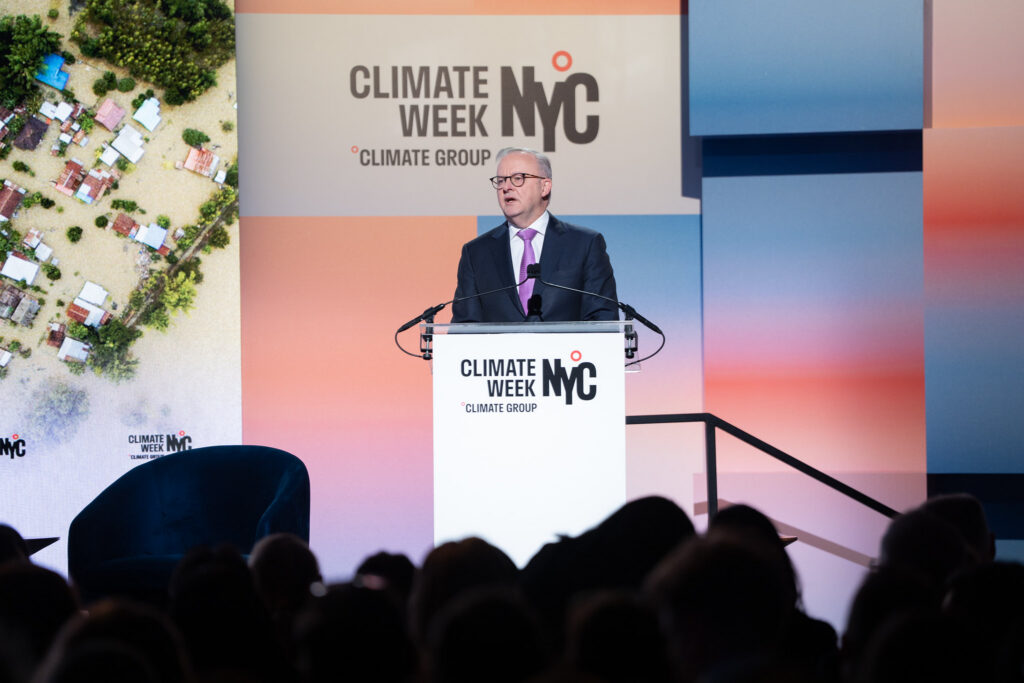
As climate-related disasters become more frequent and severe, governments worldwide are urged to treat climate change and nature loss as pressing national security issues. This call to action was made by prominent leaders, including Britain’s former energy minister Ed Miliband, during the opening of Climate Week NYC.
Climate Change as a National Security Threat
Ed Miliband, who served as the UK’s energy minister until July, emphasized the necessity of governments placing climate change at the forefront of their agendas. Addressing policy and business leaders, Miliband stated, “Climate breakdown, in my view, must be an issue for foreign ministers and prime ministers, as well as energy and climate ministers – the security community, not just the activist community, the generals, not just the green campaigner.”
Miliband advocated for a reevaluation of risk assessment, suggesting that climate considerations should be embedded into national security strategies, threat evaluations, and contingency planning. He also urged nations to collaborate and share information, as climate shocks can swiftly affect supply chains and influence financial markets and migration.
This perspective, while not entirely new, gains urgency as global warming intensifies, affecting regions like Europe with more frequent heatwaves, droughts, and forest fires. In a social media post in mid-August, Miliband reflected on the UK’s hot and dry summer, promising to gather foreign ministers at the UN General Assembly in September to address this “new national security threat” and form a coalition for action.
Australia’s Unified Response
Other leaders in New York echoed similar concerns. Australian Prime Minister Anthony Albanese highlighted his country’s firsthand experience with climate change, from severe bushfires and floods to the destruction of coastal areas by warming oceans.
Albanese warned of a potentially extreme summer due to a forecasted record-breaking El Nino, emphasizing the need for global unity in addressing climate challenges. “We need to come together, to meet the problem head on,” he said, stressing the importance of collective action.
Australia is set to lead discussions at the upcoming COP31 climate summit, with a focus on the existential threat to Pacific nations from rising sea levels. A pre-COP gathering will take place in Fiji, followed by a visit to Tuvalu.
Panama’s environment minister, Juan Carlos Navarro, shared concerns about El Niño’s impact on the Panama Canal, estimating income losses between $225 million and $400 million due to reduced maritime traffic. “What a great irony,” Navarro remarked. “Panama being a small, carbon-negative country pays the price for the big carbon-emitting countries.”
Investing in Climate Resilience
Amina J. Mohammed, Deputy Secretary-General of the United Nations, emphasized the importance of maintaining multilateral approaches to addressing climate change, despite geopolitical challenges. She urged leaders to actively participate, saying, “It does require your voices. It won’t happen by itself. We have to lean into it.”
Kaysie Brown from think-tank E3G noted that the comments made at Climate Week NYC reinforced the political case for integrating climate considerations into national security strategies. She stated, “In a world of escalating climate impacts and the record El Niño expected to heighten risks worldwide, investing in global climate resilience and the clean energy transition are critical to credible strategies to enhance stability and national security.”
Suneeta Kaimal from the Natural Resource Governance Initiative (NRGI) highlighted the shift in focus from energy transition to energy security, arguing that resilience remains a key requirement. “The fact that the framing has changed…points to the need for resilience,” she said.
Iceland’s Prime Minister Kristrún Frostadóttir shared insights from her country’s response to the 1970s oil crisis, investing in geothermal energy to build resilience for future shocks. “Resilience wasn’t built while the crisis was happening. It was built in the years after – deliberately, patiently, as a national mission,” she noted.
New COP Goal on Electrification
UN climate chief Simon Stiell announced a new voluntary target for COP31, aiming for 35% of global energy use to come from electricity by 2035. This strategy seeks to shield nations, families, and businesses from fossil fuel supply disruptions and rising costs.
The Turkish COP presidency detailed the electrification goal, encouraging governments to support developing countries in identifying their grid investment needs and securing financing for electrification. “It is a development strategy, an industrial strategy, a health strategy, and a security strategy,” Stiell emphasized.
Original Story at www.climatechangenews.com