As Australia’s renewable energy landscape evolves, investor sentiment appears to be shifting. A recent survey conducted by Oxford Economics for the Clean Energy Investor Group (CEIG) reveals a noticeable decline in the country’s attractiveness for clean energy investments. This survey, now in its third year, encompasses opinions from stakeholders managing a significant 18GW of renewable energy capacity across 139 power stations, collectively worth over AU$41 billion (US$28.41 billion).
In the latest findings, only 12% of participants viewed Australia as “very attractive” for clean energy investments, compared to 23% the previous year. Conversely, the percentage of those finding the country “somewhat unattractive” more than doubled, rising from 8% to 19%. Despite these changes, a majority of 58% still consider Australia either somewhat or very attractive, attributing this to the nation’s regulatory stability, adherence to the rule of law, and abundant renewable resources.
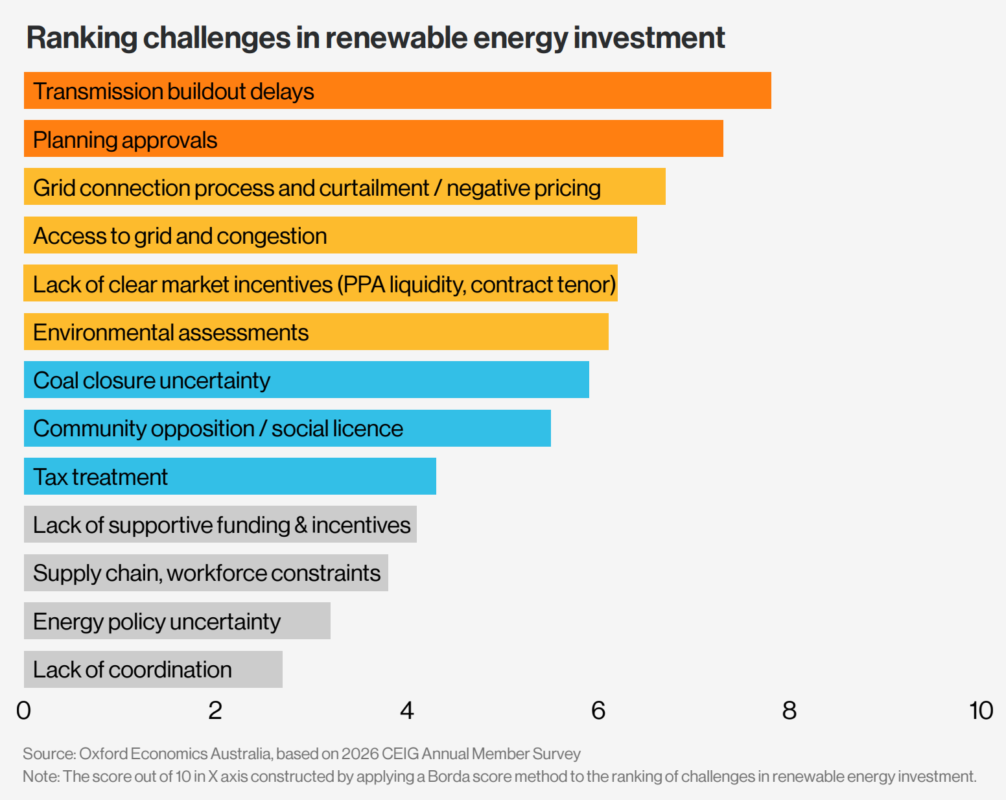
Attention turns to the Australian Energy Market Operator (AEMO) as it calls for a significant increase in utility-scale wind and solar capacity—up to 120GW by 2050, which is about five times the current capacity. However, the CEIG survey indicates waning investor confidence in achieving this scale, with transmission delays now highlighted as the primary obstacle, surpassing planning approval challenges from the previous year.
Despite the optimism following the 2025 federal elections, which 90% of last year’s respondents saw as a positive signal for clean energy, anticipated progress in transmission infrastructure has not materialized. Moreover, recent reforms, such as changes to the EPBC Act and New South Wales Planning Systems Reforms, have yet to yield significant improvements in planning approvals, now ranked second among investment challenges. Issues like grid connection, curtailment, and negative pricing also persist.
The survey also highlights a need for greater transparency and certainty regarding the Capacity Investment Scheme, with concerns about market distortion, support for wind and long-duration energy storage, and clarity on future auction designs.
State Rankings Shift as Queensland Holds and Western Australia Rises
New South Wales remains the top state for renewable energy investment, scoring 9.3 out of 10, ahead of Queensland’s 7.6. Yet, constraints like planning approvals and grid congestion continue to challenge New South Wales, with 57% of respondents identifying these issues. Western Australia has notably moved to third place with a score of 7.0, boosted by the South West Interconnected System Transmission Plan, despite lacking a renewable energy target.
Victoria, now in fourth place with a score of 6.7, grapples most with transmission delays, as 43% of investors cite this as the key issue. South Australia, in fifth at 6.2, shares similar challenges. Queensland’s policy uncertainty, exacerbated by the decision to extend coal power operations, has led to 59% of respondents expressing concerns over energy policy.
The 2030 Target and What Could Unlock Investment
Survey results regarding the 82% renewable target by 2030 paint a stark picture. Only 8% believe the target is achievable under current policies, with 65% convinced it won’t be met. The report suggests that bridging this confidence gap will require enhanced revenue certainty for new projects, expedited transmission infrastructure, and reforms to align the Capacity Investment Scheme with investment decisions.
On a positive note, the growing demand from data centers is seen favorably, with 92% of respondents viewing it as beneficial for clean energy investment, and half describing the impact as “strongly positive.” For this demand to drive new renewable generation, it is recommended that data centers source energy from new renewable capacities, aligning with the federal government’s National Data Centre Expectations.
Long-term power purchase agreements with data centers could foster a deeper offtake market, especially in Western and South Australia. CEIG’s 2026 report emphasizes four priorities: accelerating transmission, improving grid connection processes, strengthening revenue certainty, and ensuring that data center demand results in additional renewable generation.
Original Story at www.pv-tech.org