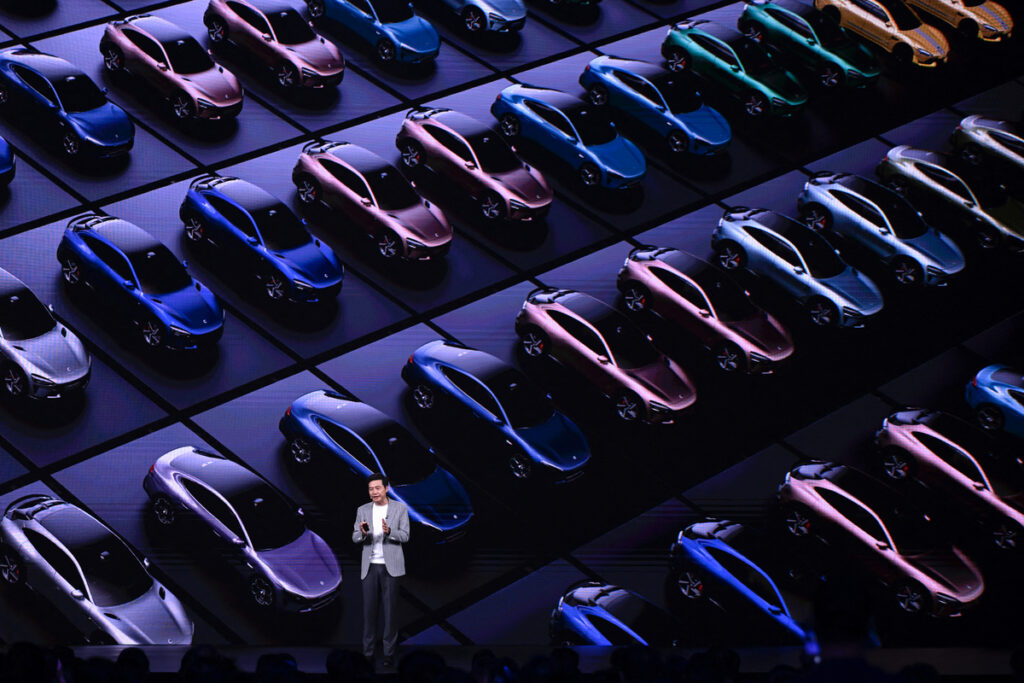
In a development that could reshape the North American auto industry, Canadian cities are set to welcome a wave of affordable Chinese electric vehicles (EVs), a move that might soon catch the attention of American consumers across the border.
As Canada begins importing these vehicles, residents of U.S. border cities like Detroit and Buffalo might soon see their Canadian neighbors driving brands such as Xiaomi, Leapmotor, and BYD. American tourists visiting Canada may also encounter these brands when using ride-share services.
For years, both the U.S. and Canada resisted the influx of China’s low-cost, technologically advanced EVs, fearing threats to domestic manufacturers and potential surveillance issues. However, President Donald Trump’s 25 percent tariff on Canadian automobiles and parts has disrupted the North American automotive landscape.
In response, Canada is pivoting from a once-stable but now unpredictable relationship with the U.S., aiming to establish itself as a global player in the EV sector. This shift could help Chinese automakers gain insight into North American consumer preferences and potentially break into the U.S. market, the only major market they have yet to penetrate.
Stephanie Brinley, an auto analyst at S&P Global Mobility, remarked, “Whether it’s 2027 or 2037, we can expect to see more Chinese automakers coming to the U.S. market. That’s the trajectory.”
Earlier this year, Canadian Prime Minister Mark Carney overturned longstanding policies, reducing tariffs to permit a limited number of Chinese EVs. Initially, 49,000 vehicles can be imported annually at a 6 percent tariff, potentially increasing to 70,000 within five years.
While this initial figure represents less than 3 percent of Canada’s new car sales, it marks a significant shift in policy and market dynamics.
Canada’s industry minister, Mélanie Joly, expressed the sentiment that “We don’t want to be hostage of our geography,” during a speech in Toronto in February.
Chinese automakers are quickly making moves. Companies like BYD, Chery Automobile, and Geely Holding are preparing to enter the Canadian market this year, according to Automotive News.
Historically, Canada mirrored the U.S. in imposing strict tariffs on Chinese EVs. The automotive industries of both nations are highly interconnected, and both perceived Chinese-subsidized EVs as a competitive threat.
Brian Kingston, CEO of the Canadian Vehicle Manufacturers’ Association, stated, “The whole idea was to keep China out.”
Bending Toward China
The Trump administration’s tariffs have disrupted the foundations of Canada’s auto industry, prompting significant changes. Last year, Stellantis relocated Jeep Compass production from Ontario to Illinois, affecting 3,000 Canadian workers.
Kingston noted, “We built our industry based on an integrated supply chain. The Canadian industry is under pressure like it never has been before because of U.S. tariffs.”
Canada is motivated to embrace electric vehicles, supported by its expanding battery supply chain and hydropower resources, which allow for environmentally friendly production.
With Trump’s policies impacting U.S. climate initiatives and American automakers reducing their EV commitments, Canada views China as a viable partner for manufacturing.
Carney’s office stated that the import agreement “will drive considerable new Chinese joint-venture investment in Canada with trusted partners to protect and create new auto manufacturing careers for Canadian workers, and ensure a robust build-out of Canada’s EV supply chain.”
Canada lacks a domestic automaker, relying instead on plants owned by American and Japanese companies. However, Canadian suppliers like Magna International and Linamar are globally influential.
Canada envisions these suppliers collaborating with Chinese manufacturers to create vehicles for export, as Joly mentioned in an interview with Bloomberg.
Despite historical tensions, Canadians increasingly favor collaboration with China over the U.S. A survey five years ago showed only 19 percent of Canadians had a positive view of China. However, a recent POLITICO poll revealed that 57 percent prefer relying on China rather than Trump’s America.
Even Canadian auto dealerships are warming to the idea of Chinese EVs. Huw Williams of the Canadian Automobile Dealers Association commented, “Selling Chinese cars is not our preference, but any vehicles sold should be through a dealership.”
Not an Easy Entry
Despite potential Canadian-Chinese collaborations, Chinese EVs face significant barriers to entering the U.S. market. Current regulations impose a 100 percent tariff on these vehicles.
Implemented by the Biden administration in 2024, this tariff addresses concerns over China’s government-subsidized EVs and their potential impact on U.S. automakers.
Additionally, cybersecurity regulations prohibit the sale of vehicles with Chinese-connected technology.
Nevertheless, Chinese automakers might circumvent these obstacles by establishing U.S. manufacturing facilities with minimal Chinese affiliations.
In a speech to the Detroit Economic Club, Trump stated, “If they want to come in and build the plant and hire you and hire your friends and your neighbors, that’s great. Let China come in.”
Some companies, like Polestar and BYD, have already set up operations in the U.S., capitalizing on earlier, less tense trade relations between the countries.
Any future Canadian-Chinese EV would need to meet rigorous U.S. safety and technical standards, a process that requires significant time and investment, according to Brinley from S&P Global Mobility.
Convincing consumers to adopt a new automotive brand also presents challenges, as buyers seek assurance of an established service network — a hurdle for all new market entrants.
Brinley noted, “There’s a difference between seeing a car on the road and thinking that’s cool, and buying it at scale.”
While Chinese EVs are already prevalent in Mexico, selling nearly 100,000 last year according to Yahoo Finance, their presence in Canada might resonate differently with Americans.
Mike Murphy, a political consultant, commented on the proximity, saying, “Canada is the proverbial backyard, psychologically.”
Original Story at www.eenews.net