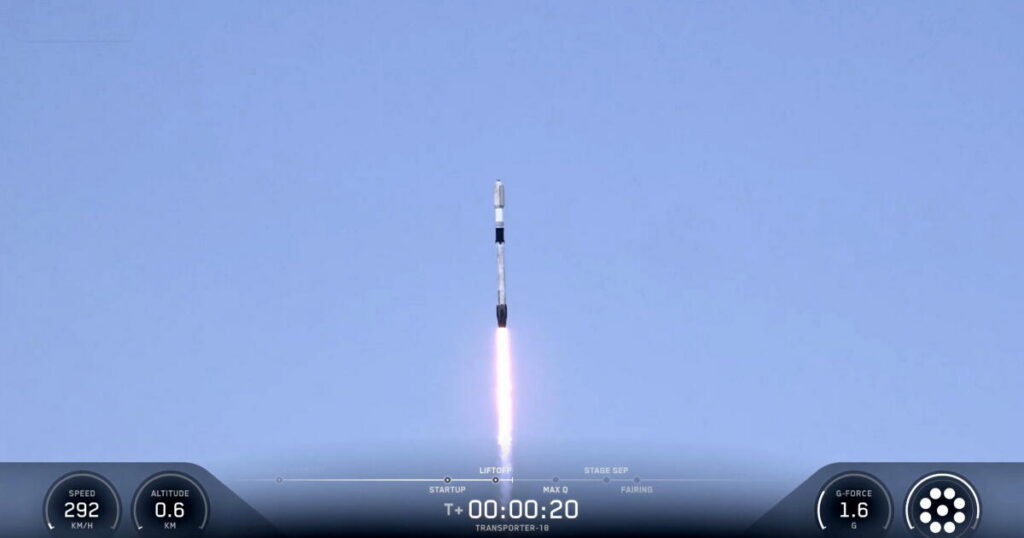
In a significant advancement for environmental monitoring, California has successfully launched its second satellite dedicated to detecting methane emissions. This launch, which took place from Vandenberg Space Force Base in Lompoc, was executed aboard a SpaceX rocket. The new satellite enhances the capabilities of Pasadena-based Carbon Mapper, a nonprofit organization, in its mission to identify and address methane plumes, a potent greenhouse gas.
The introduction of this second satellite allows for more frequent and widespread observations of methane emissions. Lindsay Buckley, spokesperson for the California Air Resources Board, emphasized the increased efficiency in pinpointing leaks and ensuring timely repairs. Methane, unlike other pollutants, is not a result of combustion but leaks from sources such as landfills, oil and gas equipment, and manure pits at dairy farms.
With the new satellite in orbit, California can now enhance its efforts to meet its ambitious climate goals. The state has committed to reducing methane emissions by 40% below 1990 levels by the year 2030. Notably, landfills contribute to about 41% of the state’s methane emissions.
Carbon Mapper launched its first satellite, Tanager-1, in collaboration with Planet Labs and NASA Jet Propulsion Laboratory in August 2024. The organization aims to eventually cover 90% of global methane emissions using a constellation of satellites. These satellites utilize sensors to detect methane by analyzing light wavelengths reflecting off the Earth’s surface. The data collected by these satellites is accessible with a 30-day lag on Carbon Mapper’s website.
“If you can make the data accessible, and you can work with people in a way that teaches them to use the data, then you can achieve large reductions in emissions,” said Riley Duren, CEO of Carbon Mapper.
The California Air Resources Board (CARB) began its collaboration with Carbon Mapper last spring to accurately identify methane emissions. The satellite’s capabilities allow for facility-level observation accuracy within 50 meters. Images are typically received within 48 hours, facilitating prompt notifications to operators when leaks are detected.
Since the initial data reception in May 2025, CARB has addressed at least 18 significant methane leaks. Buckley highlighted a 918 kg per hour leak at the Midway-Sunset Oil and Gas field in Kern County, which was promptly fixed the same day the California Resources Corporation was alerted.
While livestock operations contribute about 26% of the state’s methane emissions, they are not directly regulated yet. Some emissions occur under permissible conditions, such as maintenance activities involving pressure relief valves. However, in instances of unnotified leaks, companies make necessary repairs once alerted. The 18 significant leaks repaired equate to preventing over 142,000 metric tons of carbon dioxide from entering the atmosphere, akin to removing about 32,000 gas-powered vehicles from the road for a year.
Carbon Mapper’s overarching goal is to prevent the annual equivalent of a billion tons of carbon dioxide emissions with a full satellite constellation. The organization plans to launch two additional satellites next year. Besides California, Carbon Mapper collaborates with 11 other states to monitor significant methane emitters, although California uniquely enforces regulations through notifications.
Over the past year, Carbon Mapper reports 66 repairs at oil and gas sites across the U.S. and 60 additional leaks under investigation. Landfill emission impact quantification is ongoing. The newly launched Tanager-2, a replica of Tanager-1, is set on a different orbit, enabling even more frequent observations. Currently, methane observations are made about three times a week. “Once we build the constellation out, the four-plus satellites, we’ll be able to make multiple observations a day of the same area,” Duren stated.
Original Story at www.latimes.com