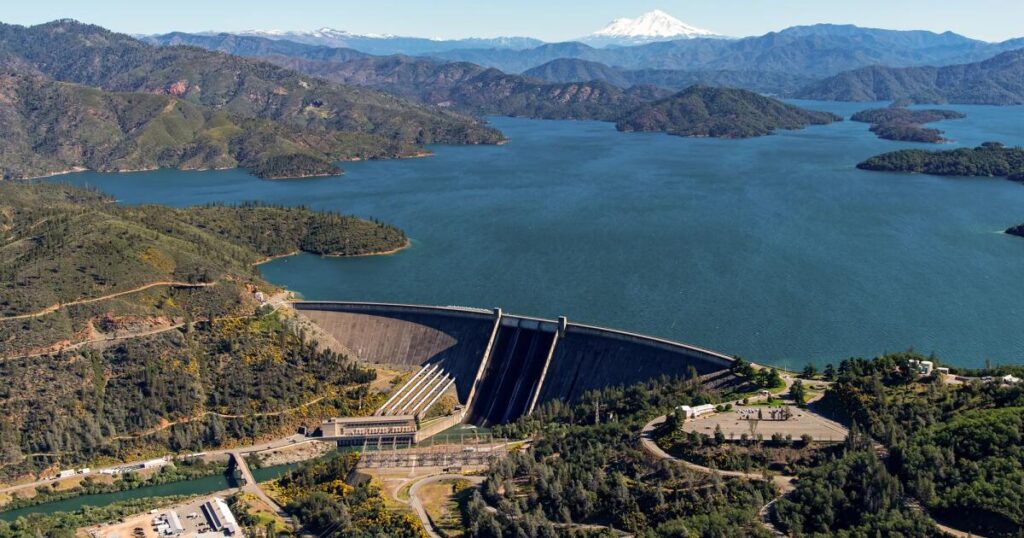
As California faces an unprecedented heat wave, the state’s snowpack, a crucial water source, is melting at an alarming rate, raising concerns about water supply in the coming months.
The Sierra Nevada snowpack is pivotal for California, accounting for about a third of the state’s water supply. It plays a vital role in replenishing reservoirs during spring and summer. However, a warm storm after February’s snow, coupled with record-breaking March temperatures, has led to accelerated snowmelt and fast-flowing rivers.
Traditionally, April marks the peak of the snowpack, but climate change is causing the runoff to occur earlier, reducing the water available in the warmer months for various needs, including homes, agriculture, and hydropower. Levi Johnson, operations manager for the Central Valley Project, remarked, “In an ideal world, you’d have your reservoir full right now, and this additional huge snowpack reservoir that we know will help replenish and provide more water supply.” However, this year, this ideal scenario is not unfolding.
Despite reservoirs currently being above historic averages and nearly full, the Sierra Nevada snowpack is rapidly declining, dropping to 38% of average for mid-March. Although not yet the worst on record, it is approaching the lowest five on record for April 1, according to state climatologist Michael Anderson. The snowpack is diminishing at roughly 1% per day from early to mid-March.
Conflicting roles for reservoirs
California’s reservoirs often have dual roles: flood prevention and water storage. These functions can conflict, as seen with Lake Mendocino during the 2012–16 drought, when federal rules required water releases that led to significant shortages.
This situation prompted the Forecast Informed Reservoir Operations partnership, utilizing advanced forecasts to guide water release decisions. This approach prevented Lake Mendocino from going dry during recent droughts, according to Don Seymour from Sonoma Water.
The Yuba Water Agency is considering this program for New Bullards Bar, a much larger reservoir that relies on Sierra snowmelt. With snowmelt occurring two months earlier than usual, general manager Willie Whittlesey noted, “We’re seeing snowmelt conditions in mid-March that we normally don’t see until at least mid-May.” However, federal guidelines require maintaining empty space for potential floodwaters until June, complicating water storage efforts.
Moreover, a major pipe rupture is forcing the agency to further restrict water storage, potentially costing tens of thousands of acre-feet of snowmelt. Similar challenges are faced by the California Department of Water Resources at Lake Oroville and the East Bay Municipal Utility District, which manages the Camanche and Pardee reservoirs.
Improved forecasts after a major miss
Despite the heat and early melt, California is better prepared than before. Five years ago, inaccurate runoff predictions led to water shortages. Now, with reservoirs above historic averages and improved forecasting, the situation is more manageable.
Andrew Schwartz from UC Berkeley’s Central Sierra Snow Laboratory noted significant improvements in forecasts. However, the early melt could still create challenges, as Johnson from the Central Valley Project pointed out. Enhanced modeling and collaboration efforts are helping, but state budget constraints and federal cuts pose ongoing challenges.
Original Story at www.latimes.com