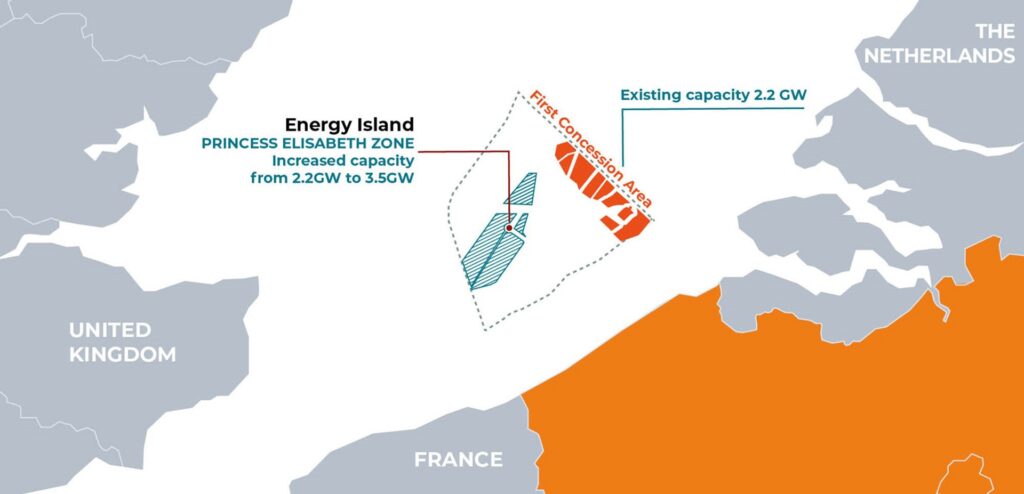
The Belgian government has approved a new framework to relaunch the tender for the first offshore wind site in the Princess Elisabeth Zone (PEZ 1) and set 1 October 2031 as the deadline for commissioning the first phase of the Princess Elisabeth energy island (MOG II).
The updated framework was necessary after the cancellation of the original PEZ 1 tender in July 2025 due to legal and regulatory uncertainties concerning the support mechanism and state aid approval.
“A year ago, we made a difficult but necessary decision. We did not opt for speed for speed’s sake, but for a tender that holds up legally, gives investors confidence, and protects the consumer. Today, that new framework is in place. The offshore sector is once again resting on solid foundations,” said Federal Energy Minister Mathieu Bihet on 18 July.
The new regulations extend the construction period from four to five years, remove the cap on the strike price, and introduce a two-sided Contract for Difference (CfD) mechanism. The lowest strike price bid will win the tender.
Mandatory citizen participation is no longer required, but developers can include such schemes voluntarily.
The tender aligns with the EU’s Net-Zero Industry Act (NZIA) and includes prequalification criteria for cybersecurity, sustainability, and supply chain resilience. At least 75% of wind turbines must not be manufactured or assembled in China, with limits on Chinese turbine components.
Along with the tender framework, the Council of Ministers approved a royal decree setting 1 October 2031 as the latest date for Elia’s Princess Elisabeth energy island to start service.
The government states that the offshore grid infrastructure and the PEZ 1 tender will now progress in parallel to avoid delays.
The revised tender rules will be reviewed by the Belgian Council of State and notified to the European Commission under state aid rules before the PEZ 1 auction is relaunched.
The Princess Elisabeth Island, the world’s first energy island, is located 45 kilometers off the Belgian coast.
The Princess Elisabeth Zone includes three sites totaling up to 3.5 GW in offshore wind capacity connected to the island’s infrastructure. The first site will have around 700 MW, with the next two sites planned to have 1,400 MW each.
Original Story at www.offshorewind.biz