The Uncharted Terrain of High-Speed E-Bikes
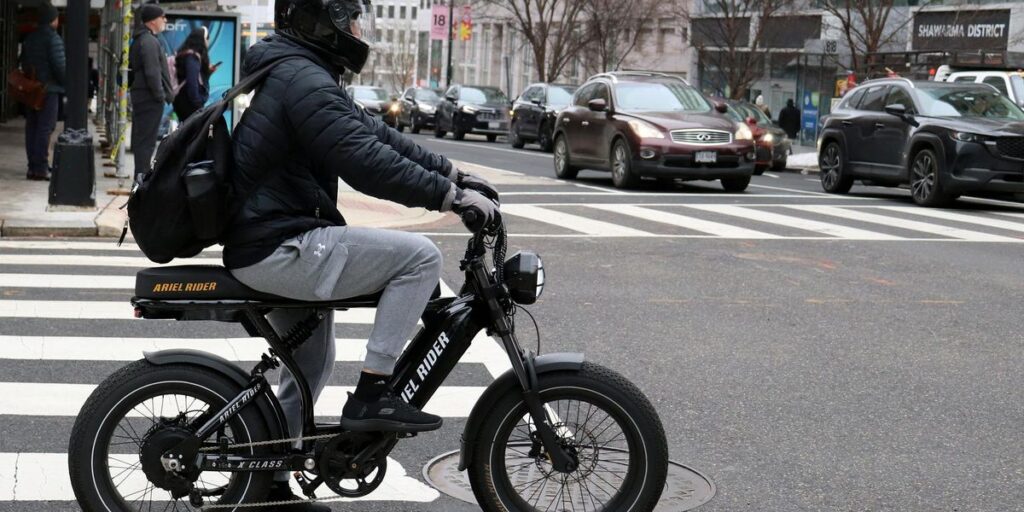
Ariel Rider, an e-bike manufacturer based in Redmond, Washington, has launched preorders for its latest model, the MUDD 72V. This new entry, boasting a top speed of 105 kilometers per hour (65 miles per hour) and an 8,000-watt motor, is described as a “power bike.” It visually resembles a fat-tire e-bike but rides more like a lightweight electric motorcycle. Yet, according to current regulations, it is neither.
The gap in regulation that Ariel Rider has leveraged stems from an unaddressed area in existing laws. The U.S. has two main frameworks governing e-bikes. The first is the vehicle classification system, largely determined by states. In New York, for instance, there are three classes of e-bikes: Class 1 offers pedal assistance up to 20 mph, Class 2 includes a throttle but remains capped at 20 mph, and Class 3 allows pedal assist up to 25 mph in cities with over a million residents, currently just New York City.
The second framework involves safety certifications, notably the requirement for UL Solutions-certified batteries and electrical systems for e-bikes sold within New York City. This code addresses fire risks, not vehicle classification. Even a compliant Class 2 e-bike can be prohibited if its battery isn’t certified, which was the case for some of Ariel Rider’s older models in 2024.
Ariel Rider’s MUDD doesn’t aim to fit into these e-bike categories. Instead, it’s marketed for private-property or off-road use, circumventing public road regulations. The company’s terms of service clarify that the bike isn’t certified for on-road use and lacks a path for DMV registration. Despite being marketed as a “power bike,” Ariel Rider has not responded to inquiries from IEEE Spectrum about this positioning.
Regulatory Challenges and Loopholes
Under New York’s vehicle and traffic law, any vehicle exceeding certain speed or power limits is classified as a moped or motorcycle, necessitating registration, licensing, and insurance. However, Ariel Rider bypasses this by selling the MUDD as an off-road vehicle, not intended for public roads. Current statutes, such as New York Vehicle and Traffic Law §2407, require liability insurance for ATVs when used off the owner’s property. However, these statutes define ATVs as vehicles with three or more wheels, leaving two-wheelers like the MUDD unclassified.
The Rise of High-Power Off-Road Vehicles
Ariel Rider is not alone in this category. The trend was kickstarted by Hangzhou Qiulong Technology in China with the release of the Sur-Ron Light Bee in 2014, which helped establish the lightweight electric dirt bike segment. Companies like Talaria Power Tech and Segway have followed suit, offering high-wattage motors and forgoing the “motorcycle” label in their marketing.
The category is expanding rapidly. According to The Business Research Company, the global dirt-bike market, encompassing both gas and electric models, is expected to reach US $9.17 billion this year, with electric models growing the fastest. The competition is fierce, as evidenced by a recent Texas jury ruling that required Talaria to pay nearly $13 million for infringing a Sur-Ron patent, highlighting the financial stakes involved.
Regulatory bodies are taking note. New Zealand Police have conducted operations to seize lightweight electric dirt bikes used illegally on roads, while in New York, State Sen. George Borrello has proposed legislation (S8909) to empower officers to seize Class 3 e-bikes outside New York City. The “Ghost Car Task Force” is already targeting unregistered mopeds and out-of-class vehicles.
State Responses to High-Powered E-Bikes
Different states are handling the regulatory gap in various ways. Some, like California, have enacted legislation like SB 586, which defines “off-highway electric motorcycles” and requires a DMV-issued Green Sticker for registration. Others have yet to address the gap, leaving machines like the MUDD in a regulatory gray area.
As states continue to refine their e-bike and off-highway vehicle laws, the emergence of powerful, low-cost two-wheelers that don’t fit traditional categories remains a challenge. Industry groups, such as PeopleForBikes, advocate for clear distinctions in vehicle classifications, pushing for more precise definitions of what constitutes an e-bike to ensure that only legitimate low-speed bikes are protected from over-regulation.
Original Story at spectrum.ieee.org