
A company linked to the cryptocurrency industry is exploring natural gas drilling near Deep River, north of Sanford in Lee County, North Carolina.
If approved, this would be the first commercial well drilled into the Triassic Basin, a natural gas reserve extending under North Carolina and other Eastern Seaboard states.
Deep River Data, headquartered in Alamance County, aims to extract gas from Butler Well No. 3, located just south of U.S. Highway 421 near the Lee-Chatham county line, according to emails obtained via public records.
Company adviser Dan Spuller, a crypto entrepreneur and natural gas landman, contacted the state Oil & Gas Commission in September about a drilling unit application. He stated the natural gas would power a data center for “AI workloads,” not crypto mining. Both use energy-intensive server farms for continuous computational tasks.
“We want a complete submission packet on first impression to avoid delays and streamline the Commission’s review,” Spuller wrote.
Duke Energy projects data centers in North Carolina could increase demand by nearly 6 gigawatts, driving new natural gas plants and pipelines, major sources of methane and carbon dioxide. Methane, leaking from well heads, pipelines, and compressor stations, traps 86 times more heat over 20 years than carbon dioxide.
Nationwide, data centers have tapped into the grid and revived coal and nuclear plants for power. The Lee County project would access natural gas reserves in the Deep River Basin, spanning 150 miles over 11 counties in central and southern North Carolina.
Spuller informed Inside Climate News that conventional drilling, not fracking, would be used. Fracking, a more destructive extraction method, involves horizontal drilling and toxic chemicals mixed with water at high pressures to crack shale formations.
Fracking is legal in North Carolina but remains unused. Lee County saw fracking moratoria in 2017 and 2019; both have expired.
“We are assessing if the well can safely produce gas using conventional methods,” Spuller stated. “The project is in a pre-feasibility phase, and its viability is still being evaluated. Nothing is approved, permitted, or built.”
Butler Well No. 3 was drilled vertically in 1998 to a 2,655-foot depth, according to a 2011 report by the North Carolina Geological Survey. The well is situated in a geological region of black shale and old coal deposits, a legacy of mining history.
“The Oil and Gas Commission must closely scrutinize this exploitation proposal near the Deep River,” said Therese Vick of the Blue Ridge Environmental Defense League. “The commission must perform due diligence. Having worked with communities in Lee and Chatham Counties for over a decade, my concerns are numerous.”
Data centers can consume large amounts of water to cool servers. The project would be less than a tenth of a mile from Deep River and Patterson Creek.
Spuller said water use “would be minimal,” with no plans to withdraw water from the Deep River.
The project could use groundwater or a public water main along U.S. Highway 421. The company is considering closed-loop systems and other sustainable options, although some systems use more energy.
Spuller mentioned the project will likely need standard utility connections like electricity, fiber, and basic access roads, typical for small-scale data facilities, without heavy-industrial components.
The state Geological Survey noted Butler Well No. 3 is within three and a half miles of a 6-inch distribution line to Sanford Industrial Park, serving large volume gas users.
Stephanie Stephens, Deep River Riverkeeper, is concerned the project could herald more data centers along the Carolina Core, an area including Sanford targeted for economic development.
“We want to be selective about industries coming in,” she said.
The proposed data center would be near the new Boone Trail kayak and canoe access site.
The Deep River is troubled. Nearly 23 miles are on the federal impaired waters list, containing 1,4-Dioxane, a likely carcinogen, discharged from Asheboro’s wastewater plant. Another 131 miles of river tributaries are also impaired, state records show.
“We already have a polluted river,” Stephens said.
Lee County records show Butler Well No. 3 is on a 643-acre tract owned by Ed Myrick of Florida. Dan Butler, who lives in Southern Pines, purchased the mineral rights in 1975 from Weyerhauser. Butler owns over 2,700 acres of mineral rights in Lee County, state records indicate.
Since 1998, several companies have drilled Butler Well No. 3. They abandoned projects due to the small gas amount and lack of a pipeline.
Butler is a third-generation oil and gas developer, with family roots in Pennsylvania’s oil fields.
It’s unclear if the property, currently allowing residential and agricultural uses, requires rezoning. Lee County’s development ordinance lacks data center provisions, said County Zoning Administrator Thomas Mierisch.
Spuller became a registered landman in North Carolina in 2021, enabling him to negotiate agreements for gas exploration or development.
Deep River Data officials also work in cryptocurrency, but Spuller said the project won’t be a cryptomine. “It is envisioned as a modular data-infrastructure project” for AI workloads and compute-intensive research, he explained.
Deep River Data was incorporated on April 30, according to North Carolina’s business registry. Company officers include Spuller, Dan Fisher, and Gerald Wilkie, Jr., all with cryptocurrency ties. HM Tech, a bitcoin mining facility in Graham, is a managing member of Deep River Data.
Wilkie was among 55 cryptocurrency firm representatives who signed a letter in 2022 to EPA Administrator Michael Regan disputing the industry’s environmental harm. Congressional Democrats had expressed concerns about crypto facilities polluting communities and contributing to greenhouse gas emissions.
Wilkie signed the letter as HMTech’s founder. The letter stated, “There are no pollutants, including carbon dioxide, released by digital asset mining.”
Wilkie did not respond to an interview request from Inside Climate News.
Besides Deep River Data, Spuller is the executive vice president of industry affairs for the Blockchain Association in Washington, D.C., but says Deep River Data is separate from that work.
Earlier, Spuller worked as communications director for former Republican Gov. Pat McCrory’s inaugural committee. He later joined the state Department of Commerce, assisting with the North Carolina Money Transmitters Act of 2016.
Former Lt. Gov. Dan Forest appointed Spuller to the North Carolina Blockchain Initiative in 2019, where he served until this year. From 2016 to 2020, he led membership and growth at the Chamber of Digital Commerce.
On Oct. 20, Spuller and Eric Peterson from Kraken Digital Assets Exchange appeared before the House Select Committee on Blockchain and Digital Assets.
They advocated for legislation favorable to stablecoin, considered less volatile than other cryptocurrencies. It facilitates fund transfers between crypto tokens.
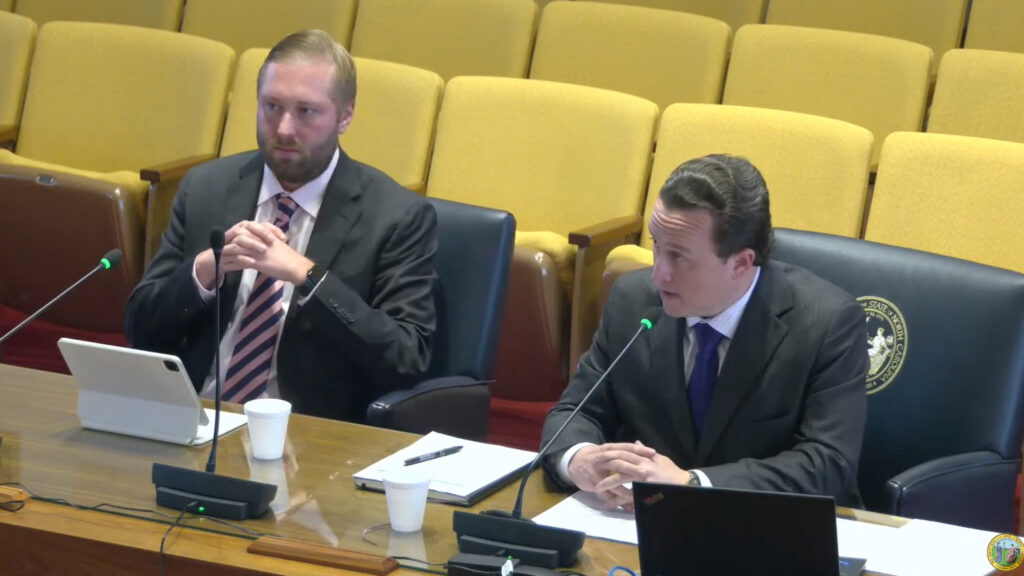
Spuller was advocating for House Bill 92, the North Carolina Digital Assets Investment Act, which would allow the state treasurer to invest public funds in digital assets. The measure passed the House but awaits Senate approval.
“Hopefully, they will pass it because it signals our state’s openness to business,” Spuller said. “There’s no reason not to pass that. It’s on my wish list.”
Original Story at insideclimatenews.org